Fines will be waived for low-income riders, among other changes aimed at bringing "fairness and equity" to TriMet's enforcement system.


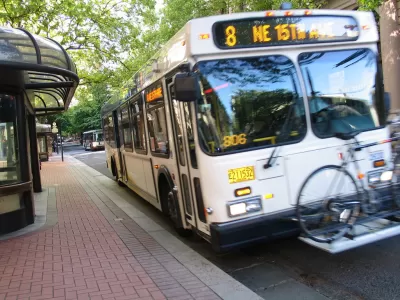
The Board of Directors of TriMet has restructured the way the agency penalizes fare evasion.
Currently, riding without fare is punishable by a $175 fine. Beginning in July, fines for adult riders will be assessed in tiers corresponding to the number of prior offenses, with $175 as the highest. Community service will also become an option in lieu of payment, with required hours determined by a similar tier structure.
Additionally, fare citations will be waived for adult riders eligible for TriMet's low-income fare program (launching concurrently with the new penalty system), or the existing Honored Citizen program for senior and disabled riders.
"The changes are in response to criticism that fare evasion charges disproportionately affect minorities and unnecessarily pushes too many of them into the criminal justice system," Jim Redden of Portland Tribune reports. Similar concerns have prompted changes to fare enforcement strategies in New York, Cleveland, Washington state, and California. In Portland, an internal study found "no systemic racial bias" in TriMet's fare enforcement, but noted that pushing people into the court system over the low-level offense could "affect a person's ability to get a job, rent a house or serve in the military."
FULL STORY: TriMet changes fare evasion penalties


D.C. Makes the Case for Decriminalizing Fare Evasion
The District may soon remove criminal penalties from fare evasion with a proposal that would lower fines and strike the possibility of jail time.
Transit Riders in Portland Can Pay Their Fare With Their Smartphones
Introducing the Hop Fastpass system.

A Unique Response to Transit Service Interruptions: Free Fares
Portland's TriMet is dealing with technical problems arising from a failed maintenance project and a record-breaking heat wave.

Planetizen Federal Action Tracker
A weekly monitor of how Trump’s orders and actions are impacting planners and planning in America.

The state-sanctioned urbicide of Austin
People don’t kill cities. Freeways do.

US to reduce Colorado River water deliveries to Mexico
A new Colorado Treaty amendment reduces Mexico’s Colorado River water allocation by 250,000 acre feet.

5 New England states march closer to 800 megawatt wind energy project
Securing federal approval for the project may be complicated under the Trump administration, which has historically been hostile towards domestic wind power.

Baltimore to break ground on $50 million Transit Priority Project
The project will bring faster bus trips, safer streets and better bike connections to Baltimore.

Airbnb launches $250 million 'last-dollar financing' housing accelerator, makes first investment in Austin
The company will put $6.4 million towards affordable housing development in Texas’ capital.

FREE Course: Walkable City 1: Why Walkability?
After describing his path towards focusing on walkability as the essence of good planning, Jeff Speck marches through his five principal reasons for making more walkable places.
Reinventing Malls: Planning Alchemy—Turning Gray Fields Into Gold
The course focuses on the opportunities and imperatives that shape reinvention of mall sites.

Eagle County Government
Harvard University Graduate School of Design
Nashville Planning Department
The Architects Foundation
University of Cincinnati Online
The Pocatello Development Authority
The Urban Renewal Agency of the City of Pocatello
Journal of the American Planning Association