Many of the Best Picture nominees are set in cities, and none are focused on suburbia.



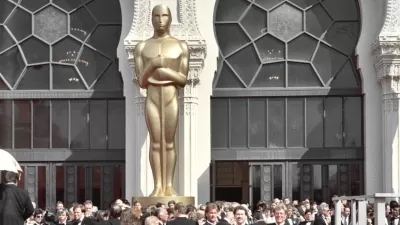
Even if popular culture does not shape public attitudes towards cities and suburbs, it certainly reflects those attitudes. For example, 1990s television shows like Friends and Seinfeld reflected the growing popularity of urban life.
Many of this year's Oscar nominees involve urban settings as well, at least for parts of the movie. Of course, there are exceptions: one of the Best Picture nominees, Dunkirk, occurs on a depopulated beach where British soldiers and sailors are trying to evacuate France. Obviously, it makes no sense to describe Dunkirk as relevant to urbanism. Similarly, The Post mostly takes place indoors. Although it is certainly set in Washington, D.C., I cannot say that it has a strong urban or suburban emphasis. But other Best Picture nominees are more relevant to urban surroundings.
For example, in Call Me By Your Name, the characters all live within biking distance of a small Italian town. The town is a lovely example of pre-automobile small-town urbanism, with short buildings and streets narrower than those of any city in North America, and bicycles everywhere. I rate this movie NU, for New Urbanist.
Three Billboards Outside Ebbing, Missouri also takes place in a walkable small town. Two of the major characters are police officers working in a walkable American downtown, and the female lead’s curio store appeared to me to be within walking distance of downtown. But in this movie, unlike Call Me By Your Name, suburbia rears its head: the billboards in question are on a highway, and the police chief, an admirable character, is portrayed as living in large-lot suburbia with no visible houses or sidewalks nearby.
The Shape of Water, set in 1962, also occurs in a land of low-rise urbanism; the heroine lives in a mixed-use Baltimore neighborhood above a movie theatre, and takes the bus to work. Public transit also plays a small role in Darkest Hour; near the end of the movie, Winston Churchill takes the London subway to ask the opinions of the citizenry, and is heartened by the populace's fighting spirit.
In Get Out, the city is portrayed positively, but only by comparison to the sinister country. The male lead apparently lives in an urban apartment, but is driven to his girlfriend’s family’s cabin in the woods, which is clearly accessible only by automobile. In this exurban location, he meets with many horrific misadventures. In Get Out, the exurbs are a land of villainy. Phantom Thread, like Get Out, involves characters transitioning between a city (London) and a non-urban environment of country houses. However, it did not seem to me that the characters' adventures in either the city or the country were disproportionately ominous. Get Out struck me as pro-urban, while Phantom Thread was neither pro- nor anti-urban.
Finally, Lady Bird occurred in the semi-suburbia of Sacramento, California; most adult characters drive, but the title character does some walking here and there. Most of the streets seem to have sidewalks, but the downtown is somewhat invisible.
But by and large, the Oscar nominees don’t appear to be particularly anti-urban or pro-suburban. They mostly are not set in conventional suburbia, and nothing in them suggests that suburbia is normal or that cities are not. In that sense, the Oscar nominees reflect the increased popularity of cities.

Satisfied in the Suburb
According to the Pew Research Center, suburban dwellers are the most content with where they live, despite reports that also find that suburbs are not regarded the most ideal places to live.

Midburbs: A New Definition of Suburbs
When the name “suburb” just doesn't quite fit.

New Research Blames Affluent Suburbs for Housing Crisis
Small, often wealthy enclaves build far less multifamily housing than their larger counterparts, exacerbating the dearth of affordable housing near big cities and job centers.

Planetizen Federal Action Tracker
A weekly monitor of how Trump’s orders and actions are impacting planners and planning in America.

Amtrak, CN end decades-long dispute with eight-year agreement
The new operating agreement establishes an updated framework for the companies to work together, including processes to resolve disputes.

Northwest rail fans eager for Sept. 30 debut of Amtrak’s Airo fleet
Get ready for that new train smell and more seats. But they won’t go faster or run more frequently on the Cascades route in Washington and Oregon.

Trump administration unlawfully slashed $7 billion in clean energy grants, judge rules
The Environmental Protection Agency ended the Solar For All program, which provided the grants, after President Donald Trump’s inauguration.

Record-breaking wildlife overpass in Colorado brings 91% reduction in animal collisions
Prior to the overpass, vehicles were hitting one deer per day on Colorado’s Interstate 25.

California lawmakers approve just 5% of much-needed LA28 transportation funding
State legislators appear just as unwilling as Trump to pay for Olympics-related transportation projects.

FREE Course: Walkable City 1: Why Walkability?
After describing his path towards focusing on walkability as the essence of good planning, Jeff Speck marches through his five principal reasons for making more walkable places.
Reinventing Malls: Planning Alchemy—Turning Gray Fields Into Gold
The course focuses on the opportunities and imperatives that shape reinvention of mall sites.

City of Thousand Oaks
City of Wisconsin Rapids
Harvard University Graduate School of Design
The Architects Foundation
University of Cincinnati Online
The Pocatello Development Authority
The Urban Renewal Agency of the City of Pocatello

