Here's a helpful tool for understanding economic growth.



Ian Hathaway presents a geographic analysis of the "Inc. 5000"—Inc. Magazine's list of the fastest growing businesses in the United States.
With the fast growth of the companies on the Inc. 5000, a deeper analysis of the companies on the list provides insight into the U.S. economy. So, for instance, the information technology and health industries account for almost a third of the companies on the Inc. 5000 list. But there's more to be learned from the list.
"An analysis of the geographic location of I5HGCs reveals another concentration—this time by place," writes Hathaway. "[N]early 98 percent of I5HGCs are located in metropolitan areas. Micropolitan and rural areas are headquarters to just two percent."
The largest metropolitan areas do not lead the country in Inc. 5000 company density, however. "Of the top four metros, three are medium-sized—Boulder, Provo, and Huntsville. Only Washington (a large metro) is not," explains Hathaway.
To conclude the article explaining and illustrating his analysis, Hathaway also shares the results of a linear regression analysis designed to assess the factors association with regional Inc. 5000 company density. The analysis identified four variables as especially important in explaining regional density of Inc. 5000 companies: 1) the share of workers with college degrees, 2) the share of workers employed in high-tech industries, 3) the share of the population f prime entrepreneurship age, and 4) the overall rate of business formation in the region.
FULL STORY: High-growth firms and cities in the US: An analysis of the Inc. 5000


Oregon cities are excluding a key tool that could help their housing goals: maps
An effort to use geospatial analysis to understand how housing and access to opportunity are distributed in Oregon cities has largely stalled.
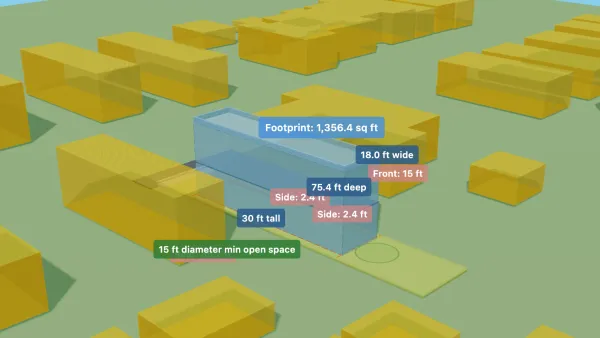
Interactive, 3D Chicago Zoning Map Lets You Visualize Potential Development
A new tool creates a visual model of potential development on Chicago lots based on the property’s specific zoning regulations.

See the First Complete Map of NYC Walking Traffic
A new model of pedestrian routes and activity can help NYC planners make more informed decisions about transportation infrastructure and pedestrian safety improvements.

Planetizen Federal Action Tracker
A weekly monitor of how Trump’s orders and actions are impacting planners and planning in America.

The state-sanctioned urbicide of Austin
People don’t kill cities. Freeways do.

US to reduce Colorado River water deliveries to Mexico
A new Colorado Treaty amendment reduces Mexico’s Colorado River water allocation by 250,000 acre feet.

5 New England states march closer to 800 megawatt wind energy project
Securing federal approval for the project may be complicated under the Trump administration, which has historically been hostile towards domestic wind power.

Baltimore to break ground on $50 million Transit Priority Project
The project will bring faster bus trips, safer streets and better bike connections to Baltimore.

Airbnb launches $250 million 'last-dollar financing' housing accelerator, makes first investment in Austin
The company will put $6.4 million towards affordable housing development in Texas’ capital.

FREE Course: Walkable City 1: Why Walkability?
After describing his path towards focusing on walkability as the essence of good planning, Jeff Speck marches through his five principal reasons for making more walkable places.
Reinventing Malls: Planning Alchemy—Turning Gray Fields Into Gold
The course focuses on the opportunities and imperatives that shape reinvention of mall sites.

Eagle County Government
Harvard University Graduate School of Design
Nashville Planning Department
The Architects Foundation
University of Cincinnati Online
The Pocatello Development Authority
The Urban Renewal Agency of the City of Pocatello
Journal of the American Planning Association