The headline on the New York Times when the "Genius Transit Challenges was announced: "M.T.A. Asks Transit Fans, ‘Who Wants to Be a Subway-Saving Millionaire?’" Now it looks like the winner will already be a millionaire.


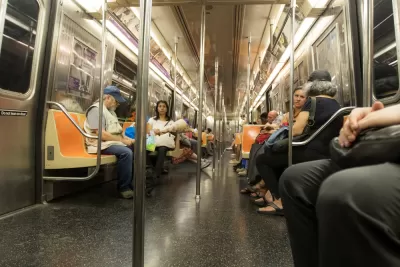
"The New York Metropolitan Transportation Authority (MTA) announced the 19 finalists in three categories for the MTA Genius Transit Challenge today," reports Olivia Martin.
"Winners will be declared in early 2018 and will receive up to a $1 million genius award," adds Martin to describe the contest. The MTA announced the "Genius Transit Challenge" over the summer to crowdsource ideas to improve the beleaguered New York subway system, although the list of finalists has a decidedly less democratic feel than we might have expected. Massive corporations like AECOM, Alstom, Siemens, Bombadier, and Bechtel populate the list. "The three categories are: to improve signaling, to identify strategies to better deploy subway cars, and increase communications infrastructure," writes Martin.
Read the full story: 19 Finalists Announced for MTA’s Genius Transit Challenge
New York Crowdsourcing Solutions to Subway Challenges—$3 Million in Rewards Offered
Three "genius" citizen planners will be awarded $1 million in return for the best and brightest ideas for improving the New York subway.
Winners of the MTA's Genius Transit Challenge Announced
Six winners in three categories—signaling, subway cars, and communications—have won the MTA's unique crowd-sourcing exercise.
New York Mayor: Tax the Rich to Pay for Transit
Mayor Bill de Blasio is looking for new ways to fund transit improvements and access.

Planetizen Federal Action Tracker
A weekly monitor of how Trump’s orders and actions are impacting planners and planning in America.

California plans to bury El Niño’s downpour
If the state plays its cards right, it may be able to store a billion acre-feet of El Niño’s water in aquifers.

Desperate measures: Advocates weigh draining Lake Powell to fill Colorado River
Draining the reservoir could reduce evaporation losses by a couple hundred thousand acre-feet.

Chicago voters approve permanent festival grounds, penalty for vacant property owners
Currently, major summer and fall festivals take over public parks for weeks at a time, drawing criticism from nearby residents

NYC votes to cut outdoor dining red tape, speed up permitting
New York City also voted to allow the Department of Transportation to begin work on urgent projects before notifying elected officials.

California appears to reject Prop. 45
The proposition would have expanded the projects that qualify for a streamlined environmental review, effectively paring down the California Environmental Quality Act.

FREE Course: Walkable City 1: Why Walkability?
After describing his path towards focusing on walkability as the essence of good planning, Jeff Speck marches through his five principal reasons for making more walkable places.
Reinventing Malls: Planning Alchemy—Turning Gray Fields Into Gold
The course focuses on the opportunities and imperatives that shape reinvention of mall sites.

City of Rosemead
Rutgers University, Edward J. Bloustein School of Planning and Public Policy
One Hundred Miles
Hunter College, City University of New York (CUNY)
The Architects Foundation
University of Cincinnati Online
City of Cambridge
Montrose County
The Pocatello Development Authority