Details of the ongoing testing and experimentation of an autonomous shuttle bus called Minnie at a facility north of the Twin Cities.


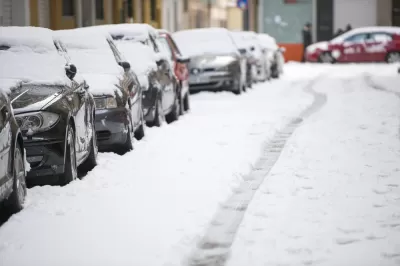
"Winter driving in Minnesota presents some challenges for the technology underpinning autonomous vehicles, much of it being developed by companies in temperate Silicon Valley, and tested in sunnier climes," reports Greta Kaul.
There's a test to prove it too. As Kaul reports, the Minnesota Department of Transportation is testing an autonomous shuttle bus affectionately nicknamed "Minnie," at a facility near Albertville. Conditions in Minnesota and other northern states will determine the future feasibility of autonomous vehicles. "It’s important, [Minnesota Department of Transportation officials] say, that conditions like snow, salt-caked cars and black ice are considered by both manufacturers and policymakers as cars start to drive themselves."
So far, Minnie has encountered difficulties with snowbound conditions. For instance, road salt blocks sensors. 3M "is working with MnDOT on the shuttle project, is helping to develop films that protects the sensors," according to Kaul. There's also falling snow: "LIDAR is a very sophisticated form of technology, but it can be foiled by precipitation," explains Kaul. Snow is a particularly good reflector of infrared laser light, too.
Read the full story: Driving in Minnesota winters is hard — even for driverless vehicles

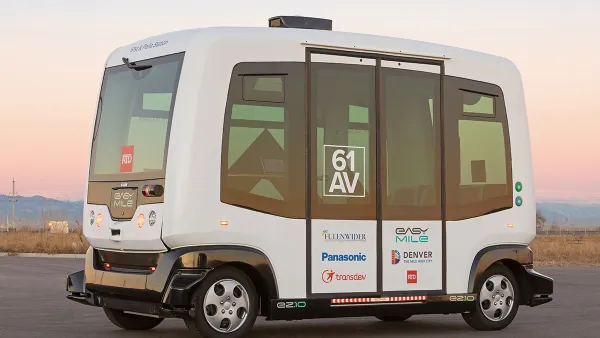
Driverless Shuttle Pilot Now Operating in Denver
Take a sneak peak at a potential future.
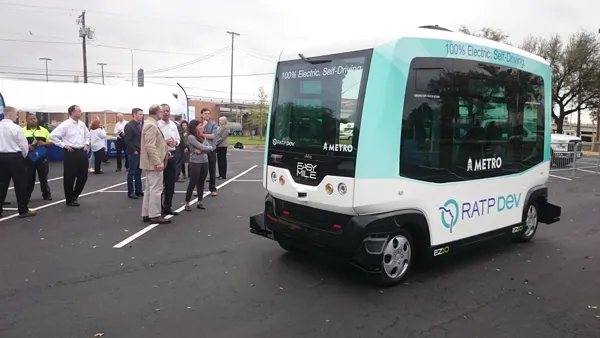
New Driverless Shuttle Tests Hit the Road in Michigan, Wisconsin
Two university campuses and a Dan Gilbert-owned campus will be among the first wave of driverless shuttle testing grounds.
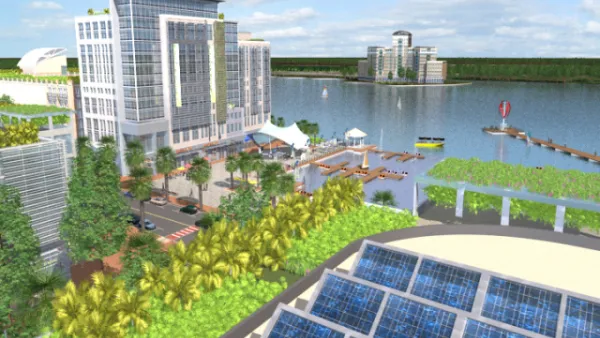
Residents Move Into America's First Solar Powered Town
Residents will live in solar powered homes and ride around the community in self-driving, solar-powered shuttles. Babcock Ranch outside of Fort Myers, Florida, has been in the making since 2005. A city of 50,000 is forecasted.

Planetizen Federal Action Tracker
A weekly monitor of how Trump’s orders and actions are impacting planners and planning in America.

Amtrak, CN end decades-long dispute with eight-year agreement
The new operating agreement establishes an updated framework for the companies to work together, including processes to resolve disputes.

Judges permit Denver to divert 77,000 acre feet from the Colorado River for reservoir expansion
Overuse and climate change have caused the Colorado River’s water levels to plummet.

NYC DOT wants faster, more permanent street upgrades
The city is examining ways to build more concrete infrastructure without getting entangled in 'decades-long' projects.

'Something we’ve never seen before:' rising utility rates could strain city finances nationwide
Data centers, climate change and other factors have caused utility rates in the United States to increase by 38% since 2020.

Trump to overrule local leaders, lease millions of acres of America’s Pacific Island territories’ seafloors to mining companies
International law says that the Indigenous people of America’s territories have a right to prior and informed consent regarding projects that impact their countries.

FREE Course: Walkable City 1: Why Walkability?
After describing his path towards focusing on walkability as the essence of good planning, Jeff Speck marches through his five principal reasons for making more walkable places.
Reinventing Malls: Planning Alchemy—Turning Gray Fields Into Gold
The course focuses on the opportunities and imperatives that shape reinvention of mall sites.

Harvard University Graduate School of Design
KFH Group Inc.
Greater Baltimore Committee
The Architects Foundation
University of Cincinnati Online
The Pocatello Development Authority
The Urban Renewal Agency of the City of Pocatello