As ridership soars, the "urban circulator" in the Woodlands Township is getting longer routes and more frequent service.


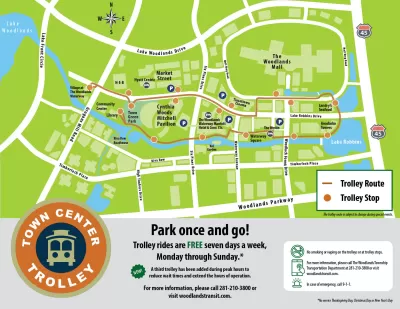
At a moment in which transit ridership in major U.S. cities is falling, one system is thriving.
The Woodlands trolley, which circulates around the center of its idyllic planned community outside of Houston, saw ridership increase 37 percent between September 2016 and September 2017.
Now four decades old, the Woodlands Township began as a personal project of the oil baron George P. Mitchell, who bought thousands of acres north of a city he believed was suffering from unplanned urban sprawl.
Mitchell hired, among others, Ian McHarg, author of the seminal Design With Nature and a landscape architect who used the Woodlands as an "opportunity to apply his theory of ecological determinism."
And although the Woodlands trolley is not actually "intended to provide service to people to who need public transportation to get around," it’s worth noting that, in the aftermath of Hurricane Harvey, the Woodlands has been cited as one place in Houston where the “original designs are working,” and where, “in sustainably designing Houston’s native ecosystems [there] is evidence that the city can do better.”
Read the full story: Woodlands trolley system expanding

Retro-silient?: America’s First “Eco-burb,” The Woodlands Turns 50
A master-planned community north of Houston offers lessons on green infrastructure and resilient design, but falls short of its founder’s lofty affordability and walkability goals.
As a Houston Suburb Urbanizes, How Long Can it Avoid "Big-City Issues"?
The Woodlands was conceived four decades ago as a new style of suburb, mixing the urban and pastoral. And by all accounts it has remained a "special place" as it has matured. But as it nears full build-out, some wonder if its bubble might soon burst.
Growth Not Catching Suburban Houston Town By Surprise
A small suburban Houston town has been planning ahead for growth that's expected to bring its population from just over 700 to nearly 40,000 in the next 15 years.

Planetizen Federal Action Tracker
A weekly monitor of how Trump’s orders and actions are impacting planners and planning in America.

The state-sanctioned urbicide of Austin
People don’t kill cities. Freeways do.

US to reduce Colorado River water deliveries to Mexico
A new Colorado Treaty amendment reduces Mexico’s Colorado River water allocation by 250,000 acre feet.

Nation's most wind-powered state turns to coal as data centers increase energy demand
For the first time in decades, Iowa has increased its generation of coal power.

NYC cools commuters with city's first rain garden above a bus stop
New York City officials say the plants in the rain garden can absorb 16 gallons of rainwater during heavy storms.

Brightline West’s future may rely on $6 billion federal loan
The company has until Nov. 2 to make a $400 million equity investment into its proposed high-speed rail line.

FREE Course: Walkable City 1: Why Walkability?
After describing his path towards focusing on walkability as the essence of good planning, Jeff Speck marches through his five principal reasons for making more walkable places.
Reinventing Malls: Planning Alchemy—Turning Gray Fields Into Gold
The course focuses on the opportunities and imperatives that shape reinvention of mall sites.

Greater Baltimore Committee
Eagle County Government
Harvard University Graduate School of Design
The Architects Foundation
University of Cincinnati Online
The Pocatello Development Authority
The Urban Renewal Agency of the City of Pocatello
Journal of the American Planning Association