Buildings are responsible for a little less than half of greenhouse gas emissions in the U.S. Break this figure down further and you'll find that building heating accounts for about a fifth of all U.S. emissions.


Heat pump basics
A heat pump’s job is to extract heat from the environment and direct it wherever it’s needed — a living room, for example, or a hot-water tank. It can also create cool air and water by transferring the collected heat away from the target area. Window air conditioners and refrigerators are both variants of this technology.
Heat pumps that draw heat from the ground or water (geothermal boreholes in the first instance, lakes or rivers in the second) are more efficient than those that pull it from the air. But all can transmit more energy (in the form of heat) than they require to operate (in the form of electricity) — at least outside of regions that frequently experience extreme cold. This makes them generally more efficient than other heating systems. If powered by zero-carbon electricity, they can heat buildings without generating greenhouse gas emissions.
Read the full story: Could the humble heat pump be a decarbonization hero?

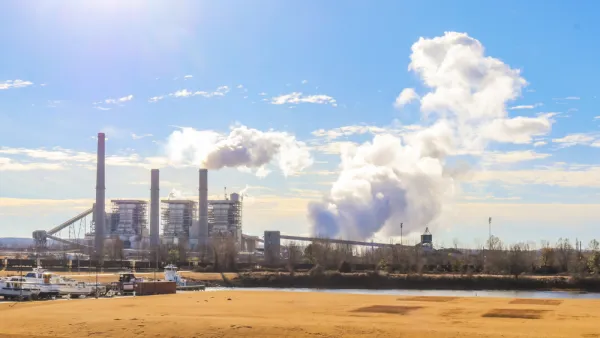
Report: U.S. Greenhouse Gas Reductions Not Hitting Paris Agreement Goal
The United States is making modest gains in the power and transportation sectors, but emissions in the industrial sector are holding steady, absent new reduction initiatives.

Study: Cutting U.S. Emissions by 50 Percent This Decade Is Possible
With coordinated effort at the local, state, and federal levels, the United States could meet its goal of cutting greenhouse gas emissions in half by 2030.
Court unfreezes $20B in federal climate grants
A U.S. Court of Appeals ruled that the Trump administration potentially violated the Inflation Reduction Act by attempting to claw back grants awarded under the Greenhouse Gas Reduction Fund program.

Planetizen Federal Action Tracker
A weekly monitor of how Trump’s orders and actions are impacting planners and planning in America.

Amtrak, CN end decades-long dispute with eight-year agreement
The new operating agreement establishes an updated framework for the companies to work together, including processes to resolve disputes.

Judges permit Denver to divert 77,000 acre feet from the Colorado River for reservoir expansion
Overuse and climate change have caused the Colorado River’s water levels to plummet.

Maryland local governments examine if they should have more power to raise property taxes
Maryland’s housing market is out of reach for the majority of moderate-income residents.

Northwest rail fans eager for Sept. 30 debut of Amtrak’s Airo fleet
Get ready for that new train smell and more seats. But they won’t go faster or run more frequently on the Cascades route in Washington and Oregon.

NYC DOT wants faster, more permanent street upgrades
The city is examining ways to build more concrete infrastructure without getting entangled in 'decades-long' projects.

FREE Course: Walkable City 1: Why Walkability?
After describing his path towards focusing on walkability as the essence of good planning, Jeff Speck marches through his five principal reasons for making more walkable places.
Reinventing Malls: Planning Alchemy—Turning Gray Fields Into Gold
The course focuses on the opportunities and imperatives that shape reinvention of mall sites.

Harvard University Graduate School of Design
KFH Group Inc.
Greater Baltimore Committee
The Architects Foundation
University of Cincinnati Online
The Pocatello Development Authority
The Urban Renewal Agency of the City of Pocatello