Good fire news from Oregon offers some relief from several weeks of scary environmental news from around the country.


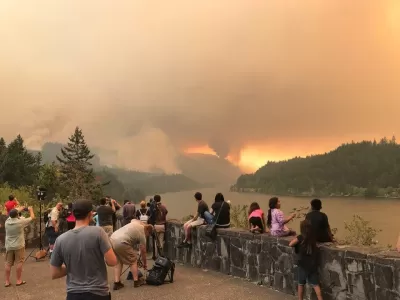
"Despite burning for days, torching more than 30,000 acres and obscuring most of the area with thick smoke, the Eagle Creek fire has left some parts of the Columbia River Gorge intact and will potentially improve wildlife populations," reports Katie Shepherd.
"As the ash begins to settle in some areas burned by the fire started on Sept. 2, photos are revealing parts of the gorge that look to be untouched by the flames. Firefighters posed in front of Multnomah Falls on Wednesday morning to celebrate keeping the picturesque spot safe from the blaze," adds Shepherd.
Officials at the Oregon Department of Fish and Wildlife are even telling the public that the fire could have a rejuvenating effect for local wildlife populations.
Apocalyptic photos of fire tearing up the Columbia River Gorge, maps of the state blanketed in wildfires, and smoke from fires in western states enveloping the entire continent have offered a counterpoint to the flooding in Houston and the threat of Hurricane Irma. At least for now, it could have been a lot worse in the beautiful Columbia River Gorge.


More Reason to Leave the Car Behind When Visiting the Columbia River Gorge
A lot of websites only provide directions by car. Columbia Gorge Car-Free chooses routes more conducive to a natural setting.
Oregon DOT's Columbia River Gorge Bus Service a Smashing Success
The first season of a two-year pilot project for the Columbia Gorge Express has been a huge hit.
Will Columbia River Gorge Oil Train Derailment Be a 'Death Knell' for Bakken Crude-by-Rail?
After a long night fighting a fire that erupted when a 96-car oil train carrying Bakken crude from North Dakota derailed on June 3 in Mosier, Oregon, the fire chief called for an end to shipping the volatile oil by rail.

Planetizen Federal Action Tracker
A weekly monitor of how Trump’s orders and actions are impacting planners and planning in America.

The state-sanctioned urbicide of Austin
People don’t kill cities. Freeways do.

US to reduce Colorado River water deliveries to Mexico
A new Colorado Treaty amendment reduces Mexico’s Colorado River water allocation by 250,000 acre feet.

Mamdani overhauls NYC's Vision Zero plan with 100 new policy goals
The overhaul aims to reduce traffic deaths and make streets safer for pedestrians, cyclists and drivers through lower speed limits, new safety infrastructure and more.

Amtrak not solely to blame for New Jersey commuter rail's unreliability, report finds
A new study from the Garden State Initiative found that NJ Transit’s budget grew 20% across a 4 year period, but reliability declined significantly over the same period.

EPA erases limits on planet-warming pollution from power plants
Under Monday’s plan, power plants would still have some limits on how much mercury, arsenic and other contaminants they can emit.

FREE Course: Walkable City 1: Why Walkability?
After describing his path towards focusing on walkability as the essence of good planning, Jeff Speck marches through his five principal reasons for making more walkable places.
Reinventing Malls: Planning Alchemy—Turning Gray Fields Into Gold
The course focuses on the opportunities and imperatives that shape reinvention of mall sites.


Eagle County Government
Harvard University Graduate School of Design
Nashville Planning Department
The Architects Foundation
University of Cincinnati Online
The Pocatello Development Authority
The Urban Renewal Agency of the City of Pocatello
Journal of the American Planning Association