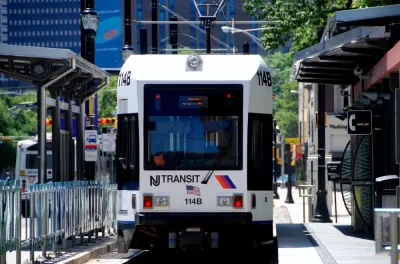
A fired employee of NJ Transit has raised some alarming allegations as he departs the agency—going so far as to say he wouldn't ride the system.


Ryan Hutchins reports:
In bombshell testimony that’s likely to dog the Christie administration in its final months, NJ Transit’s fired chief compliance officer said Friday he was forced out with little explanation after his repeated attempts to raise questions about systemic issues at the troubled agency, which he called a “runaway train.”
Todd C. Barretta raised alarms about the state of NJ Transit—operators of the third largest commuter rail system in the United States in addition to bus and light rail lines—during testimony in front of state lawmakers. Barretta testified that NJ Transit "had failed to update important policies for more than a decade and kept key positions empty, or inappropriately staffed," adds Hutchins. Barretta also said that the agency is run with a culture of patronage hires.
Officials with NJ Transit, including Executive Director Steven Santoro, disputed Barretta's testimony. Hutchins includes soundbites from Santoro's response to the damning accusations. The article includes more details about the hearings that gave occasion for Barretta's testimony, and potential fallout for the accusations of patronage.
Read the full story: Fired NJ Transit executive describes 'toxic' agency rife with patronage, corruption
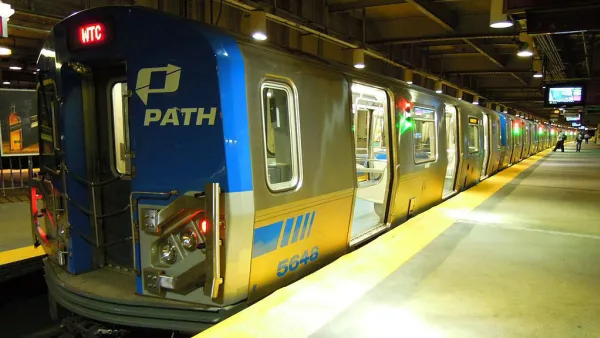
Financing of Hudson River Rail Tunnels in Peril
A funding agreement between New York, New Jersey, and the U.S. DOT for one of the most important rail projects in the nation is in danger of collapsing because of the way the two states are financing their share of the $12.9 billion cost.
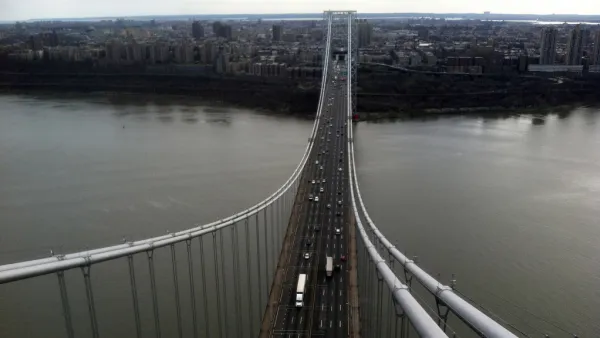
Bridgegate Implications for New Jersey and Beyond
In The New York Times Sunday Review, Matt Katz, a political reporter for WNYC and New Jersey Public Radio, gives an update on the federal trial for 'Bridgegate' and also paints a bleak picture for New Jersey, and maybe the United States.
Strike Averted! New Jersey Transit Unions Reach Tentative Agreement
Thirty hours before rail workers would have begun a strike that would have paralyzed commuting between New York and New Jersey, transit agency and rail unions reached a deal, though it must still be ratified by workers.

Planetizen Federal Action Tracker
A weekly monitor of how Trump’s orders and actions are impacting planners and planning in America.

California plans to bury El Niño’s downpour
If the state plays its cards right, it may be able to store a billion acre-feet of El Niño’s water in aquifers.

Desperate measures: Advocates weigh draining Lake Powell to fill Colorado River
Draining the reservoir could reduce evaporation losses by a couple hundred thousand acre-feet.

Mamdani’s pied-à-terre tax survives legal challenge
A panel of judges found that the plaintiffs failed to demonstrate injury as a result of New York City's implementation of the tax.

Eastern Nebraska is running out of electricity
Data centers and electrification are straining eastern Nebraska’s grid, throttling economic development.

Seattle passes record-breaking transit services expansion
Proposition 1 will double the city’s transit tax to add 95,000 more bus trips and preserve 180,000 bus trips annually.

FREE Course: Walkable City 1: Why Walkability?
After describing his path towards focusing on walkability as the essence of good planning, Jeff Speck marches through his five principal reasons for making more walkable places.
Reinventing Malls: Planning Alchemy—Turning Gray Fields Into Gold
The course focuses on the opportunities and imperatives that shape reinvention of mall sites.

City of Rosemead
Rutgers University, Edward J. Bloustein School of Planning and Public Policy
One Hundred Miles
University of Michigan School for Environment and Sustainability (SEAS)
Hunter College, City University of New York (CUNY)
The Architects Foundation
City of Cambridge
Montrose County
The Pocatello Development Authority