Because of the coal power it displaces, solar and wind energy generated in the Mid-Atlantic, and Upper Midwest has an outsized impact.



A study from Lawrence Berkley Labs looked to quantify the impact of clean energy on public health, and the money saved by keeping those people healthy. "They examined how much wind and solar reduced emissions of four main pollutants — sulfur dioxide (SO2), nitrogen oxides (NOx), fine particulate matter (PM2.5), and carbon dioxide (CO2) — over that span of years," David Roberts reports for Vox. The study found that clean energy likely prevented 7,000 premature deaths saving 56 billion dollars. These savings are before accounting for CO2 reduction and the impact that would have for climate change.
The impact of clean energy is different in different regions of the U.S., "In California, wind and solar are mostly displacing natural gas. In the upper Midwest and mid-Atlantic regions, which rely more heavily on coal, wind and solar have greater impact," Roberts explains.
Finally, because tax rates in the U.S. are progressive and air is breathed equally by all people, funding clean energy is particularly equitable. "This is something that often gets lost in discussions of environmental regulations. It’s not just that their total benefits almost always exceed their direct costs. It’s that those benefits are uniquely egalitarian and progressive," Roberts argues.
Read the full story: Wind and solar power are saving Americans an astounding amount of money

Decisive Supreme Court Win for Clean Air and Public Health
In a huge and perhaps unexpected win for the EPA, the Supreme Court on April 29 reversed an appellate court panel ruling that had rejected their attempt to regulate interstate air pollution caused by about 1,000 coal-fired power plants in 28 states.
Court of Appeals Deals Second Blow to EPA on Clean Air Regs
For the second time, a court has thrown out EPA efforts to address pollution from power plants in 'clean-air' states that cause pollution downwind. This time, the Cross-State Air Pollution Rule was the victim.
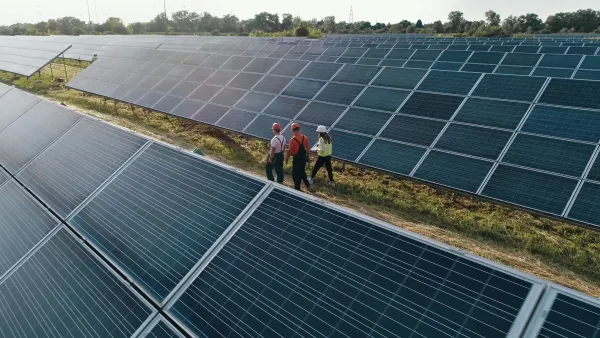
Study: States approved 90% of renewable energy projects between 2018 and 2024
Ohio had the highest rejection rate for wind and solar proposals.

Planetizen Federal Action Tracker
A weekly monitor of how Trump’s orders and actions are impacting planners and planning in America.

‘Going backwards:’ Baltimore mayor, students rally against state's transit funding plan
Maryland's proposed six-year plan provides no funding for Baltimore’s BMORE bus program and reduces its road maintenance funding.

Detroit to transform waterfront with $2.2 billion investment
Developers will convert about 18 acres of unused parking lot space into civic spaces.

25 states, cities sue the EPA over erased power plant emissions limits
The coalition also intends to sue the EPA for not regulating emissions from gas-fired power plants.

Newsom vetoes giving CA tribes greater voice in water projects
In his veto letter, Newsom said the bill would add ‘uncertainty’ to the state’s fight to secure Californians’ water supplies.

Michigan Senate votes to revise 'lax' dam safety laws
A Bridge Michigan investigation found more than 100,000 Michigan residents live in the floodpath of a high or significant-hazard dam.

FREE Course: Walkable City 1: Why Walkability?
After describing his path towards focusing on walkability as the essence of good planning, Jeff Speck marches through his five principal reasons for making more walkable places.
Reinventing Malls: Planning Alchemy—Turning Gray Fields Into Gold
The course focuses on the opportunities and imperatives that shape reinvention of mall sites.

City of Thousand Oaks
City of Wisconsin Rapids
Harvard University Graduate School of Design
The Architects Foundation
University of Cincinnati Online
Northern Illinois Transit Authority (NITA)
The Pocatello Development Authority
The Urban Renewal Agency of the City of Pocatello