With the recently adopted Community Greening Plan, Capital Region Water has committed to the implementation of green stormwater infrastructure in Harrisburg. The plan is empowering residents to partner in stormwater management.



Like many cities with combined sewers, Harrisburg, Pennsylvania is developing a long-term plan to reduce sewer overflows into its river. With its recently adopted "Community Greening Plan" [pdf], Capital Region Water has committed to the implementation of green stormwater infrastructure throughout Harrisburg—including transforming public places such as parks and greenways—as part of this stormwater management strategy.
Yet, faced with similar stormwater management issues as other water utilities, Capital Region Water is taking a notably different approach to implementing green stormwater infrastructure—one that empowers Harrisburg’s residents to suggest project locations and partner in their implementation. This plan is based on several exciting conversations with city residents, businesses, and local organizations, and is the start of many more.
Capital Region Water worked closely with the city of Harrisburg and citizens throughout the planning process. A group of "community ambassadors," made up of representatives of the local community, provided input into the plan and, in the process, became well versed in green stormwater infrastructure. Capital Region Water took the community ambassadors to see built green stormwater infrastructure projects in Lancaster and Philadelphia, including planted corner bumpouts to collect street runoff, swales in parking lots, rain gardens next to schools, and man-made wetlands. Getting to see the Lancaster and Philadelphia projects in person gave the community ambassadors a better understanding of how this infrastructure works and how it could transform the look of Harrisburg.
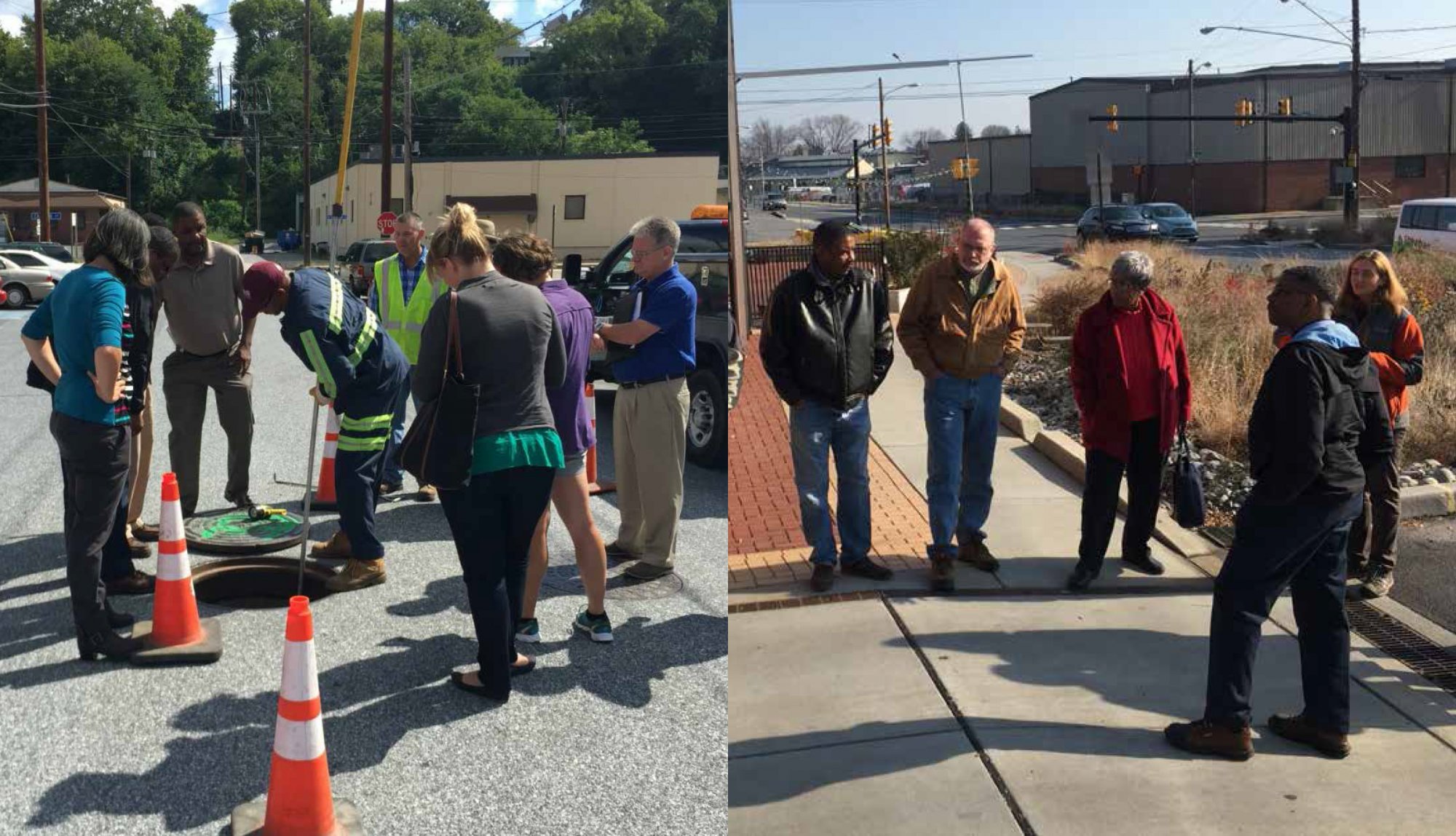
Capital Region Water assembled a group of Community Ambassadors, representatives from neighborhoods across Harrisburg, who provided input into the plan and, in the process, became well-versed in green stormwater infrastructure challenges and techniques. Capital Region Water took the Community Ambassadors to see built green stormwater infrastructure projects in Lancaster and Philadelphia, which gave them a much better understanding of how this infrastructure works and how it could transform the look of Harrisburg. (Image and text via the Community Greening Plan)
The Community Greening Plan is written for both Capital Region Water and the community at large. While it includes a citywide analysis of where the easiest opportunities to implement green stormwater infrastructure are located based on physical conditions, it also recognizes that community-driven projects may take precedence over projects that are easy to engineer because they have built-in constituencies to advocate and care for them. The Community Greening Plan also provides illustrative examples of how green stormwater infrastructure can be incorporated into homes, neighborhoods, streets, alleys, schools, parks, public spaces, community centers, and vacant lots. The plan is designed to be accessible and inspiring to the community, sparking the collective imagination about how green stormwater infrastructure could be located in neighborhoods.
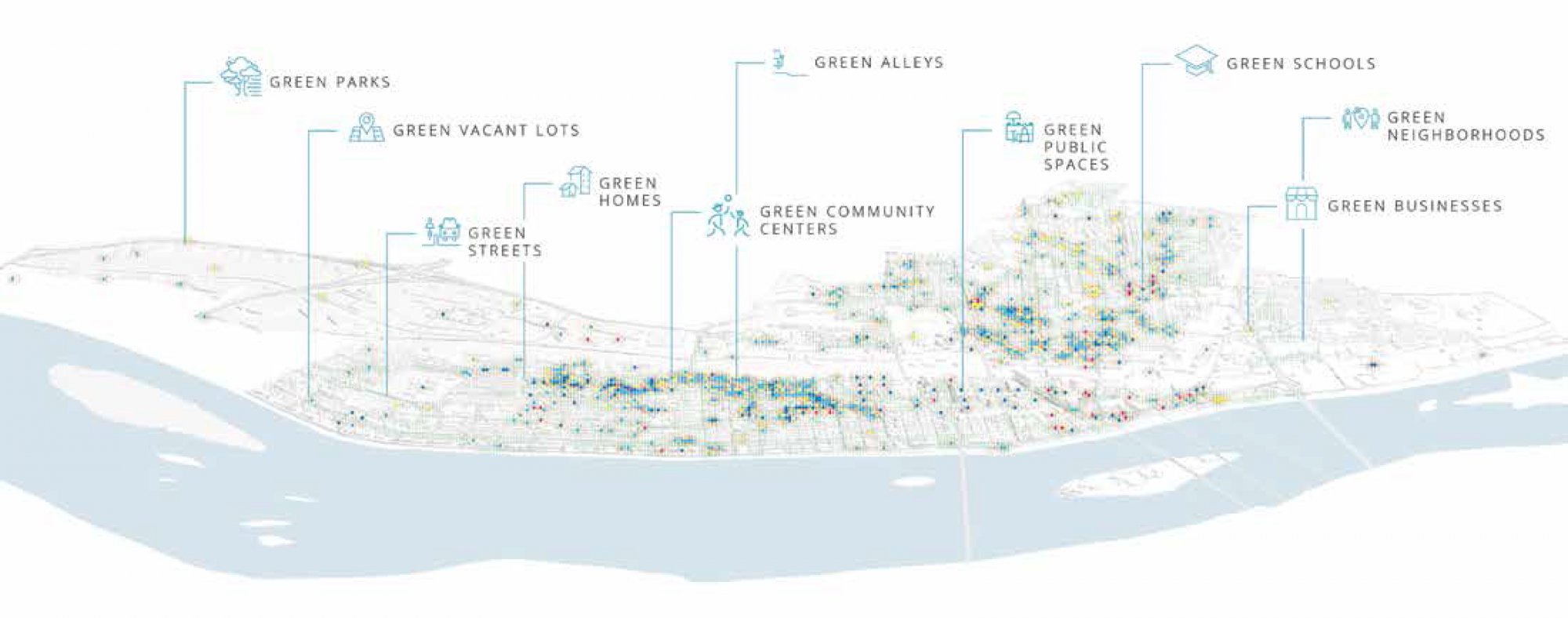
Because green stormwater infrastructure is distributed—comprising many projects in many locations—the anticipated effect of implementing the Community Greening Plan is cumulative. Each small project adds up to a network of green stormwater infrastructure that manages stormwater, improves the health of waterways, and enhances and beautifies the public realm. (Image and text via the Community Greening Plan)
Even before the plan was complete, Capital Region Water began looking for pilot project opportunities to implement green stormwater infrastructure and maximize stormwater management in cost effective and innovative ways. Working with community groups, Capital Region Water selected three pilot project areas for green stormwater infrastructure that demonstrate a wide range of green stormwater infrastructure tools—from simple, low-cost grading alternatives to signature design projects. The selected pilot projects prioritize management solutions for surface, vegetated systems, but the majority of the systems also include a subsurface infiltration or detention component to maximize stormwater management.
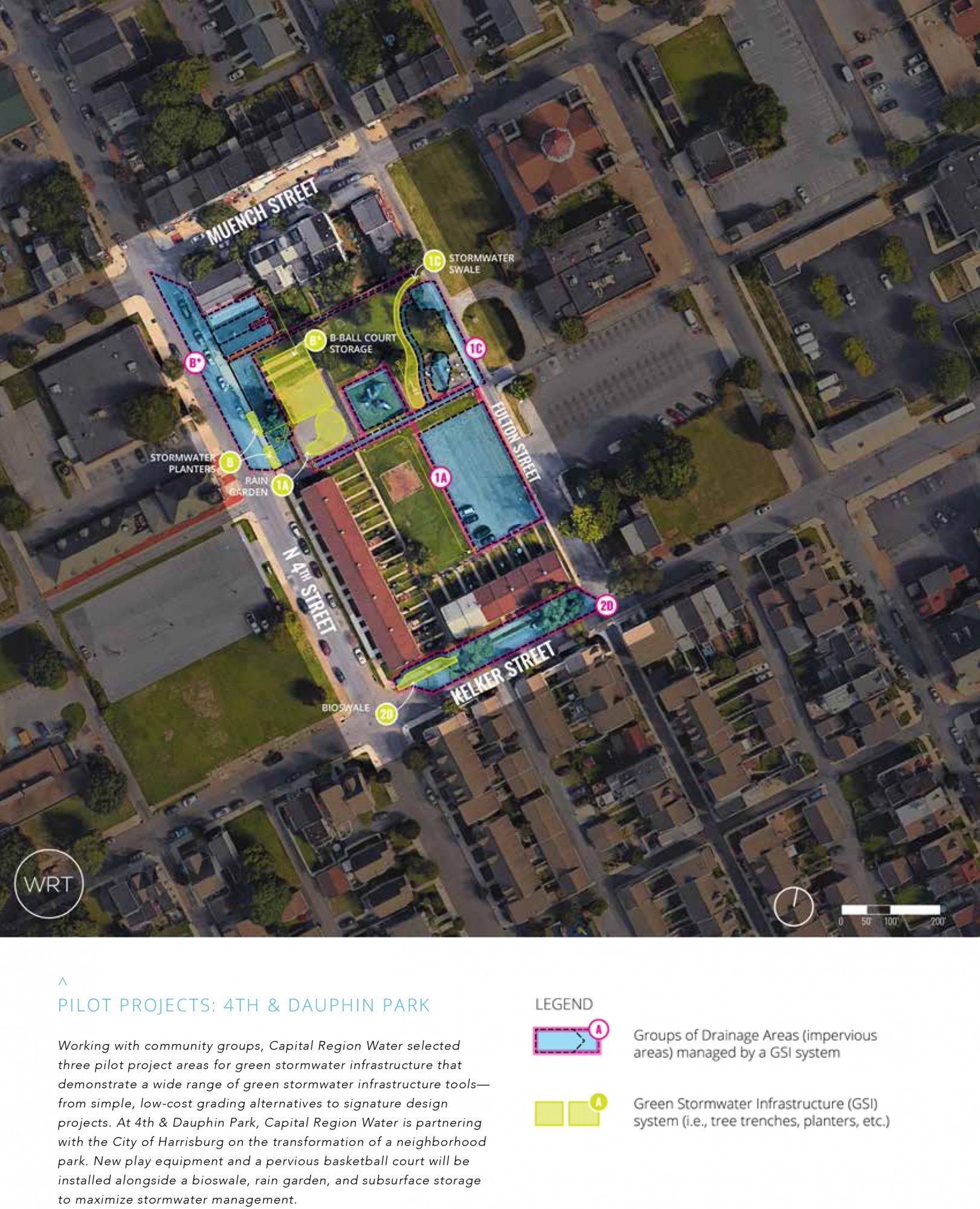
In addition to the pilot projects, Capital Region Water was presented with an opportunity to join the city of Harrisburg in transforming four neighborhood parks. Grants from the Pennsylvania Department of Conservation and Natural Resources (DCNR) helped to fund both the Community Greening Plan and the park renovations, so all three parties shared a desire to leverage their investments. The Community Greening Plan—as with green infrastructure plans in York and Lancaster also funded through DCNR's Community Conservation Partnership Grant Program—has elevated the importance of public parks and trails from being perceived in some cases as 'nice to have' amenities into multi-functional necessities for flood and pollution control. The DCNR grant program is helping leverage state and federal funding sources and enabling communities to make impactful, holistic, and sustainable changes that make them better and healthier places to live, work, and play.
The parks receiving upgrades range in size and amenities and are located in different neighborhoods across the city. Upgrades will replace outdated, unsafe play equipment and deteriorating walkways with new pervious basketball courts over underground stormwater storage, new play structures, rain gardens, porous sidewalks, and swales. Green stormwater infrastructure is integrated into the city’s designs in a cohesive, integrated way that doesn’t sacrifice either stormwater management or recreation for the other. The topography of the parks and the areas surrounding them allow the parks to manage not only their own stormwater, but also stormwater from surrounding streets, sidewalks, and parking areas.
With construction slated for completion this summer and fall, Harrisburg will get a glimpse of the Community Greening Plan in action. Capital Region Water will use lessons learned from these projects to inform future green stormwater infrastructure projects in parks and other public spaces throughout the city. And, Capital Region Water will have taken a few substantial steps toward improving stormwater management goals, quality of life, and partnerships with the community.
Claire Maulhardt, City Beautiful H2O Program Manager, Capital Region Water
Andrew Dobshinsky, Senior Associate / Planner + Urban Designer, WRT

South Los Angeles Park Offers Hidden Benefits
Not only does the redevelopment of a large section of Earvin Magic Johnson Park in Willowbrook offer much needed green space and new amenities, it also helps to conserve water and improve water quality.
FYI about GSI: The Recipe for Green Stormwater Infrastructure Success
New research highlights some of the ways planners can increase the social benefits and public acceptance of green stormwater infrastructure.
Stormwater Credits Provide Incentives for Green Infrastructure
Most harmful stormwater originates on private property, and public agencies are looking for ways to entice property owners to implement more effective infrastructure.

Planetizen Federal Action Tracker
A weekly monitor of how Trump’s orders and actions are impacting planners and planning in America.

Amtrak, CN end decades-long dispute with eight-year agreement
The new operating agreement establishes an updated framework for the companies to work together, including processes to resolve disputes.

Northwest rail fans eager for Sept. 30 debut of Amtrak’s Airo fleet
Get ready for that new train smell and more seats. But they won’t go faster or run more frequently on the Cascades route in Washington and Oregon.

Brightline Florida files for bankruptcy
The transit company is over $5 billion in debt.

St. Louis Metro to test if single-car trains can reduce operating costs, maintain rider satisfaction
The pilot program will run from October to spring 2027, and begin with one single-car train operating on Metrolink’s Red and Blue lines.

Pennsylvania is building data centers in abandoned mines
Housing data centers in mines provides an alternative to destroying local forests and may spare residents from data centers’ noise and air pollution.

FREE Course: Walkable City 1: Why Walkability?
After describing his path towards focusing on walkability as the essence of good planning, Jeff Speck marches through his five principal reasons for making more walkable places.
Reinventing Malls: Planning Alchemy—Turning Gray Fields Into Gold
The course focuses on the opportunities and imperatives that shape reinvention of mall sites.

City of Thousand Oaks
City of Wisconsin Rapids
Harvard University Graduate School of Design
The Architects Foundation
University of Cincinnati Online
The Pocatello Development Authority
The Urban Renewal Agency of the City of Pocatello

