The new rule is projected to impact 80,000 people, nearly half of whom are children.


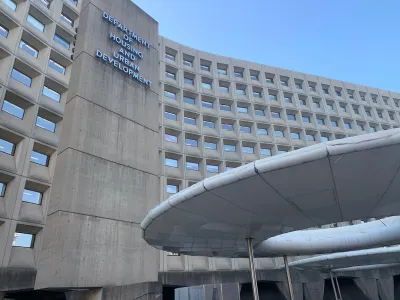
The U.S. Department of Housing and Urban Development now requires households receiving federal housing assistance to provide proof of U.S. citizenship or eligible immigration status for all household members, Ryan Kushner writes for Smart Cities Dive. In the past, federal housing assistance was prorated, meaning aid was based on the number of eligible family members in the household, and did not take into account household members without citizenship.
“The new regulation could impact housing assistance for as many as 80,000 people, according to the National Low Income Housing Coalition. A lawsuit challenging the rule’s legality was filed in the U.S. Central District of California Monday,” Smart Cities Dive reports. “Of the approximately 80,000 individuals who could be displaced by the new requirements, nearly half are children, according to the National Low Income Housing Coalition.”
The HUD said an audit of HUD-assisted households found roughly 200,000 tenants “with incomplete or unknown eligibility verification.”
Read the full story: HUD finalizes rule targeting mixed-immigration-status households receiving aid

HUD Proposes Updates to HOME Grant Program
The agency’s proposal would streamline and modernize its largest affordable housing grant program, which will award $1.3 billion in FY 2024.

HUD Resiliency Awards Target Affordable Multifamily Housing
The Green and Resilient Retrofit program aims to reduce vulnerability to climate challenges and improve energy efficiency in multifamily buildings.

How to Fix Racist Housing Policies: Sue the Suburbs
Strengthening U.S. Department of Housing and Urban Development's civil rights enforcement could send a powerful signal to communities resistant to changing discriminatory housing rules.

Planetizen Federal Action Tracker
A weekly monitor of how Trump’s orders and actions are impacting planners and planning in America.

Washington state to charge fee to drivers with fuel-efficient cars
Revenue from the fee will go towards supporting the state’s highways.

Illinois considers spending $1 billion in taxpayer money on data center
A quantum computing campus and data center are currently under construction in Chicago.

HUD to end aid for mixed-immigration-status households
The new rule is projected to impact 80,000 people, nearly half of whom are children.

Trump has changed his mind on congestion pricing — maybe
The Trump administration is offering $100 million in grants so cities can implement their own traffic control programs.

‘Demolition of our heritage:’ Some US tribes speak out against BAAJA
A coalition of indigenous groups in the United States are concerned about provisions in the bill that may weaken their ability to halt large energy projects.

FREE Course: Walkable City 1: Why Walkability?
After describing his path towards focusing on walkability as the essence of good planning, Jeff Speck marches through his five principal reasons for making more walkable places.
Reinventing Malls: Planning Alchemy—Turning Gray Fields Into Gold
The course focuses on the opportunities and imperatives that shape reinvention of mall sites.

City of Charlotte
City of Rosemead
Rutgers University, Edward J. Bloustein School of Planning and Public Policy
University of Michigan School for Environment and Sustainability (SEAS)
Hunter College, City University of New York (CUNY)
The Architects Foundation
University District Partnership