Streetsblog USA breaks the news of a major policy departure for the National Transportation Safety Board: speeding kills, and every level of government must do more to counter the problem.



Stephen Miller reports: "In a draft report released earlier this week, the National Transportation Safety Board says excessive speed is a deadly problem in our nation’s transportation system — one that federal and state officials aren’t doing enough to address."
The NTSB report includes 19 recommendations, covering ideas from how engineers set speed limits (the so-called 85th Percentile Rule), new technology that can warn drivers about speeding, and better enforcement. The recommendations "should be a wake-up call, especially to the Federal Highway Administration (FHWA), state legislatures, and transportation and police departments across the country," writes Miller.
According to Miller, the report represents a breakthrough for the agency that investigates plane and railroad disasters, only turning to automobile safety when it comes to impaired driving and seat belts. "Unlike driving drunk or not wearing a seat belt, which have been the subject of sustained national attention for decades, there’s little stigma against driving too fast," writes Miller.
Read the full story: NTSB: Speed Kills, and We’re Not Doing Enough to Stop It
San Francisco Mayor Ed Lee Pushing for Speed Camera Legislation
If Lee has his way, San Francisco will join other cities like New York, Chicago, and Washington, D.C. by employing speed cameras to issue citations to offending motorists in school zones. But first he needs to find a legislator to draft a bill.
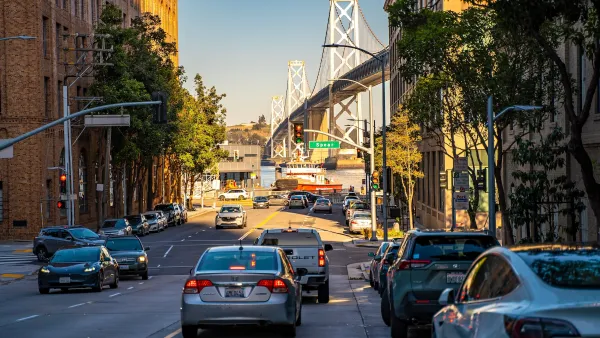
After San Francisco installed traffic cameras, speeding dropped by 80%
The city was allowed to install speed cameras as part of a five-year pilot program approved by California in 2023.

Data Shows Chicago Speed Cameras Reduce Speeding, Crashes
Countering claims made by the Chicago Tribune that automated enforcement doesn’t improve safety, Streetsblog Chicago lays out the data showing how traffic safety fared in camera zones.

Planetizen Federal Action Tracker
A weekly monitor of how Trump’s orders and actions are impacting planners and planning in America.

Eastern Nebraska is running out of electricity
Data centers and electrification are straining eastern Nebraska’s grid, throttling economic development.

Washington state to charge fee to drivers with fuel-efficient cars
Revenue from the fee will go towards supporting the state’s highways.

Instead of building new housing, LA developers are turning mansions into mega-mansions
In the richest areas, the number of houses valued at $30 million with demolition permits has skyrocketed since 2018.

Illinois considers spending $1 billion in taxpayer money on data center
A quantum computing campus and data center are currently under construction in Chicago.

As development costs rise, Boston moves to lessen affordable housing requirements
The Boston Zoning Commission and the City Council still need to approve Boston Mayor Michelle Wu’s proposed changes

FREE Course: Walkable City 1: Why Walkability?
After describing his path towards focusing on walkability as the essence of good planning, Jeff Speck marches through his five principal reasons for making more walkable places.
Reinventing Malls: Planning Alchemy—Turning Gray Fields Into Gold
The course focuses on the opportunities and imperatives that shape reinvention of mall sites.

City of Charlotte
City of Rosemead
Rutgers University, Edward J. Bloustein School of Planning and Public Policy
University of Michigan School for Environment and Sustainability (SEAS)
Hunter College, City University of New York (CUNY)
The Architects Foundation
City of Cambridge
The Pocatello Development Authority
The Urban Renewal Agency of the City of Pocatello