The struggling, industrial South Bay city of Carson wants to shake its image as the site of Los Angeles' landfills and waste treatment plants. It has embarked on a $1 million overhaul of its general plan, despite having a $4.1 million budget gap.



"The [Carson] City Council hired San Francisco-based urban planning firm Dyett & Bhatia earlier this month to oversee public outreach and rewrite the city’s 2004 General Plan," reports Sandy Mazza for the Daily Breeze. "The firm outbid five other companies for the two-year job."
“It’s going to set the stage for future development in the community,” City Manager Ken Farfsing said. “This is going to be a totally different city in five to 10 years.
Carson, population 100,000 [pdf], is the youngest city in the South Bay of the Los Angeles metropolitan area, 12th youngest among Los Angeles County's 88 cities [pdf]. The city celebrates its 50th anniversary next year.

As an unincorporated region in the county, it was unable to prevent the location of necessary but unsightly regional facilities, according to the city's history webpage.
By the time Carson finally incorporated as a city in 1968, its landscape was pockmarked with the dozens of refuse dumps, landfills, and auto dismantling plants which none of its neighbors would have in their own cities.
The city also has a history of oil drilling which led to the development of refineries and left a brownfield legacy. "Much of the developable land is contaminated by closed landfills or industrial waste," adds Mazza. But times are changing.
The city’s downtown, along Carson Street between the 405 and 110 freeways, has seen a huge boom in residential development in recent years. Hundreds of new apartments have been built in multiuse developments that include retail shops, eateries and offices.
A critical component of the general plan update will be to generate revenue through economic development.
“The city has been running on a structural deficit for the past several years. It is critical that this update examine ways to balance the increasing cost of providing services with limited sources of revenue,” the document states.
“The city’s economic viability may be at risk unless it formulates new strategies to promote fiscally sound practices.”
Hat tip to L.A. Transportation Headlines.
Read the full story: Carson kicks off a major planning overhaul to transform city
A Win for Single-Family Zoning in California
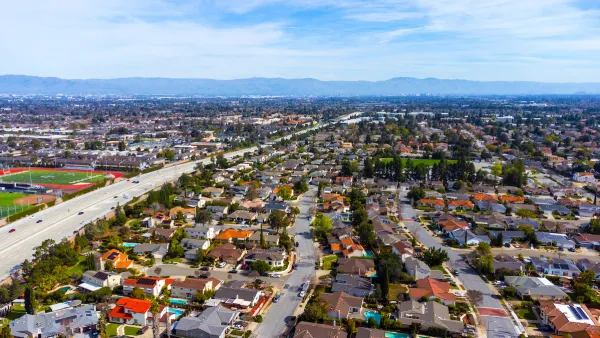
Five Southern California charter cities need not worry about lot splitting in their single-family zoned neighborhoods thanks to a Los Angeles County superior court ruling on April 22. Depending on a forthcoming ruling, 120 cities may join them.
Tiger Woods Crash: Blame the Road, Not the Driver, Say Authorities
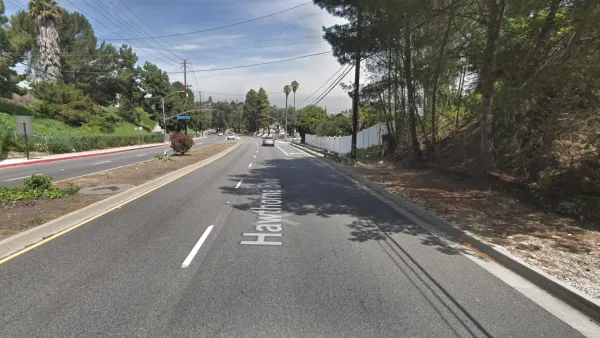
"Purely an accident" is how the Los Angeles County Sheriff's Department characterized the one-person, single-vehicle rollover crash that severely injured golfing celebrity Tiger Woods on Feb. 23 while driving on the Palos Verdes Peninsula.

When Whites Return to the Black Neighborhoods They Fled
Los Angeles Times op-ed writer Erin Aubry Kaplan shares her feelings upon seeing whites return to Inglewood, California half a century after they fled. One consistent theme emerges: "Whatever black people have can be taken away."

Planetizen Federal Action Tracker
A weekly monitor of how Trump’s orders and actions are impacting planners and planning in America.

California plans to bury El Niño’s downpour
If the state plays its cards right, it may be able to store a billion acre-feet of El Niño’s water in aquifers.

Desperate measures: Advocates weigh draining Lake Powell to fill Colorado River
Draining the reservoir could reduce evaporation losses by a couple hundred thousand acre-feet.

Mamdani’s pied-à-terre tax survives legal challenge
A panel of judges found that the plaintiffs failed to demonstrate injury as a result of New York City's implementation of the tax.

Eastern Nebraska is running out of electricity
Data centers and electrification are straining eastern Nebraska’s grid, throttling economic development.

Seattle passes record-breaking transit services expansion
Proposition 1 will double the city’s transit tax to add 95,000 more bus trips and preserve 180,000 bus trips annually.

FREE Course: Walkable City 1: Why Walkability?
After describing his path towards focusing on walkability as the essence of good planning, Jeff Speck marches through his five principal reasons for making more walkable places.
Reinventing Malls: Planning Alchemy—Turning Gray Fields Into Gold
The course focuses on the opportunities and imperatives that shape reinvention of mall sites.

City of Rosemead
Rutgers University, Edward J. Bloustein School of Planning and Public Policy
One Hundred Miles
University of Michigan School for Environment and Sustainability (SEAS)
Hunter College, City University of New York (CUNY)
The Architects Foundation
City of Cambridge
Montrose County
The Pocatello Development Authority