This tool from Sidewalk Labs lets planners draw upon vast quantities of data to create agent-based models, simulating who gains and loses when changes are made.


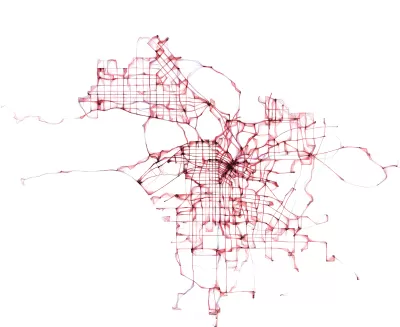
Comparing it to a far-more-accurate version of Sim City, Oscar Perry Abello covers Doppelgänger, an agent-based modeling tool from Google's Sidewalk Labs. Doppelgänger provides "real-world planners a simulation based not on some 1990-era coder's best approximation of people, but instead one based on the terabytes upon terabytes of real-world data available in today's digital world."
According to Sidewalk Labs modeling lead David Ory, "Doppelgänger enables planners to create a set of virtual households that accurately reflects real neighborhoods, cities, regions, or states, along any dimension relevant to the problem at hand. [It] can create households that have accurate numbers of children, seniors, teachers, persons with disabilities, electric-vehicle owners, swing-shift workers, and so on."
With its capacity for future projections, the tool may help planners visualize which sections of a city benefit (or lose out) from a given change.
Read the full story: Digital Tool Aims to ID Urban Planning’s Winners, Losers
Next on the List for Data Startups: Managing Curb Space
The humble curb is getting crowded: not only with new modes of transportation, but also with a slew of new data tools aiming to keep track of it all.

Sidewalk Labs Launches 'Operating System' for Urban Data
The 'Coord' platform will give mobility companies a centralized place to access and use local data on parking, curb space, tolls, and the like.

10 urbanist video games that aren’t Sim City
Sim City may have inspired an entire generation of urban planners — but these games have perfected the art of city-building simulation.

Desperate measures: Advocates weigh draining Lake Powell to fill Colorado River
Draining the reservoir could reduce evaporation losses by a couple hundred thousand acre-feet.

Eastern Nebraska is running out of electricity
Data centers and electrification are straining eastern Nebraska’s grid, throttling economic development.

Malls are becoming the midtowns of the future
Mall and office park redevelopments are a generational opportunity to create new nodes of urbanity.

NYC breaks ground on anti-flooding infrastructure project
New York City's new system will reduce stormwater flows to local sewers by 90%.

One Kentucky town’s secret to affordable housing
The Smoketown Community Land Trust has already built seven affordable homes for community members.

Houston gains petal-shaped cooling infrastructure to make streets more ‘delightful’
The city has installed the pavilions along 15 blocks in Houston.

FREE Course: Walkable City 1: Why Walkability?
After describing his path towards focusing on walkability as the essence of good planning, Jeff Speck marches through his five principal reasons for making more walkable places.
Reinventing Malls: Planning Alchemy—Turning Gray Fields Into Gold
The course focuses on the opportunities and imperatives that shape reinvention of mall sites.

City of Rosemead
Rutgers University, Edward J. Bloustein School of Planning and Public Policy
One Hundred Miles
University of Michigan School for Environment and Sustainability (SEAS)
Hunter College, City University of New York (CUNY)
The Architects Foundation
City of Cambridge
Montrose County
The Pocatello Development Authority