The irony isn't lost on the authors of a new report by SPUR: Bay Area companies committed to technology innovation obstinately rely on traditional and inefficient commutes in automobiles.


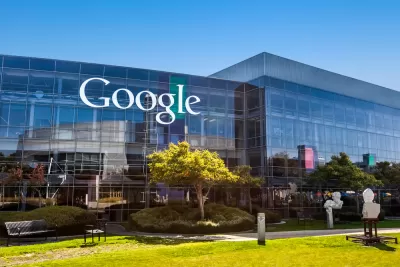
Nicholas Cheng shares news of a new study from SPUR that pushes big companies located in the San Francisco Bay Area to better connect their workplaces with public transit.
Cheng writes of the large challenge for transportation planners and commuters: "Eighty percent of jobs in the Bay Area are concentrated in suburban fringes with little access to regional rail, and three-quarters of Bay Area workers drive alone to work as a result, the study’s authors note."
SPUR editorial director Allison Arieff is quoted in the article, saying that a lack of transit options for employees is a competitive disadvantage for many tech companies.
Meanwhile, examples of car-centric planning and political decisions abound. For instance, the recently opened Warm Springs BART Station has line of sight to Tesla's Fremont factory—unfortunately it's a two-mile walk between the two locations. Also "Silicon Valley cities like Menlo Park, Mountain View and Cupertino — homes to Facebook, Google and Apple — have not been building enough homes to match demand," writes Hueng.
FULL STORY: Study calls on big tech companies to move closer to transit

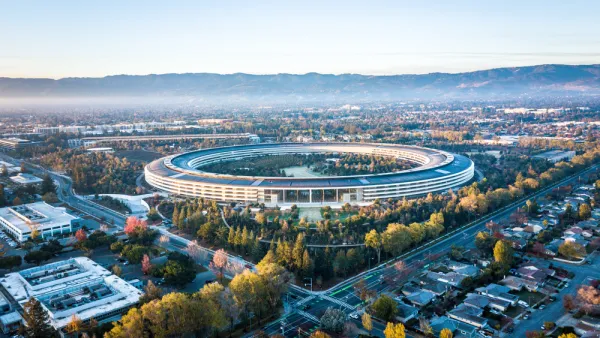
Why Big Tech Billions Won't Dent California's Housing Crisis
New multibillion-dollar affordable housing commitments from leading tech firms may build out thousands of units, but that's nothing next to California's gargantuan housing shortage.

ADUs account for nearly 28% of Bay Area housing permits
In Hillsborough, 56 of 58 homes permitted in 2025 were ADUs.
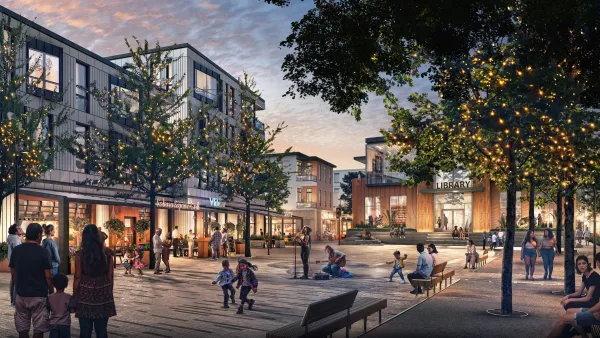
Tech investors lobby to bypass environmental review for 'California Forever' project
The backers of a proposed new community in the California Bay Area want the state to approve an 18-year-old environmental review that would let them go ahead with a major shipyard project.

Planetizen Federal Action Tracker
A weekly monitor of how Trump’s orders and actions are impacting planners and planning in America.

The state-sanctioned urbicide of Austin
People don’t kill cities. Freeways do.

US to reduce Colorado River water deliveries to Mexico
A new Colorado Treaty amendment reduces Mexico’s Colorado River water allocation by 250,000 acre feet.

Baltimore to break ground on $50 million Transit Priority Project
The project will bring faster bus trips, safer streets and better bike connections to Baltimore.

Airbnb launches $250 million 'last-dollar financing' housing accelerator, makes first investment in Austin
The company will put $6.4 million towards affordable housing development in Texas’ capital.

Guerilla urbanists are building DIY bus stop benches in Chicago
A before-and-after of one of the bus stops with a new bench. The new benches are not officially sanctioned or permitted, but the residents who placed them hope they will be the start of a network of DIY benches across the city.

FREE Course: Walkable City 1: Why Walkability?
After describing his path towards focusing on walkability as the essence of good planning, Jeff Speck marches through his five principal reasons for making more walkable places.
Reinventing Malls: Planning Alchemy—Turning Gray Fields Into Gold
The course focuses on the opportunities and imperatives that shape reinvention of mall sites.

Eagle County Government
Harvard University Graduate School of Design
Nashville Planning Department
The Architects Foundation
University of Cincinnati Online
The Pocatello Development Authority
The Urban Renewal Agency of the City of Pocatello
Journal of the American Planning Association