The Detroit Pistons recently played their last game in the Palace of Auburn Hills.



"The closing of the Palace of Auburn Hills marks just the latest example of a major suburban anchor dying well before its time," according to an article by John Gallagher.
Gallagher counts the Palace of Auburn Hills, home of the Detroit Pistons, among a group that includes the Northland Center, Summit Place Mall, the Pontiac Silverdome, and the old Kmart headquarters in Troy, as formerly "cutting-edge" developments located in the suburbs of Detroit. Now, "all face either demolition or drastic overhauls."
Gallagher cites Edward Hustoles, a now-retired urban planner who was active in metro Detroit at the time, who says that planners and politicians got duped by a narrative of unfettered expansion in the Detroit metropolitan area.
"Back in 1965, Detroit Edison hired the noted Athens-based consulting firm Doxiadis Associates to map out the future of metro Detroit," explains Gallagher. "In a stunningly misguided bit of forecasting, the Doxiadis report projected that metro Detroit's population would more than double by 2000. Instead, the population fell several million people shy of that." Add the region's population losses with the contemporary taste for urban environments, and it's been a recipe for disaster for Detroit's suburban growth plans.
Read the full story: How miscalculation, market trends doomed Palace of Auburn Hills


Detroit Columnist: 30 Years Isn't Long Enough for a Sports Arena to Stand
The short life of the Palace of Auburn Hills, once home to the NBA's Detroit Pistons, is a "colossal waste," according to John Gallagher.

Where Population Declines but the Economy Grows
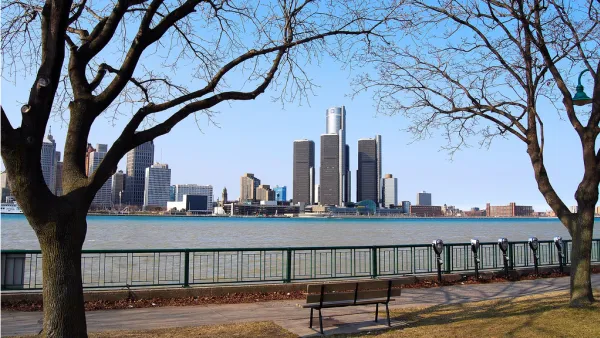
While the scale of Detroit's population loss is well known, the lesser known that the city's economy has grown steadily in recent decades. It's not alone.
'Detroit Future City' Enters a New Stage
The Detroit Future City Implementation Office has completed a new strategic plan that will redirect the organizations revitalization efforts, four years after the city adopted the largely successful Detroit Future City framework.

Planetizen Federal Action Tracker
A weekly monitor of how Trump’s orders and actions are impacting planners and planning in America.

Amtrak, CN end decades-long dispute with eight-year agreement
The new operating agreement establishes an updated framework for the companies to work together, including processes to resolve disputes.

Judges permit Denver to divert 77,000 acre feet from the Colorado River for reservoir expansion
Overuse and climate change have caused the Colorado River’s water levels to plummet.

NYC DOT wants faster, more permanent street upgrades
The city is examining ways to build more concrete infrastructure without getting entangled in 'decades-long' projects.

'Something we’ve never seen before:' rising utility rates could strain city finances nationwide
Data centers, climate change and other factors have caused utility rates in the United States to increase by 38% since 2020.

Trump to overrule local leaders, lease millions of acres of America’s Pacific Island territories’ seafloors to mining companies
International law says that the Indigenous people of America’s territories have a right to prior and informed consent regarding projects that impact their countries.

FREE Course: Walkable City 1: Why Walkability?
After describing his path towards focusing on walkability as the essence of good planning, Jeff Speck marches through his five principal reasons for making more walkable places.
Reinventing Malls: Planning Alchemy—Turning Gray Fields Into Gold
The course focuses on the opportunities and imperatives that shape reinvention of mall sites.

Harvard University Graduate School of Design
KFH Group Inc.
Greater Baltimore Committee
The Architects Foundation
University of Cincinnati Online
The Pocatello Development Authority
The Urban Renewal Agency of the City of Pocatello