Santiago Caltrava designed the Margaret Hunt Hill Bridge in Dallas, which is all you need to hear to understand the Texas-sized ambition of the project. Evaluating the bridge's success, five years after its opening, is more complicated than that.


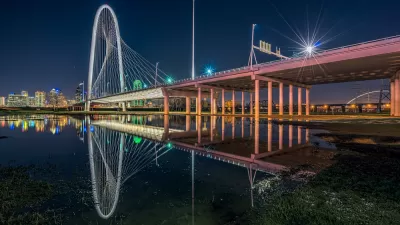
"It's been five years since the first cars rushed across the Margaret Hunt Hill Bridge [in Dallas], but if you're hoping for a verdict on its success or failure, the only possible response is that the jury is still out," writes Mark Lamster.
According to Lamster, the design of the bridge has produced a split decision. Critiques of the bridge begin to emerge for its lack of pedestrian and bike infrastructure ("representative of that endemic Dallas tendency to privilege object over context," writes Lamster) and its lack of an aesthetic connection to West Dallas.
Finally, Lamster speculates that the most lasting story about the Hunt Hill Bridge's legacy is yet to be written:
Five years in, the bridge stands above all as a metaphor, a giant arched portal to another Dallas, one that the city has yet to realize. And the greatest unresolved question of all is not so much what will happen across the bridge, but what will happen under it with the unfulfilled landscape that lies between the Trinity levees.
FULL STORY: The great white hoop: Five years of the Margaret Hunt Hill Bridge

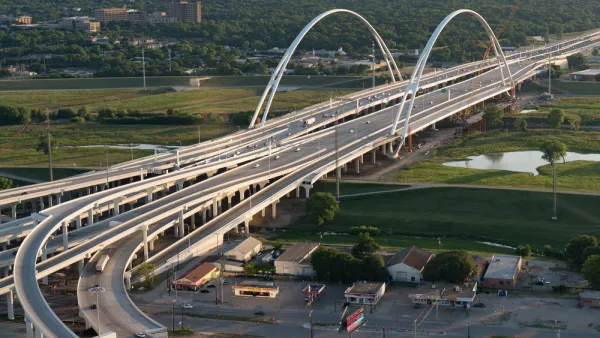
Dallas' Margaret McDermott Bridge Finally Open to Pedestrians and Cyclists
Overdue and over budget, infrastructure for pedestrian and people on bikes is finally available on the Margaret McDermott Bridge in Dallas.
As Cables on Dallas' Margaret McDermott Bridge Fail, State and City Play Blame Game
Santiago Calatrava has run into trouble over the maintenance of his bridge projects in the past—this time it looks like it's not his fault.
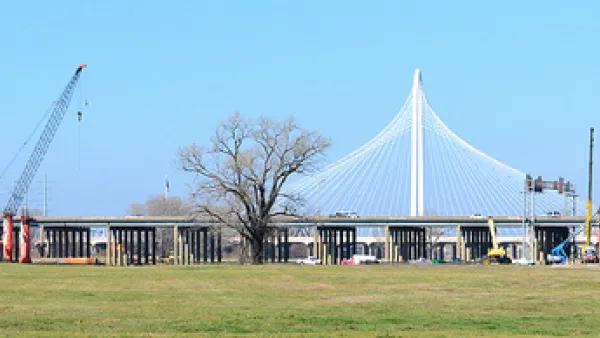
Meet the New Calatrava-Designed Bridge Under Construction in Downtown Dallas
Everything you wanted to know about the Margaret McDermott Bridge, under construction in Downtown Dallas.

Planetizen Federal Action Tracker
A weekly monitor of how Trump’s orders and actions are impacting planners and planning in America.

The state-sanctioned urbicide of Austin
People don’t kill cities. Freeways do.

US to reduce Colorado River water deliveries to Mexico
A new Colorado Treaty amendment reduces Mexico’s Colorado River water allocation by 250,000 acre feet.

5 New England states march closer to 800 megawatt wind energy project
Securing federal approval for the project may be complicated under the Trump administration, which has historically been hostile towards domestic wind power.

Baltimore to break ground on $50 million Transit Priority Project
The project will bring faster bus trips, safer streets and better bike connections to Baltimore.

Airbnb launches $250 million 'last-dollar financing' housing accelerator, makes first investment in Austin
The company will put $6.4 million towards affordable housing development in Texas’ capital.

FREE Course: Walkable City 1: Why Walkability?
After describing his path towards focusing on walkability as the essence of good planning, Jeff Speck marches through his five principal reasons for making more walkable places.
Reinventing Malls: Planning Alchemy—Turning Gray Fields Into Gold
The course focuses on the opportunities and imperatives that shape reinvention of mall sites.

Eagle County Government
Harvard University Graduate School of Design
Nashville Planning Department
The Architects Foundation
University of Cincinnati Online
The Pocatello Development Authority
The Urban Renewal Agency of the City of Pocatello
Journal of the American Planning Association