Had federal authorities acted on the motion filed by three environmental groups in October 2005, nearly 200,000 people in three counties would not have been forced to evacuate due to a poorly constructed emergency spillway for Oroville Dam.


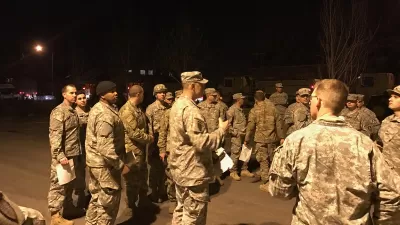
A hasty, chaotic evacuation of 188,000 people occurred in Northern California on Sunday, Feb. 12 after officials warned of serious erosion in a hillside due to the use of an auxiliary or emergency spillway of the over-capacity Oroville Dam in Butte County. The decision to use the emergency spillway was made after engineers discovered that "a 200-foot-long, 30-foot deep hole" developed in the main, concrete-lined spillway.
"The water began eating away at the ground beneath the top of the auxiliary spillway, carving deep gullies into the earth," reports Brad Plumer for Vox.. "On Sunday afternoon, the [state] Department of Water Resources warned that the lip of the auxiliary spillway, which was never built to be as sturdy as the main spillway, was in danger of 'failure' if the ground beneath gave way."
However, the potential collapse of the hillside [see video from drone] that prompted the sudden evacuation orders should not have come as a surprise. Three groups had foreseen it, but they were rebuffed by a federal commission after DWR complained about the cost to address the problem.
Just to clarify, it was not the dam that was under threat of collapse, but flooding due to collapse of the auxiliary spillway.
Paul Rogers, science reporter for The Mercury News, provides the details on the motion filed [PDF] in 2005 and why no action was taken.
Three environmental groups — the Friends of the River, the Sierra Club and the South Yuba [River] Citizens League — filed a motion with the federal government on Oct. 17, 2005, as part of Oroville Dam’s relicensing process, urging federal officials to require that the dam’s emergency spillway be armored with concrete, rather than remain as an earthen hillside.
The groups filed the motion with FERC, the Federal Energy Regulatory Commission. They said that the dam, built and owned by the state of California, and finished in 1968, did not meet modern safety standards because in the event of extreme rain and flooding, fast-rising water would overwhelm the main concrete spillway, then flow down the emergency spillway, and that could cause heavy erosion that would create flooding for communities downstream, but also could cause a failure, known as “loss of crest control.”
FERC rejected that request, however, after the state Department of Water Resources, and the water agencies that would likely have had to pay the bill for the upgrades, said they were unnecessary.
On Tuesday (Feb. 14) afternoon, the evacuation order had been lifted, changed to an "evacuation warning", report Veronica Rocha and Paige St. John for the Los Angeles Times.
"We have concluded it is safe to reduce the emergency evacuation order to an evacuation warning," said Butte County Sheriff Kory Honea, who had made the initial call Sunday to evacuate a large swath of three counties below the imperiled dam.
At the time, residents were told the spillway to the dam could collapse within an hour.
Hat tip to Mike Painter.
Read the full story: Oroville Dam: Feds and state officials ignored warnings 12 years ago

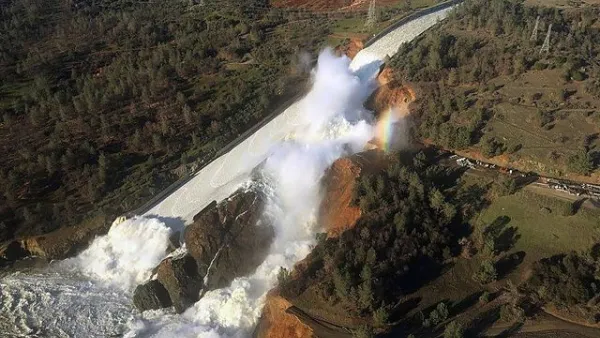
Rebuilt Oroville Spillway Could Get its First Test This Weekend
The quickly repaired Oroville Dam spillway is hoping for better performance this year, after a year of intense repair work.

Disaster Averted!
The California power grid withstood its biggest test ever on Tuesday and passed—barely. The only rolling blackouts that occurred during the Stage Three Energy Emergency alert were results of miscommunication.
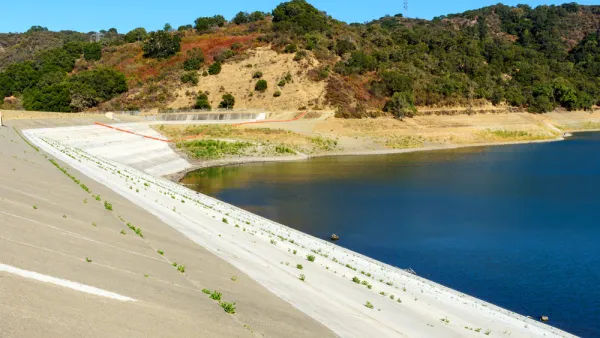
Desalination and Water Recycling Needed to Increase Bay Area Water Supply
In an ongoing drought exacerbated by climate change, the Bay Area needs to look toward two technologies to secure adequate drinking water supply: desalination and wastewater recycling, according to an analysis by the San Francisco Examiner.

Planetizen Federal Action Tracker
A weekly monitor of how Trump’s orders and actions are impacting planners and planning in America.

Amtrak, CN end decades-long dispute with eight-year agreement
The new operating agreement establishes an updated framework for the companies to work together, including processes to resolve disputes.

Northwest rail fans eager for Sept. 30 debut of Amtrak’s Airo fleet
Get ready for that new train smell and more seats. But they won’t go faster or run more frequently on the Cascades route in Washington and Oregon.

Atlanta City Council unanimously backs $3.5 billion Beltline light rail project
The resolution was drafted after Atlanta Mayor Andre Dickens pulled support for the Atlanta Streetcar extension last year.

SEPTA to bring nearby frequent transit to over 1 million new riders as part of decade-long plan
The agency's Accelerate plan will also bring frequent transit to twice the amount of jobs that are currently located near it.

NYC plants over 18,000 trees, the most new foliage in a decade
Many of the trees were planted in communities vulnerable to extreme heat.

FREE Course: Walkable City 1: Why Walkability?
After describing his path towards focusing on walkability as the essence of good planning, Jeff Speck marches through his five principal reasons for making more walkable places.
Reinventing Malls: Planning Alchemy—Turning Gray Fields Into Gold
The course focuses on the opportunities and imperatives that shape reinvention of mall sites.

City of Thousand Oaks
City of Wisconsin Rapids
Harvard University Graduate School of Design
The Architects Foundation
University of Cincinnati Online
The Pocatello Development Authority
The Urban Renewal Agency of the City of Pocatello