In the wake of a deadly cold spell, Portland Mayor Ted Wheeler and the city's government searches for ways to protect the city's homeless.


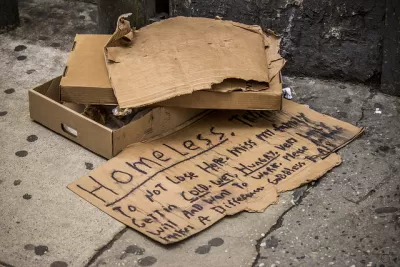
It's been a cold winter in Portland, and after four homeless people died during a cold snap, the city has been pushed into action. "These deaths rattled the residents of a city that — like Seattle — has seen its urban landscape defined not only by a burst of new construction, but a backdrop of tent cities and, each night, bedrolls unfurled in store entryways," reports Hal Bernton in the Seattle Times. Among other measures, government buildings have been converted into emergency shelters. "This was the first time The Portland Building — adorned by the massive copper Portlandia statue of a kneeling woman holding a trident — had ever welcomed the homeless," Bernton writes.
Mayor Ted Wheeler was sworn into office December 30, just before the deaths took place. "Homelessness was a big issue in the mayoral campaign, and Wheeler has proposed policies that include a push to increase shelter space and experimentation with clusters of tiny houses with running water and other amenities," Berton reports. The emergency shelters are now closed as temperatures have moderated, but many in the community hope the response is part of a lasting change to policy toward the homeless.
Read the full story: Portland responds after 4 homeless people die in cold snap
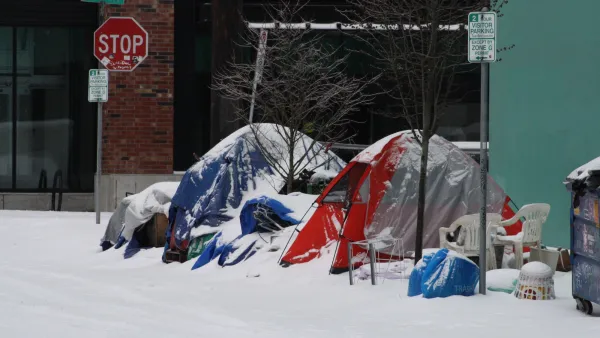
Portland Service Providers Say Mayor’s Methods for Ending Homelessness ‘Least Effective’
Experts say the mayor’s focus on overnight-only shelters fails to get people into long-term housing with the supportive services they need.
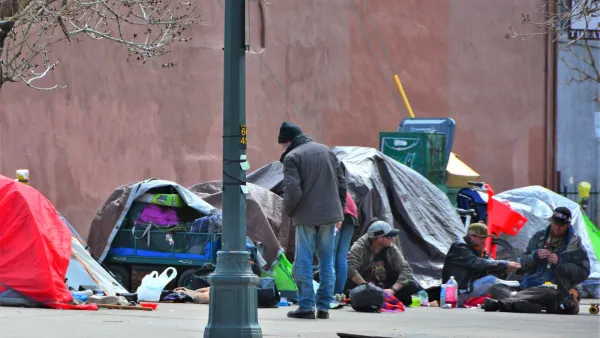
Denver Cut Unsheltered Homelessness Almost in Half Even as Unhoused Population Grows
While the total number of Denver residents without permanent housing is growing, the city has leveraged its resources to quickly create over 1,000 new emergency shelter beds.

Investigation Reveals Just How Badly California’s Homeless Shelters are Failing
Fraud, violence, death, and chaos follow a billion dollar investment in a temporary solution that is proving ineffective.

Planetizen Federal Action Tracker
A weekly monitor of how Trump’s orders and actions are impacting planners and planning in America.

California plans to bury El Niño’s downpour
If the state plays its cards right, it may be able to store a billion acre-feet of El Niño’s water in aquifers.

Desperate measures: Advocates weigh draining Lake Powell to fill Colorado River
Draining the reservoir could reduce evaporation losses by a couple hundred thousand acre-feet.

Los Angeles just elected an urban planner as its mayor
Transportation analysts are optimistic that Raman will be more aggressive in addressing transit issues than Bass.

Mamdani’s pied-à-terre tax survives legal challenge
A panel of judges found that the plaintiffs failed to demonstrate injury as a result of New York City's implementation of the tax.

Eastern Nebraska is running out of electricity
Data centers and electrification are straining eastern Nebraska’s grid, throttling economic development.

FREE Course: Walkable City 1: Why Walkability?
After describing his path towards focusing on walkability as the essence of good planning, Jeff Speck marches through his five principal reasons for making more walkable places.
Reinventing Malls: Planning Alchemy—Turning Gray Fields Into Gold
The course focuses on the opportunities and imperatives that shape reinvention of mall sites.

City of Rosemead
Rutgers University, Edward J. Bloustein School of Planning and Public Policy
One Hundred Miles
University of Michigan School for Environment and Sustainability (SEAS)
Hunter College, City University of New York (CUNY)
The Architects Foundation
City of Cambridge
Montrose County
The Pocatello Development Authority