In his continuing look at places people can exercise - other than the gym - LA park planner Clement Lau writes about the popularity of indoor malls in winter climes for exercising adults and children.


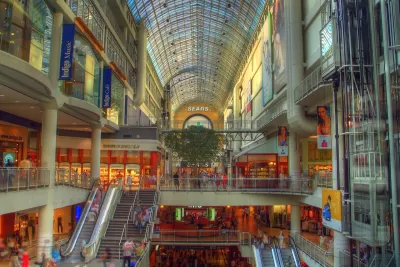
Mall walking for adults and play areas for children are two of the popular recreations at indoor malls during winter in cold weather climes, writes Clement Lau, LA park planner, USC lecturer, and planning author. In fact, the latter are also popular in Southern California malls. The ability to physically recreate at an indoor mall when the outdoors is inhospitable would also apply to inhospitable summer climes.
Lau describes his first encounter with mall walking:
Also, it was not until I spent two weeks in the Midwest in December that I recognized or appreciated how important large indoor spaces like malls are in areas with harsher weather conditions than in Southern California.
. . .
It was during these visits that I came to realize that mall walking is a popular activity that is encouraged and supported by the shopping center. For example, White Oaks Mall [Sprinfield IL] publicizes on its website that the mall is open for mall walkers Monday through Saturday at 8:30 a.m. and Sunday at 10:00 a.m. (before stores open) and that a lap around each level is equal to about half a mile. . . . [M]all walking as a form of exercise actually makes a lot of sense for older adults and in places with tough external conditions, such as extreme temperatures and inclement weather. It is a safe, comfortable physical activity mode that is often recommended by health care providers because malls offer free, accessible, and pedestrian-friendly environments. Shopping centers are desirable places for walking because they provide a sheltered indoor environment free from the dangers of automobile traffic, and can be used most days of the year regardless of weather or seasonal differences. Security guards are usually around so people feel less fearful and vulnerable when walking in malls than outdoors or in more unpredictable environments. Additionally, malls have flat surfaces, benches for places to rest, restrooms, and drinking fountains.
For more detail, please visit the source article
Read the full story: Recreation at Shopping Malls?
How COVID-19 Has Impacted Outdoor Recreation
A new report commissioned by the Outdoor Industry Association offers valuable insights about Americans’ engagement in outdoor activities amid the COVID-19 pandemic.
Hiking For All: Making the Great Outdoors More Welcoming
Not everyone feels comfortable going for a hike. Various groups are working to break down barriers so that more people can experience the joys and benefits of being in nature.
Gyms Getting Replaced by At-Home Workout Solutions
With most gyms closed to the pandemic and its associated restrictions, more and more people are getting exercise equipment installed in their own homes to maintain their fitness goals and routines.

Planetizen Federal Action Tracker
A weekly monitor of how Trump’s orders and actions are impacting planners and planning in America.

California plans to bury El Niño’s downpour
If the state plays its cards right, it may be able to store a billion acre-feet of El Niño’s water in aquifers.

Desperate measures: Advocates weigh draining Lake Powell to fill Colorado River
Draining the reservoir could reduce evaporation losses by a couple hundred thousand acre-feet.

Mamdani’s pied-à-terre tax survives legal challenge
A panel of judges found that the plaintiffs failed to demonstrate injury as a result of New York City's implementation of the tax.

Eastern Nebraska is running out of electricity
Data centers and electrification are straining eastern Nebraska’s grid, throttling economic development.

Seattle passes record-breaking transit services expansion
Proposition 1 will double the city’s transit tax to add 95,000 more bus trips and preserve 180,000 bus trips annually.

FREE Course: Walkable City 1: Why Walkability?
After describing his path towards focusing on walkability as the essence of good planning, Jeff Speck marches through his five principal reasons for making more walkable places.
Reinventing Malls: Planning Alchemy—Turning Gray Fields Into Gold
The course focuses on the opportunities and imperatives that shape reinvention of mall sites.

City of Rosemead
Rutgers University, Edward J. Bloustein School of Planning and Public Policy
One Hundred Miles
Hunter College, City University of New York (CUNY)
The Architects Foundation
University of Cincinnati Online
City of Cambridge
Montrose County
The Pocatello Development Authority