Republican legislators in the state of Wyoming are choosing sides in the energy market—with dire consequences for consumers and the environment.



[Updated January 16, 2017] "A bill proposed by six state lawmakers would charge utilities a penalty if they use wind or solar energy to provide Wyoming consumers with electricity," reports Heather Richards.
"If Senate File 71 were law, there would be six permissible resources for generating electricity for Wyomingites, including natural gas and coal. Wind and solar are not on the list, except for individual use," adds Richards.
Critics of the proposed law are calling it protectionism—and likely ineffective protectionism at that. As Richards explains, "[t]he benefit to Wyoming's producers of traditional fuels like coal is unclear, as two-thirds of Wyoming generated electricity is shipped out of the state already."
The more likely effect of the bill: a tax on wind energy that could raise the price of electricity for consumers as renewable energy becomes more and more competitive with traditional forms of energy.
Zahra Hirji provides an environmentalist take on the proposed law for InsideClimate News.
[The post was updated with the correct name of the state in question.]
Read the full story: Bill would penalize utilities for wind-generated electricity for Wyoming customers

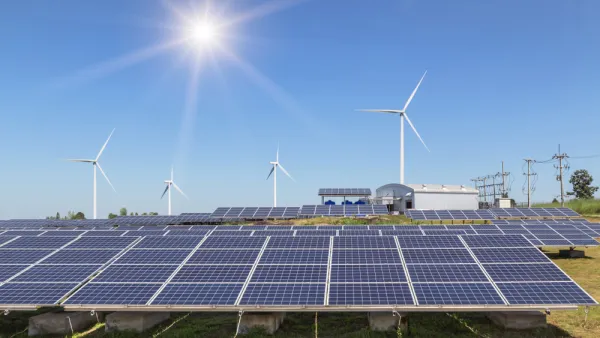
Utilities Still Catching Up to Public Opinion on Renewable Energy
Renewable energy enjoys broad public support—the utility industry is more skeptical.
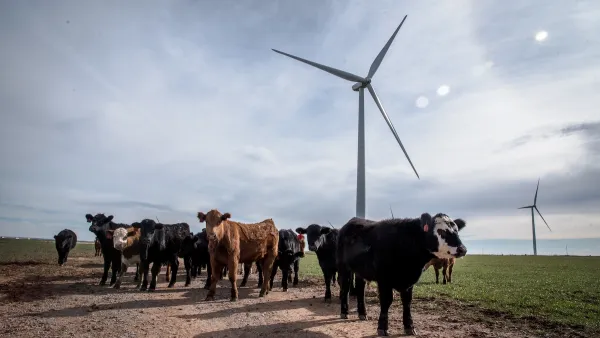
Renewable Energy Overtakes Coal for First Time
Solar and wind power generated close to a third of U.S. electricity supplies in 2024.
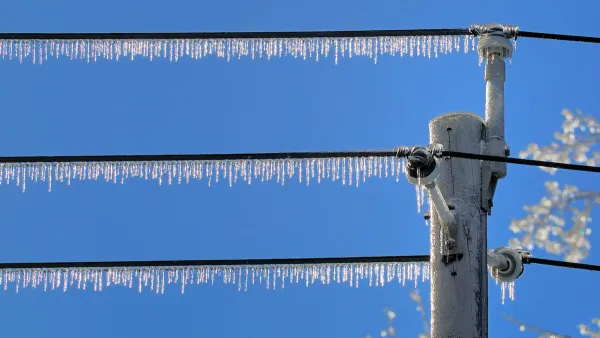
Texas Grid Holds Up to Freezing Temperatures
Efforts made to prepare the state’s infrastructure for winter storms after 2021’s disastrous freeze are paying off.

Planetizen Federal Action Tracker
A weekly monitor of how Trump’s orders and actions are impacting planners and planning in America.

The state-sanctioned urbicide of Austin
People don’t kill cities. Freeways do.

US to reduce Colorado River water deliveries to Mexico
A new Colorado Treaty amendment reduces Mexico’s Colorado River water allocation by 250,000 acre feet.

Nation's most wind-powered state turns to coal as data centers increase energy demand
For the first time in decades, Iowa has increased its generation of coal power.

NYC cools commuters with city's first rain garden above a bus stop
New York City officials say the plants in the rain garden can absorb 16 gallons of rainwater during heavy storms.

Brightline West’s future may rely on $6 billion federal loan
The company has until Nov. 2 to make a $400 million equity investment into its proposed high-speed rail line.

FREE Course: Walkable City 1: Why Walkability?
After describing his path towards focusing on walkability as the essence of good planning, Jeff Speck marches through his five principal reasons for making more walkable places.
Reinventing Malls: Planning Alchemy—Turning Gray Fields Into Gold
The course focuses on the opportunities and imperatives that shape reinvention of mall sites.

Eagle County Government
Harvard University Graduate School of Design
Nashville Planning Department
The Architects Foundation
University of Cincinnati Online
The Pocatello Development Authority
The Urban Renewal Agency of the City of Pocatello
Journal of the American Planning Association