Mass timber is called the first new way to construct tall buildings in 100 years.


"New structural systems come along rarely, and when they do, they usually wind up transforming cities," writes Justin Davidson.
The potential scale of such technological innovations is why planners should take notice of the advancements in wood construction. After millennia of two types of wood construction, architects have recently added a third technique: "sandwiching layers of wood and adhesive, yields cross-laminated timber (CLT), a kind of super-plywood that comes in immense slabs as long as a bowling lane and as thick as 12 inches."
"When steel replaced iron at the end of the 19th century, the path from the ten-story Home Insurance Building in Chicago to the Empire State Building took less than 50 years. Today, mass timber (the umbrella term for CLT and glulam) could have a similarly radical impact, because it gives architects and builders a chance to think in fresh ways," writes Davidson.
Read the full story: Imagining a Wooden Skyline

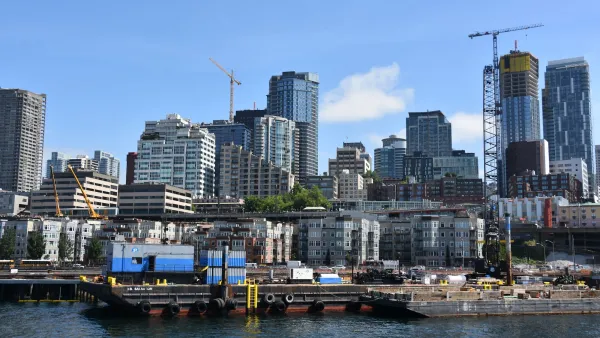
Seattle upzoning proposal seeks to boost density, support eco-friendly building materials
A city committee advanced the plan to target areas already open to multifamily development for additional density and encourage passive house and mass timber construction.

The Apartment Through History
The humble apartment, as a typology, has been with us for millennia.
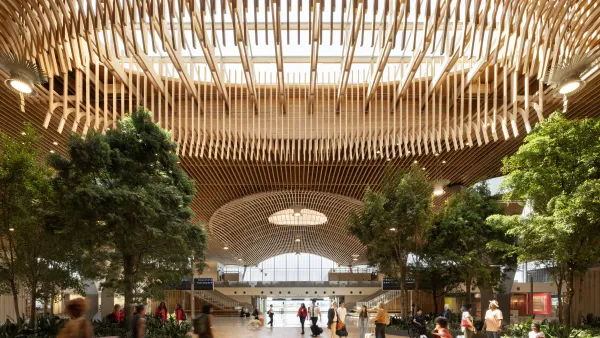
PDX International Airport’s New Terminal Is a Mass-Timber Marvel
Needing to expand to accommodate 35 million annual passengers by 2045 but constrained by Portland’s urban growth boundary, PDX had to think outside the box when planning its expansion. The result is a case study in sustainability.

Planetizen Federal Action Tracker
A weekly monitor of how Trump’s orders and actions are impacting planners and planning in America.

Amtrak, CN end decades-long dispute with eight-year agreement
The new operating agreement establishes an updated framework for the companies to work together, including processes to resolve disputes.

Northwest rail fans eager for Sept. 30 debut of Amtrak’s Airo fleet
Get ready for that new train smell and more seats. But they won’t go faster or run more frequently on the Cascades route in Washington and Oregon.

LAX SkyLink opening delayed again, contractor won’t commit to new deadline
The project was supposed to open its doors to the public in 2023.

Caltrain may slash over one-third of its stations
If Bay Area voters reject two transit tax measures, Caltrain, BART and AC Transit will see steep service cuts.

A 'dangerous' precedent: North Carolina successfully pressures communities into voting for toll roads
Two mayors resigned from the Charlotte Regional Transportation Planning Organization after it voted in favor of the toll roads.

FREE Course: Walkable City 1: Why Walkability?
After describing his path towards focusing on walkability as the essence of good planning, Jeff Speck marches through his five principal reasons for making more walkable places.
Reinventing Malls: Planning Alchemy—Turning Gray Fields Into Gold
The course focuses on the opportunities and imperatives that shape reinvention of mall sites.

City of Thousand Oaks
City of Wisconsin Rapids
Harvard University Graduate School of Design
The Architects Foundation
University of Cincinnati Online
The Pocatello Development Authority
The Urban Renewal Agency of the City of Pocatello