A new atlas explores the multiple causes of gentrification through bold graphics and data visualizations.


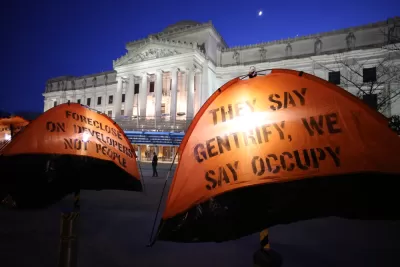
In The Atlas of Gentrification, designer Herwig Scherabon looks beyond "the migration of hipsters" to expose the nuances of gentrification in cities around the U.S. and U.K.
Inspired by the author's observations in London, Chicago, and San Francisco, the atlas also studies New York; Boston; Portland, Oregon; Los Angeles; Detroit; and Glasgow.
These cities were chosen because they each have a different issue at the core of their gentrification stories, he says; while it’s sky rocketing rents in London, it’s racial segregation in Chicago, forced evictions in San Francisco and so on. These issues make the movement, displacement and replacement of people in each city uniquely nuanced.
In the U.K., for instance, the atlas connects changes in the housing market to the rise of Margaret Thatcher. A section on the racialized income inequality in Chicago reads, "Beneath the anger lie deep racial divides, decades-old, and often the direct result of public policy."
While some primary research was conducted in Glasgow, the book relies primarily upon government data and publicly accessible research.
Scherabon has also received recognition for his visualizations of income inequality in Los Angeles and Chicago. The Atlas of Gentrification is not yet published.
Read the full story: What gentrification looks like, in lines, dots, shapes and colours

Who's Mapping Gentrification, and Where?
In these cities, data on gentrification has been compiled to build mapping tools documenting the process. The hope is to identify neighborhoods where low-income residents are at risk of displacement.

Using Yelp to Predict Gentrification
New research draws on the popular review site Yelp to predict changes in housing prices and demographics.

Anticipating Gentrification in Detroit
Where is gentrification most likely to occur in cities like Detroit? And how can that data guide policy? A new report provides some insight.

Planetizen Federal Action Tracker
A weekly monitor of how Trump’s orders and actions are impacting planners and planning in America.

Amtrak, CN end decades-long dispute with eight-year agreement
The new operating agreement establishes an updated framework for the companies to work together, including processes to resolve disputes.

Judges permit Denver to divert 77,000 acre feet from the Colorado River for reservoir expansion
Overuse and climate change have caused the Colorado River’s water levels to plummet.

NYC DOT wants faster, more permanent street upgrades
The city is examining ways to build more concrete infrastructure without getting entangled in 'decades-long' projects.

'Something we’ve never seen before:' rising utility rates could strain city finances nationwide
Data centers, climate change and other factors have caused utility rates in the United States to increase by 38% since 2020.

Trump to overrule local leaders, lease millions of acres of America’s Pacific Island territories’ seafloors to mining companies
International law says that the Indigenous people of America’s territories have a right to prior and informed consent regarding projects that impact their countries.

FREE Course: Walkable City 1: Why Walkability?
After describing his path towards focusing on walkability as the essence of good planning, Jeff Speck marches through his five principal reasons for making more walkable places.
Reinventing Malls: Planning Alchemy—Turning Gray Fields Into Gold
The course focuses on the opportunities and imperatives that shape reinvention of mall sites.

Harvard University Graduate School of Design
KFH Group Inc.
Greater Baltimore Committee
The Architects Foundation
University of Cincinnati Online
The Pocatello Development Authority
The Urban Renewal Agency of the City of Pocatello