We talked to Barcelona's mobility guru, Mercedes Vidal, about how the high pollution levels that are pushing the city to rethink heavy traffic flows, provide faster more efficient public transport and hike up parking fees.


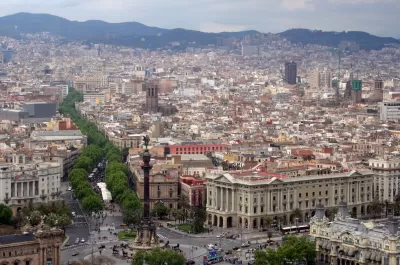
Barcelona has a serious pollution problem. While the city only exceeds the limits imposed by European regulations a few days per year, on any given day 44 percent of the population is exposed to NO2 levels that exceed the European rules. It has been estimated that the high pollution in Barcelona causes about 3,500 premature deaths each year.
While pollution was not a high priority for the city’s previous administration, former mayor Xavier Trias, with the support of most of the political groups in the city council, approved the new Urban Mobility Plan, which gives the new government the tools to tackle traffic, pollution, and reclaim road space for pedestrian use.
According to Vidal, the basis of the Mobility Plan is the Superilles (Catalan for Superblocks). After nearly 30 years of planning and many political hurdles, the superblocks are finally starting to be deployed in Barcelona, with the first one opened in the Poble Nou district in September. Over the next three years, Vidal says, the plan is to open around 10 new superblocks in different areas of the city. “We are going to increase space for pedestrians with superblocks and other pacifying strategies,” she said.
FULL STORY: Barcelona tackles its traffic, pollution with parking policies and superblocks

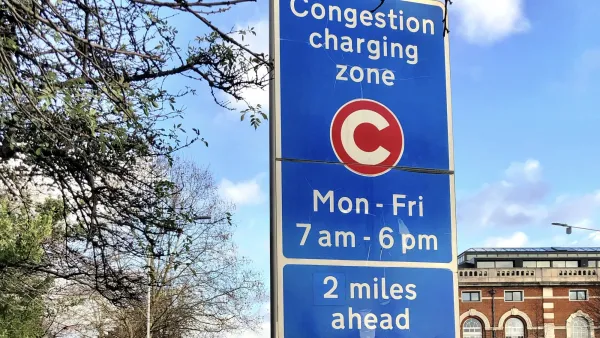
Report from London: Pollution Pricing Reduces Tailpipe Emissions
A new report shows that London's new emission fee, an additional driver charge that became operational 24/7 in April for all motor vehicles not meeting Euro standards that enter the congestion charge zone, has cut nitrogen oxide emissions by 31%.
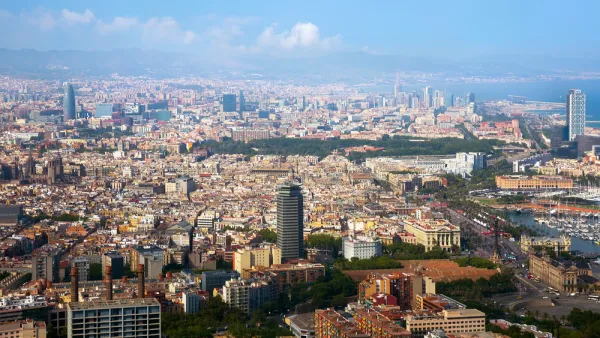
Barcelona's Ambitious Plan to Become a Post-Car City
Barcelona is planning to expand on its initial superblock experiment in an attempt to ease the stranglehold of car congestion and air pollution gripping the dense city.
Barcelona Needs Swift Action Against Pollution
The capital of Catalunya is suffering from persistent high pollution due to car density and the largest number of motorcycles in Europe. City administrators, aware of the situation, have been unwilling to take any action that would upset drivers.

Planetizen Federal Action Tracker
A weekly monitor of how Trump’s orders and actions are impacting planners and planning in America.

The state-sanctioned urbicide of Austin
People don’t kill cities. Freeways do.

US to reduce Colorado River water deliveries to Mexico
A new Colorado Treaty amendment reduces Mexico’s Colorado River water allocation by 250,000 acre feet.

Mamdani overhauls NYC's Vision Zero plan with 100 new policy goals
The overhaul aims to reduce traffic deaths and make streets safer for pedestrians, cyclists and drivers through lower speed limits, new safety infrastructure and more.

Amtrak not solely to blame for New Jersey commuter rail's unreliability, report finds
A new study from the Garden State Initiative found that NJ Transit’s budget grew 20% across a 4 year period, but reliability declined significantly over the same period.

EPA erases limits on planet-warming pollution from power plants
Under Monday’s plan, power plants would still have some limits on how much mercury, arsenic and other contaminants they can emit.

FREE Course: Walkable City 1: Why Walkability?
After describing his path towards focusing on walkability as the essence of good planning, Jeff Speck marches through his five principal reasons for making more walkable places.
Reinventing Malls: Planning Alchemy—Turning Gray Fields Into Gold
The course focuses on the opportunities and imperatives that shape reinvention of mall sites.

Eagle County Government
Harvard University Graduate School of Design
Nashville Planning Department
The Architects Foundation
University of Cincinnati Online
The Pocatello Development Authority
The Urban Renewal Agency of the City of Pocatello
Journal of the American Planning Association