A new visualization from the Smithsonian's National Museum of Natural History shows how the earth "breathes"—in the form of volcanic eruptions, earthquakes, and emissions.


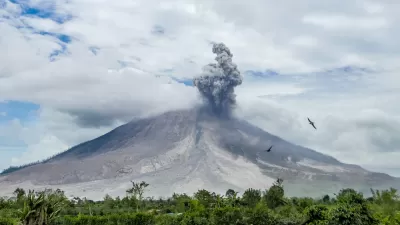
"Pretend that you're an alien in a spacecraft above Earth. You are looking down and watching the pulse of planet Earth. The breath, the respiration," says Elizabeth Cottrell, as quoted in an article by Sarah Kaplan.
Cottrell is a research geologist who directs the Global Volcanism Program at the National Museum of Natural History. She's describing the action of a new visualization of the planet's eruptions, earthquakes, and gas emissions. As she rotates the globe with a click of her mouse, blue dots signifying tremors and red triangles for volcanoes flare up and fade away, carving the planet's surface in predictable patterns. The animation emits a 'ping"'with each earthshaking event," writes Kaplan to explain the visualization.
The article provides additional discussion of why the visualization could be considered "cool" or "fascinating" rather than terrifying (especially for those of us living in California).
Read the full story: Watch Earth pulse with earthquakes and eruptions in this stunning visualization
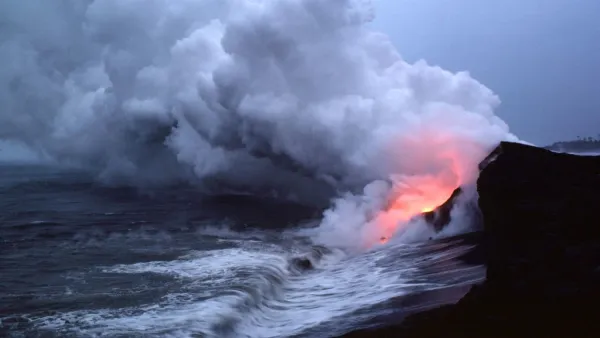
Friday Eye Candy: Mount Kilauea’s Volcanic Activity, Past and Present
Newly released images from NASA's terra satellite chronicles the history of lava on Hawaii's Big Island.
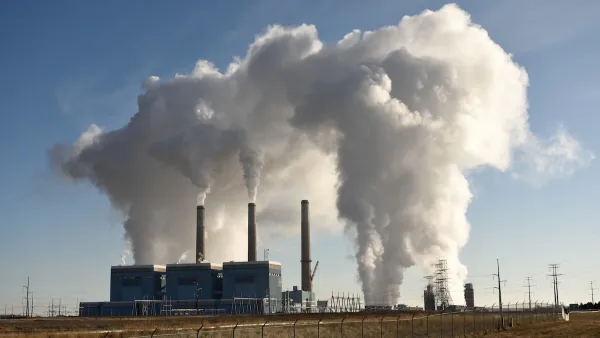
25 states, cities sue the EPA over erased power plant emissions limits
The coalition also intends to sue the EPA for not regulating emissions from gas-fired power plants.
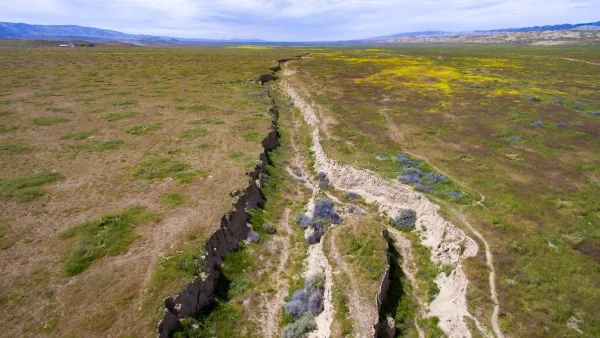
San Andreas fault at highest stress level in a millennium
A new study shows that the West Coast's major fault system is in 'a critically loaded state.'

Planetizen Federal Action Tracker
A weekly monitor of how Trump’s orders and actions are impacting planners and planning in America.

Eastern Nebraska is running out of electricity
Data centers and electrification are straining eastern Nebraska’s grid, throttling economic development.

Move over, LA: St. Louis gears up for Olympics, invests millions in downtown redevelopment
The Missouri city will host the 2028 Olympic soccer group stage and knockout matches.

Dallas releases zoning code overhaul to officials
The drafted overhaul is over 400 pages long.

NYC renovations for dangerous, ‘mercilessly crammed’ street delayed until 2027
Construction was supposed to begin this fall.

San Diego’s Midway Rising project gets greenlight from city council
The project looks to become the largest affordable housing development in California's history.

FREE Course: Walkable City 1: Why Walkability?
After describing his path towards focusing on walkability as the essence of good planning, Jeff Speck marches through his five principal reasons for making more walkable places.
Reinventing Malls: Planning Alchemy—Turning Gray Fields Into Gold
The course focuses on the opportunities and imperatives that shape reinvention of mall sites.

City of Rosemead
Rutgers University, Edward J. Bloustein School of Planning and Public Policy
One Hundred Miles
University of Michigan School for Environment and Sustainability (SEAS)
Hunter College, City University of New York (CUNY)
The Architects Foundation
City of Cambridge
The Pocatello Development Authority
The Urban Renewal Agency of the City of Pocatello