Some good news from a state that has seen far too much bad news this year: local officials report that the trees of New Orleans are making a surprisingly strong comeback after devastation wrought by Hurricane Katrina.


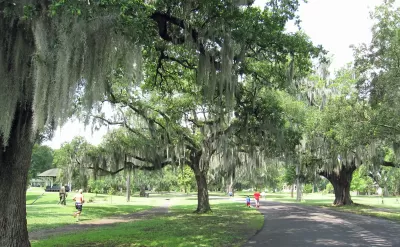
"An estimated 320 million trees are thought to have been damaged or killed in Mississippi and Louisiana after Katrina — an unprecedented loss that local researchers in 2007 estimated would change the area’s ecosystem for the worse for generations to come," according to an article by Della Hasselle. "Fast-forward to 2016, however, and officials with New Orleans’ numerous organizations dedicated to protecting green spaces are celebrating what they call an unanticipated comeback for the city’s trees."
City organizations and nonprofit groups have been working hard for more than a decade to restore the city and region's green spaces. According to Hasselle, "the latest tallies show about half of the trees lost to Katrina have been replanted in public spaces alone..." And although a "grand total is difficult to calculate…the number of newly planted trees is even higher" because of the many trees planted on private property, like the yards of residents.
The article details the hard work of the city's Department of Parks and Parkways and organizations like Parkway Partners and the nonprofit NOLA Tree Project in overcoming the many environmental and biological threats that ravaged the region's trees and other plant life after Hurricane Katrina.
Planetizen covered the terrible effects of Hurricane Katrina on the city of New Orlean's greenery in 2007, as well some of the resurgence of the city's parks and open spaces in 2014.
Read the full story: New Orleans green spaces experiencing unanticipated post-Katrina comeback
New Orleans Seeks Consultants for $8M Tree Planting Initiative
The city seeks consultancy firms to help implement an $8 million USDA Urban and Community Forestry Grant, advancing its goal of planting 40,000 trees by 2030 and strengthening urban sustainability and resilience.
A Tree Grows in Pigeon Town
I don’t know what it is about New Orleans that makes me wax rhapsodic. But something about the city makes everyday life look poetic. I returned to the Crescent City last week after having last visited just seven months ago, when a tree planting
Satellite Imagery Reveals Katrina's 'Unprecedented' Impact
According to new analysis of satellite data, Hurricane Katrina destroyed 320 million trees. Dead trees will release about 367 million tons of carbon dioxide as they decompose.

Planetizen Federal Action Tracker
A weekly monitor of how Trump’s orders and actions are impacting planners and planning in America.

Eastern Nebraska is running out of electricity
Data centers and electrification are straining eastern Nebraska’s grid, throttling economic development.

Move over, LA: St. Louis gears up for Olympics, invests millions in downtown redevelopment
The Missouri city will host the 2028 Olympic soccer group stage and knockout matches.

Dallas releases zoning code overhaul to officials
The drafted overhaul is over 400 pages long.

NYC renovations for dangerous, ‘mercilessly crammed’ street delayed until 2027
Construction was supposed to begin this fall.

San Diego’s Midway Rising project gets greenlight from city council
The project looks to become the largest affordable housing development in California's history.

FREE Course: Walkable City 1: Why Walkability?
After describing his path towards focusing on walkability as the essence of good planning, Jeff Speck marches through his five principal reasons for making more walkable places.
Reinventing Malls: Planning Alchemy—Turning Gray Fields Into Gold
The course focuses on the opportunities and imperatives that shape reinvention of mall sites.

City of Rosemead
Rutgers University, Edward J. Bloustein School of Planning and Public Policy
One Hundred Miles
University of Michigan School for Environment and Sustainability (SEAS)
Hunter College, City University of New York (CUNY)
The Architects Foundation
City of Cambridge
The Pocatello Development Authority
The Urban Renewal Agency of the City of Pocatello