The scale of Tesla's vision for the Gigafactory, already under construction in Storey County, Nevada, is unparalleled.


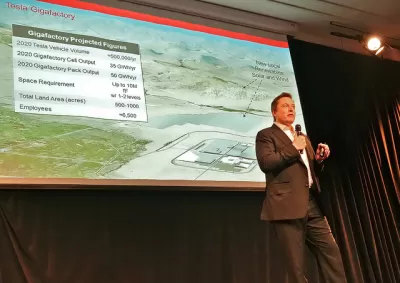
Tesla began construction on the Gigafactory earlier this summer, after announcing the location for the enormous battery-making facility Nevada almost two years ago exactly. Although construction is expected to last for several years, the project is already beginning to take shape, and an article by Pat Finn for Architizer puts the whole operation in perspective.
First and foremost, writes Finn, "[t]his structure’s standout feature is its size: The completed Gigafactory is projected to be the largest building in the world by footprint." More details on that fact are included in a list of ten "amazing" facts about the Gigafactory, including its footprint on a 3,200-acre lot and containing 5.8 million square feet (539,000 square meters) of operational space.
Another important fact about the Gigafactory is that operations will commence long before construction is complete. Although only 14 percent of the facility is complete, it's enough to begin operations, explains Finn. "Construction will continue as operations go ahead in the completed wings."
Read the full story: 10 Facts About Elon Musk’s Gigafactory, the Soon-To-Be Largest Building in the World
Nevada's $1.2 Billion Investment in Tesla Predicted to Have $100 Billion Impact
The generous incentives granted the electric car company for securing the $5 billion factory will yield disproportionate economic benefits, according to Gov. Brian Sandoval, for a state suffering high unemployment and a lack of economic diversity.
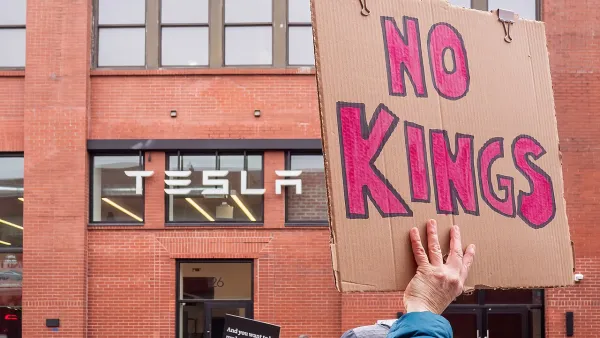
Dear Tesla Driver: “It’s not You, It’s Him.”
Amidst a booming bumper sticker industry, one writer offers solace to those asking, “Does this car make me look fascist?”

Tesla’s Self-Driving Still Not Working in Las Vegas Tunnels
The Boring Company had previously said it was working with Tesla to use its self-driving system in its tunnels below Las Vegas to save costs on drivers, but two years later, there is no clear timeline for “full autonomy.”

Planetizen Federal Action Tracker
A weekly monitor of how Trump’s orders and actions are impacting planners and planning in America.

Washington state to charge fee to drivers with fuel-efficient cars
Revenue from the fee will go towards supporting the state’s highways.

Illinois considers spending $1 billion in taxpayer money on data center
A quantum computing campus and data center are currently under construction in Chicago.

Did data centers change how voters cast their ballots?
Texas, Ohio, and Georgia all flipped party control. But in rural counties, the effect of local data centers was mixed.

Amtrak invests in eight new Airo trainsets
The new trainsets will begin serving passengers in 2031.

HUD to end aid for mixed-immigration-status households
The new rule is projected to impact 80,000 people, nearly half of whom are children.

FREE Course: Walkable City 1: Why Walkability?
After describing his path towards focusing on walkability as the essence of good planning, Jeff Speck marches through his five principal reasons for making more walkable places.
Reinventing Malls: Planning Alchemy—Turning Gray Fields Into Gold
The course focuses on the opportunities and imperatives that shape reinvention of mall sites.

City of Charlotte
City of Rosemead
Rutgers University, Edward J. Bloustein School of Planning and Public Policy
University of Michigan School for Environment and Sustainability (SEAS)
Hunter College, City University of New York (CUNY)
The Architects Foundation
University District Partnership