The National League of Cities is preparing for a future where cities will need to regulate the use of airspace by commercial drones.


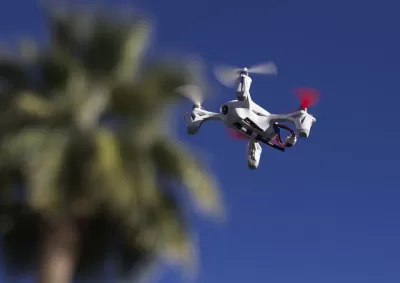
"While fully self-driving cars may still be a decade or so away, remotely piloted and even automated drones are already here," according to an article Elias Stahl, and it's time for cities to prepare for the expanded use of drones.
According to Stahl, the Federal Aviation Administration released regulations for the use of drones in U.S. airspace in June in anticipation of the number of drones growing "from 2.5 million in 2016 to 7 million by 2020…" But those federal regulations "leave the bulk of enforcement and regulation to local and state government."
There are already examples of cities deploying drones for their own purposes, but as with many other forms of mobility, innovation so far is outpacing regulation. To advance the role of cities in maintaining control of their airspace, the National League of Cities released a new "Cities and Drones" [pdf] guide for municipalities. "The challenge for local officials will be crafting policy and regulations that enable this drone technology to serve their cities best, embracing innovation, while still considering the safety and privacy concerns of their residents," according to Stahl.
Read the full story: Drones Will Have an Impact on Your City. Here’s What You Need to Know.

Could You Pass the Drone License Test?
The new exam is required nationwide for commercial use of drones.
A New Era for Drone Aviation
New rules for commercial drone aviation went into effect on August 29, clearing the way for rapid adoption of the technology.
Mapping Drone No-Fly Zones
While the FAA sorts out regulations for commercial drone flights in the United States, cities, states, and other groups have already restricted the flight of drones. Mapbox is working to compile a comprehensive map of prohibited air space.

Planetizen Federal Action Tracker
A weekly monitor of how Trump’s orders and actions are impacting planners and planning in America.

California plans to bury El Niño’s downpour
If the state plays its cards right, it may be able to store a billion acre-feet of El Niño’s water in aquifers.

Desperate measures: Advocates weigh draining Lake Powell to fill Colorado River
Draining the reservoir could reduce evaporation losses by a couple hundred thousand acre-feet.

Housing is the top priority of Seattle’s sole new councilmember
Jenks campaigned on building 1,000 new units of affordable housing.

New tax cuts may slash $1.5 billion in funding for Miami transit, public parks
Amendment 3 will save Miami-Dade homeowners $2,700 in 2028.

Arizona, Wisconsin, Pennsylvania hope to finally advance climate goals post-midterms
The three states have spent years under Republican or divided control.

FREE Course: Walkable City 1: Why Walkability?
After describing his path towards focusing on walkability as the essence of good planning, Jeff Speck marches through his five principal reasons for making more walkable places.
Reinventing Malls: Planning Alchemy—Turning Gray Fields Into Gold
The course focuses on the opportunities and imperatives that shape reinvention of mall sites.

City of Rosemead
Rutgers University, Edward J. Bloustein School of Planning and Public Policy
One Hundred Miles
University of Michigan School for Environment and Sustainability (SEAS)
Hunter College, City University of New York (CUNY)
The Architects Foundation
City of Cambridge
Montrose County
The Pocatello Development Authority