In the latest news, chemical company Chemours will remain in downtown Wilmington, Delaware's largest city. In June, McDonald's decamped from Chicago's suburbs for downtown. This latest corporate trend is the topic of a New York Times article.


"Chemours will keep its global headquarters in downtown Wilmington, preventing nearly 1,000 jobs from leaving Delaware," reports Jeff Mordock for The News Journal on August 2.
By keeping those employees in and around Wilmington, Chemours prevented what could have been a devastating blow to the city's economy. In May, Bernice Whaley, director of economic development for the state, said the loss of Chemours could cost the state 3,409 direct and indirect jobs along with $554 million of revenue.
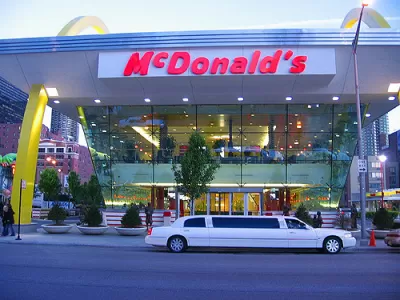
In June, McDonald's decided to decamp from Oak Brook, Ill, for downtown Chicago, "part of a trend in which many well-known suburban companies, including Kraft Heinz, Motorola Mobility and Motorola Solutions, have been moving their headquarters downtown," reported Ryan Ori for Chicago Real Estate Daily on June 6. "Many others, including Allstate, have shifted some workers to new downtown offices from the suburbs."
"The gravitational pull of the city is as irresistible to McDonald's today as the forces that propelled it away were 45 years ago," reported Phil Rosenthal for The Chicago Tribune on June 14.
The gravitational pull of the city is as irresistible to McDonald's today as the forces that propelled it away were 45 years ago.
Earlier this year, General Electric chose the 'back to the city' route by deciding to relocate from Fairfield, Conn. to Boston's Seaport District. Posted last January:
"Labor market economist Enrico Moretti at UC Berkeley says GE's move is reversing an old trend," writes [WBUR's Curt Nickisch for NPR]. "Companies left troubled cities in the '70s and '80s for manicured suburban office parks. Now they're moving back into revitalized urban centers."
GE's relocation begins later this month.
David J. Collis, who teaches corporate strategy at Harvard Business School, repeated the narrative to The New York Times on August 1.
“Part of it is that cities are more attractive places to live than they were 30 years ago and are more willing to provide tax incentives, and young people want to be there,” said Collis.
And from the Chicago Tribune:
"Just months after the [McDonald's] 1971 relocation [from Chicago to Oak Brook, Ill.], an executive who oversaw the relocation told the Tribune that there had been 100 percent turnover every two years among office staff when McDonald's was based downtown."
"Unlike Chicago and Boston, Wilmington’s urban renaissance remains a work in progress, and Chemours was very close to moving to a new home in southern New Jersey or suburban Philadelphia, despite the DuPont family’s deep roots in Wilmington and the state of Delaware," reports economics writer, Nelson D. Schwartz, from Wilmington for The New York Times.
“We are going through a change in our work force, and we wanted to be where we could attract millennials,” the company’s chief executive, Mark Vergnano, said. “This is a group that likes to be in an urban setting, with access to public transportation. They don’t want to be confined to a building with a cafeteria or be next door to a shopping center.”
Richard Florida weighs in
Besides blue-chip icons like G.E., McDonald’s and Kraft Heinz, venture capital investors and start-ups are increasingly looking to urban centers, particularly on the West Coast, said Richard Florida, an urban theorist and professor at the University of Toronto.
“The period of companies moving to suburbs and edge cities has ebbed, but I had thought that start-ups would continue to locate in so-called nerdistans, like office parks,” he said. But a recent study by Mr. Florida showed more than half of new venture capital flowing into urban neighborhoods, with two San Francisco ZIP codes garnering more than $1 billion each, he said.
And Joel Kotkin
Over all, there has been a slight pickup in employment and population in the central core of big cities, said Joel Kotkin, an author and urban geographer at Chapman University in California. But many close-in suburbs and neighborhoods are withering, particularly in the Northeast. More distant suburbs and exurbs are still thriving, especially in the Sun Belt.
“The elite functions are going downtown,” Mr. Kotkin said. “But at the same time, middle-management jobs are moving to the suburbs in places like Dallas, if they’re not leaving the country entirely.”
Back to Wilmington and Chemours' decision to stay
Jeffrey C. Flynn, director of economic development for Wilmington, said that the advantages of city life ultimately proved to be a compelling selling point.
“We’re not Philadelphia,” Mr. Flynn said, “but we do have an urban atmosphere.”
Hat tip to Kenyon Karl.
Read the full story: Why Corporate America Is Leaving the Suburbs for the City


Kotkin and Florida Team Up to Agree on Devolution
"Vive le difference!" reads the rallying cry if an article co-authored by Richard Florida and Joel Kotkin.
In Chicago, Suburbs Becoming More Liberal
Chicago suburban residents were long more conservative than the average Illinois voter but, over the last two decades, that has changed.
If Housing Affordability Is Top Concern, Let Metro Regions Sprawl
Research from BuildZoom, a San Francisco-based contractors' website, shows that housing affordability increases with a region's ability to build outwards, as opposed to upwards. Densification largely has not accompanied efforts to curb sprawl.

Planetizen Federal Action Tracker
A weekly monitor of how Trump’s orders and actions are impacting planners and planning in America.

Northwest rail fans eager for Sept. 30 debut of Amtrak’s Airo fleet
Get ready for that new train smell and more seats. But they won’t go faster or run more frequently on the Cascades route in Washington and Oregon.

Trump is considering data centers on 6 states' public land — some state officials say they had no idea
If the administration approves the proposed projects, data center and data center-related developments will cover 17,600 acres of public land.

After decades of planning, Sacramento gains new light rail station
Trains will arrive every 15 minutes during peak hours and every 30 minutes during non-peak hours.

Massive tunnel-boring machine breaks ground on Gateway Project
The Trump administration revoked funding for the project in October 2025, and then restored it earlier this year.

Airo trainsets begin service on Amtrak Cascades route
The trains feature panoramic windows, complementary wifi and over 300 seats per train set.

FREE Course: Walkable City 1: Why Walkability?
After describing his path towards focusing on walkability as the essence of good planning, Jeff Speck marches through his five principal reasons for making more walkable places.
Reinventing Malls: Planning Alchemy—Turning Gray Fields Into Gold
The course focuses on the opportunities and imperatives that shape reinvention of mall sites.

City of Thousand Oaks
City of Wisconsin Rapids
Harvard University Graduate School of Design
The Architects Foundation
University of Cincinnati Online
Northern Illinois Transit Authority (NITA)
The Pocatello Development Authority
The Urban Renewal Agency of the City of Pocatello