Barcelona wants to be the world’s best city for people. To reclaim the public space and community living that residents lost to cars over the last century, the city is transforming mobility and access to public space by introducing the superblock.


When Catalan urban planner Ildefons Cerdà i Sunyer, back in the 1850s, designed the Eixample, the expansion of Barcelona outside the old city walls, he envisioned a city based on community living, where people could interact on wide streets, with a wealth of public and private gardens, and where transportation of people and goods wouldn’t dominate public space.
What Cerdà could not foresee in his plan, approved by the city on 1859, was the arrival of the automobile and the resulting transformation of mobility that took place in the middle of the 20th century.
The Barcelona government, however, has a new plan, which aims to reclaim most of the streets for the community, without reducing traffic flow. The plan is modeled on the original idea of the Eixample, and expands the area into “Super Illes”, the Catalan term for Superblocks.
Read the full story: Superblocks, Barcelona Answer to Car-Centric City

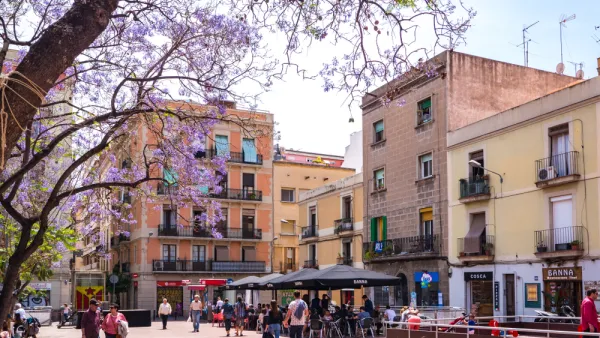
Could Los Angeles Emulate Barcelona’s ‘Superblocks’?
A proposal in the city council could bring the ‘superblock’ model to Los Angeles, opening up neighborhood streets to more biking, walking, and public amenities.
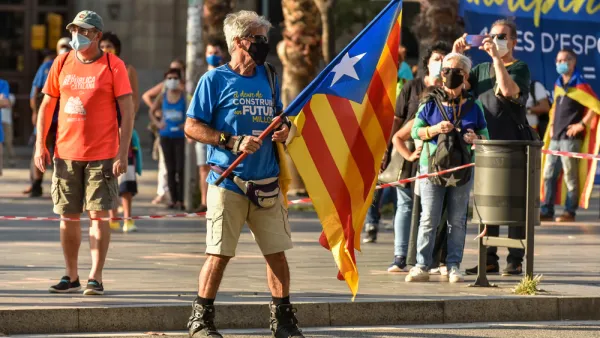
Barcelona's Long-Term, Pedestrian-First Plan Continues with the 'Barcelona Superblock'
Mayor Ada Colau announced the next step in Barcelona's plan to convert the city center into a "new city for the present and the future."
What Would Cities Look Like if They Were Designed by Women?
Cities are built by men, and so too often urban design does not reflect the needs, perspectives, and realities of women.

Planetizen Federal Action Tracker
A weekly monitor of how Trump’s orders and actions are impacting planners and planning in America.

Amtrak, CN end decades-long dispute with eight-year agreement
The new operating agreement establishes an updated framework for the companies to work together, including processes to resolve disputes.

Judges permit Denver to divert 77,000 acre feet from the Colorado River for reservoir expansion
Overuse and climate change have caused the Colorado River’s water levels to plummet.

Idaho may see an 18% drop in federal surface transit funding — the largest estimated cut in the US
Transit systems in rural communities are much more reliant on federal funding to provide their services.

How ‘post-disaster gentrification’ alters neighborhoods after natural calamities
After hurricanes, fires or other calamities, the original residents of a community are often replaced by younger, wealthier residents.

Maryland local governments examine if they should have more power to raise property taxes
Maryland’s housing market is out of reach for the majority of moderate-income residents.

FREE Course: Walkable City 1: Why Walkability?
After describing his path towards focusing on walkability as the essence of good planning, Jeff Speck marches through his five principal reasons for making more walkable places.
Reinventing Malls: Planning Alchemy—Turning Gray Fields Into Gold
The course focuses on the opportunities and imperatives that shape reinvention of mall sites.

Harvard University Graduate School of Design
KFH Group Inc.
Greater Baltimore Committee
The Architects Foundation
University of Cincinnati Online
The Pocatello Development Authority
The Urban Renewal Agency of the City of Pocatello