Last week the Los Angeles City Council and Santa Clara County Board of Supervisors approved housing initiatives. "Build Better LA" requires large developments to have affordable units. Silicon Valley voters will vote on a $950 million housing bond.


Responding to the housing crisis in California, the council and board voted on the same day, June 21, to ask voters in their respective jurisdictions to address the problem by voting to increase the supply of affordable housing, though in very different ways.
The Los Angeles City Council voted 13-1 to place the "Build Better LA" Affordable Housing and Development Initiative on the November ballot, writes Dennis Romero for LA Weekly. The measure was originally unveiled by a coalition of labor unions and housing advocates last February.
"If approved, the measure would require developers to include affordable housing units in large projects for which they seek special permission to skirt zoning codes or to build beyond density and height restrictions," writes Elijah Chiland for Curbed Los Angeles.
It would also require that 30 percent of construction workers on these projects be hired locally, and that 10 percent be from areas where the median income is under $40,000. Or, developers could avoid the affordable housing rule altogether by electing to pay a fee instead.
A policy summary [PDF] includes additional requirements as they relate to Transit Oriented Communities, Affordable Housing Trust Fund, Parking, and Density Bonus. According to the summary, the initiative "[w]ould ensure that parking requirements can be reduced for projects that include affordable housing and job standards, thus ensuring the integrity of the density bonus program."
The city housing initiative will appear on the ballot with what amounts to a half-cent county transportation sales tax measure.
As posted last March, proponents of a competing housing measure to restrict large developments, the "Neighborhood Integrity Initiative," are aiming for the March 2017 ballot.
About 400 miles north of Los Angeles, the five-member Board of Supervisors of Santa Clara County unanimously voted to place a 30-year, $950 million affordable housing bond before voters in northern California's most populous county.
“For the first time in recent memory, voters see the most important problem facing Santa Clara County as housing,” [Supervisor Cindy Chavez, a cosponsor of the measure said in a press release]. “We have nearly five thousand people living on our streets and in our creeks, and the housing for them does not exist. This is why this bond measure is essential.”
[T]he $950 million General Obligation Bond would not affect the County’s General Fund, but would raise property taxes based on the value of the property for tax purposes. The owner of a home valued at $500,000 by the Tax Assessor’s Office, for example, would pay $12.66 per $100,000 of assessed valuation, or $63.30 a year more in property taxes.
Funds would be allocated to housing meant for various levels of median income levels, including "up to $50 million for Moderate Income residents who are first-time homebuyers."
"The majority of the funds -- $750 million -- would go toward those considered to be in the 'extremely low income' category, often meaning homeless or on the verge of being homeless," writes Eric Kurhi in The Mercury News
The measure will need to pass by a two-thirds margin because the funds are targeted for specific purposes, as was not the case with a June sales tax measure in San José, the county seat, that passed with 61 percent of the vote.
The property tax measure will appear on the county ballot with a half-cent sales tax measure to extend BART under San Jose to the Santa Clara Caltrain Station.
In addition, as posted earlier this month, San Francisco voters will decide on initiatives that deal with increasing heights for affordable housing, legalizing construction of inlaw (accessory dwelling) units, and removal of tent encampments.
FULL STORY: Housing Initiatives to Appear on Northern and Southern California Ballots in November


L.A.'s Anti-Density Advocate Still Hopes to Make Planners 'Uncomfortable'
One of the main forces behind Measure S spills her thoughts on Hollywood, homelessness and what’s wrong with planning in Los Angeles.
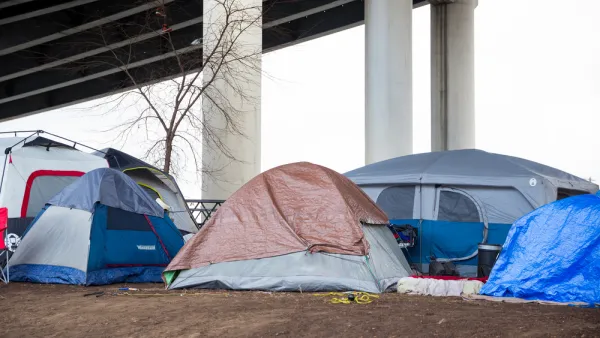
San Francisco Voters Express Frustration with Tent Living
Voters appear to have passed the most contentious ballot measure in San Francisco, Proposition Q, that allows city workers to remove tent encampments if shelter is available. Voters in other Bay Area counties passed taxes for affordable housing.
Competing Land Use Initiatives on the November Ballot in Los Angeles
Move over "Neighborhood Integrity Initiative." The "Build Better LA" initiative will compete for the soul of the city in the November election.

Planetizen Federal Action Tracker
A weekly monitor of how Trump’s orders and actions are impacting planners and planning in America.

The state-sanctioned urbicide of Austin
People don’t kill cities. Freeways do.

US to reduce Colorado River water deliveries to Mexico
A new Colorado Treaty amendment reduces Mexico’s Colorado River water allocation by 250,000 acre feet.

Mamdani overhauls NYC's Vision Zero plan with 100 new policy goals
The overhaul aims to reduce traffic deaths and make streets safer for pedestrians, cyclists and drivers through lower speed limits, new safety infrastructure and more.

Amtrak not solely to blame for New Jersey commuter rail's unreliability, report finds
A new study from the Garden State Initiative found that NJ Transit’s budget grew 20% across a 4 year period, but reliability declined significantly over the same period.

EPA erases limits on planet-warming pollution from power plants
Under Monday’s plan, power plants would still have some limits on how much mercury, arsenic and other contaminants they can emit.

FREE Course: Walkable City 1: Why Walkability?
After describing his path towards focusing on walkability as the essence of good planning, Jeff Speck marches through his five principal reasons for making more walkable places.
Reinventing Malls: Planning Alchemy—Turning Gray Fields Into Gold
The course focuses on the opportunities and imperatives that shape reinvention of mall sites.

Eagle County Government
Harvard University Graduate School of Design
Nashville Planning Department
The Architects Foundation
University of Cincinnati Online
The Pocatello Development Authority
The Urban Renewal Agency of the City of Pocatello
Journal of the American Planning Association