For a little while there, it looked like the Texas Ranger were going urban.


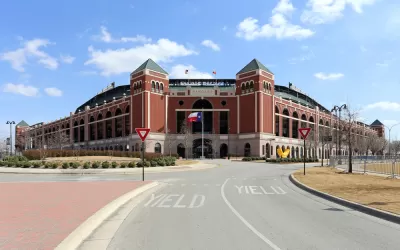
Marice Richter and Robert Francis report on a big announcement by the city of Arlington, Texas, and the Texas Ranger Major League Baseball team: "The city of Arlington and the Texas Rangers announced plans to replace Globe Life Park with a new 'world class' stadium that will have a retractable roof and air conditioning."
The announcement sets the stage for Arlington to keep the Rangers in Arlington through 2054, blocking efforts to move the team to Dallas. As for the administrative details of the deal, the article notes that "[the] Arlington City Council will consider the project along with a new private-public partnership with the Rangers at its meeting on Tuesday [May 24]." The stadium will also require Arlington voters to approve an extension of "a half-cent sales tax that was approved to help finance Cowboys Stadium and $500 million [for] construction of the new stadium."
Read the full story: Arlington, Rangers reveal new $1 billion stadium plan

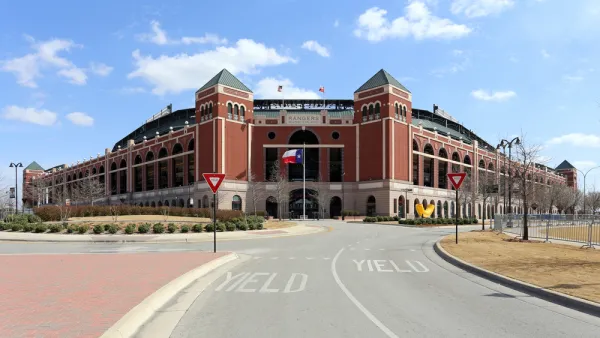
Report: Arlington Baseball Stadium Likely to Cost Taxpayers More Than Promised
An investigation by WFAA-TV finds that the 50-50 deal promised by city officials to build a new baseball stadium in Arlington is more likely going to end up being an 80-20 deal.
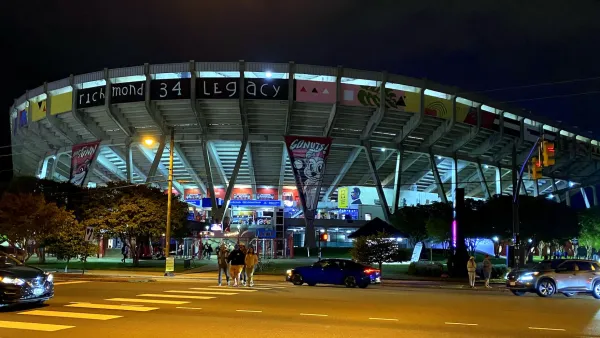
Richmond's new 'stadium district' will include hundreds of homes, offices, jobs
The city is planning for a neighborhood revival in the area around a new baseball stadium.
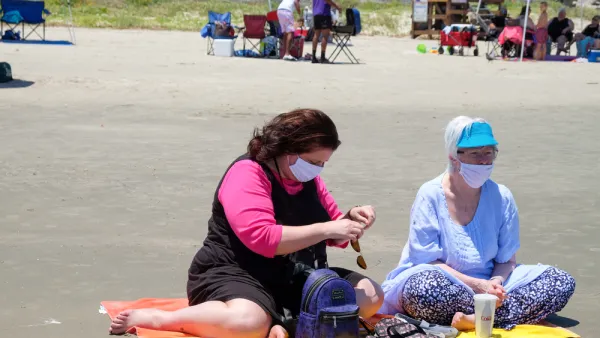
City vs. State: Mayors Want Power to Require Mask Wearing to Slow Coronavirus Spread
Coronavirus cases are surging in the Lone Star State's urban areas, so mayors of nine of its largest cities asked Greg Abbott for the power to mandate the wearing of masks or facial coverings, prohibited by executive order, to slow viral spread.

Planetizen Federal Action Tracker
A weekly monitor of how Trump’s orders and actions are impacting planners and planning in America.

Amtrak, CN end decades-long dispute with eight-year agreement
The new operating agreement establishes an updated framework for the companies to work together, including processes to resolve disputes.

Judges permit Denver to divert 77,000 acre feet from the Colorado River for reservoir expansion
Overuse and climate change have caused the Colorado River’s water levels to plummet.

Boston has spent millions making the Green Line more accessible — and there’s no end in sight
While the city has invested millions into expanding and adding platforms to the Green Line to make it more accessible, new train cars set to arrive next year will be too tall for disabled passengers to board without raising the current platforms.

Idaho may see an 18% drop in federal surface transit funding — the largest estimated cut in the US
Transit systems in rural communities are much more reliant on federal funding to provide their services.

How ‘post-disaster gentrification’ alters neighborhoods after natural calamities
After hurricanes, fires or other calamities, the original residents of a community are often replaced by younger, wealthier residents.

FREE Course: Walkable City 1: Why Walkability?
After describing his path towards focusing on walkability as the essence of good planning, Jeff Speck marches through his five principal reasons for making more walkable places.
Reinventing Malls: Planning Alchemy—Turning Gray Fields Into Gold
The course focuses on the opportunities and imperatives that shape reinvention of mall sites.

Harvard University Graduate School of Design
KFH Group Inc.
Greater Baltimore Committee
The Architects Foundation
University of Cincinnati Online
The Pocatello Development Authority
The Urban Renewal Agency of the City of Pocatello