Historian Gabriel Rosenberg challenges romanticism in the history of family farms in the US.


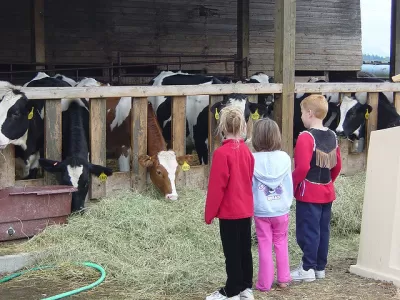
Rosenberg defines the "political mythology" of the historical family farm as an image of a stable nuclear family, conservative gender roles, and a permanent home life.
But his research presents a more complex story, one of near-constant resettlement and flexible social ties—and one tied to environmental degradation, slavery, and other histories of violence in the US:
Our contemporary political mythology built on the family farm is actually founded on a backlash to a much more complicated history ... Rural America — its landscapes and communities both — did not spring from a process of peaceful, orderly, or permanent settlement. Those processes were tumultuous, violent, and chaotic.
In addition to the piece in the Boston Globe, Rosenberg has published a book on the topic, The 4-H Harvest: Sexuality and the State in Rural America.
FULL STORY: Fetishizing family farms

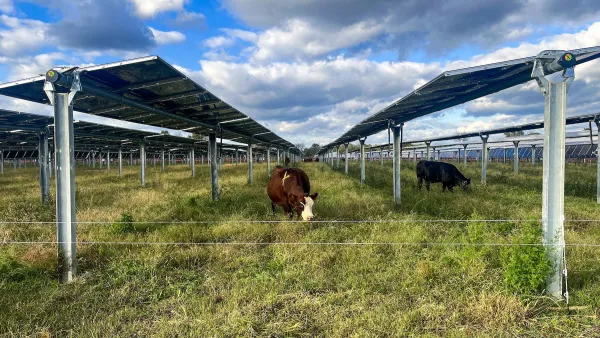
Cows at Tennessee's 'Silicon Ranch' graze under solar panels
The project aims to prove that agriculture and solar energy production can work in tandem.

Florida Farm Bill Blocks Local Bans on Gas-Powered Tools
The law also paves the way for agricultural uses on land previously designated for conservation.
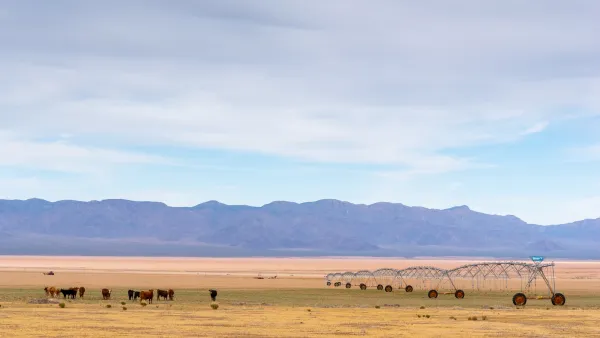
Arizona Tightens Groundwater Restrictions to Rein in Agribusinesses
The state is creating an ‘active management area’ in the western part of the state, where agribusinesses including a Saudi alfalfa exporter have practically free rein over water supplies.

The state-sanctioned urbicide of Austin
People don’t kill cities. Freeways do.

US to reduce Colorado River water deliveries to Mexico
A new Colorado Treaty amendment reduces Mexico’s Colorado River water allocation by 250,000 acre feet.

New Jersey’s second-largest city bans standalone data centers
Jersey City will continue to allow co-location facilities, such as those meant for research institutions that store their own data.

Amtrak not solely to blame for New Jersey commuter rail's unreliability, report finds
A new study from the Garden State Initiative found that NJ Transit’s budget grew 20% across a 4 year period, but reliability declined significantly over the same period.

EPA erases limits on planet-warming pollution from power plants
Under Monday’s plan, power plants would still have some limits on how much mercury, arsenic and other contaminants they can emit.

Phoenix announces new on-demand transit service, more frequent RAPID buses
Both new services will launch in October, and are part of Phoenix's Project Effective Access Solutions for Easing Congestion.

FREE Course: Walkable City 1: Why Walkability?
After describing his path towards focusing on walkability as the essence of good planning, Jeff Speck marches through his five principal reasons for making more walkable places.
Reinventing Malls: Planning Alchemy—Turning Gray Fields Into Gold
The course focuses on the opportunities and imperatives that shape reinvention of mall sites.

Eagle County Government
Harvard University Graduate School of Design
Nashville Planning Department
The Architects Foundation
University of Cincinnati Online
The Pocatello Development Authority
The Urban Renewal Agency of the City of Pocatello
Journal of the American Planning Association