With new transportation options coming to cities from a plethora of innovators and entrepreneurs, how will public transit agencies respond? Are these modes in competition, or does their widespread use actually benefit one another?


A recent VerdeXchange 2016 panel brought together the public and private sectors to hash out these complex questions. Santa Monica City Manager Rick Cole moderated a conversation among LADOT General Manager Seleta Reynolds, Lyft Transportation Policy Manager Emily Castor, Scoot founder Michael Keating, and Alta Motors CEO Marc Fenigstein.
Castor pointed out that for transportation network companies like Uber or Lyft, a strong public transit system is not a threat, but a boon to the bottom line.
"The more viable it is for people to live here without owning a car, the more likely it is that they’re going to use Lyft frequently in combination with transit and other modes," she explained. "We need to look at how we can create this robust ecosystem together."
The key, and sometimes sticking point, is "together." "How do you innovate inside a bureaucracy? How does government do startups?" Reynolds asked. "What is the most effective role for the public sector in the midst of all of this very welcome—and sometimes unwelcome—disruption?"
What works best for both the public and private sectors, the panelists agreed, is cooperatively fostering a multiplicity of options that "overlap but don’t fully substitute for one another." And it works for people: Options allow customization, which gives the efficient movement of people primacy over any particular type of vehicle.
That creates plenty of space in the market for sorely needed innovation.
One example is Scoot, an electric scooter-sharing service based in San Francisco and seeking to enter the L.A. market. "Our core rider is a transit rider who is sometimes in a hurry," founder Keating told the audience—only semi-joking.
No discussion of transportation innovation can avoid considering the coming of autonomous vehicles, of course. Also covered: the influence of transportation on public space, the place of bike-share in the transportation ecosystem, public-private partnership and co-branding services, equity in transportation planning, and more.
An edited transcript of VerdeXchange's panel "Disruption on Wheels: A New Mobility Model For Cities" is printed in The Planning Report.
Read the full story: Public & Private Pros Opine on How 'Choice' Impacts Urban Transportation

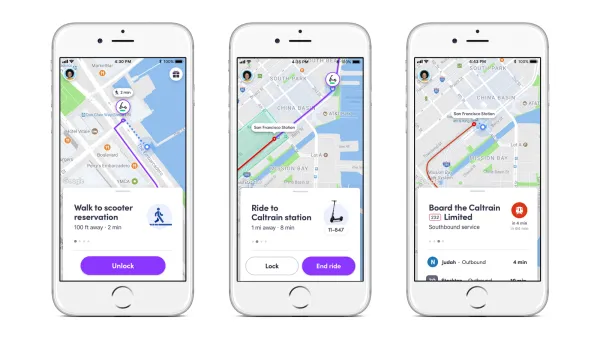
Lyft Moves Toward 'Full Mobility Package'
In cities around the country, Lyft is launching green, multimodal initiatives aimed at providing "all of the above" transportation options.
L.A. Wants to Be the Epicenter of New Transportation Technology
Gabe Klein of CityFi outlines how Los Angeles is planning on implementing the Urban Mobility in a Digital Age report.
Mobility as a Symphony: Los Angeles Prepares for Transportation of the Future
LADOT is rehearsing now for the day it has to manage autonomous vehicles alongside delivery drones and air taxis.

Planetizen Federal Action Tracker
A weekly monitor of how Trump’s orders and actions are impacting planners and planning in America.

Amtrak, CN end decades-long dispute with eight-year agreement
The new operating agreement establishes an updated framework for the companies to work together, including processes to resolve disputes.
Nation's most wind-powered state turns to coal as data centers increase energy demand
For the first time in decades, Iowa has increased its generation of coal power.

Alabama scores up to $2.5 billion federal loan for largest infrastructure project in state’s history
The Mobile River Bridge and Bayway Project aims to ease congestion at Alabama’s worst bottleneck.

Trump is considering data centers on 6 states' public land — some state officials say they had no idea
If the administration approves the proposed projects, data center and data center-related developments will cover 17,600 acres of public land.

Despite court ruling, Trump is keeping nearly all wind projects in the US on hold
At least 110 wind energy projects have not heard from the government since a federal judge ruled that the Trump administration's freeze on wind turbine clearances was likely illegal.

FREE Course: Walkable City 1: Why Walkability?
After describing his path towards focusing on walkability as the essence of good planning, Jeff Speck marches through his five principal reasons for making more walkable places.
Reinventing Malls: Planning Alchemy—Turning Gray Fields Into Gold
The course focuses on the opportunities and imperatives that shape reinvention of mall sites.

KFH Group Inc.
Greater Baltimore Committee
Eagle County Government
The Architects Foundation
University of Cincinnati Online
The Pocatello Development Authority
The Urban Renewal Agency of the City of Pocatello