Looking for a greater awareness of social responsibility, the founder and editor-in-chief of The Architect's Newspaper calls for a new organization tasked with advocacy in New York City.


William Menking pens a withering critique both of the de Blasio Administration in and the state of design advocacy in the city. The editorial starts out by pulling no punches:
The New York architectural community’s relationship to Bill de Blasio’s mayoralty is a complicated one. Not only does the mayor not understand or value the contributions that design and architecture can make to the quality of everyday life, but he also turns his back on many of the positive contributions the Bloomberg administration made in that realm.
But Menking is also willing to blame that reality solely on Mayor de Blasio:
It is an open question and one worth asking: How much is the architecture community contributing to de Blasio’s perception that architecture is only for the wealthy and middle class?
The editorial provides a call to action to the New York design community to take the substantial effort they collectively devote to design research and refocus it toward design advocacy.
FULL STORY: EDITORIAL> WHO SPEAKS FOR ARCHITECTS?

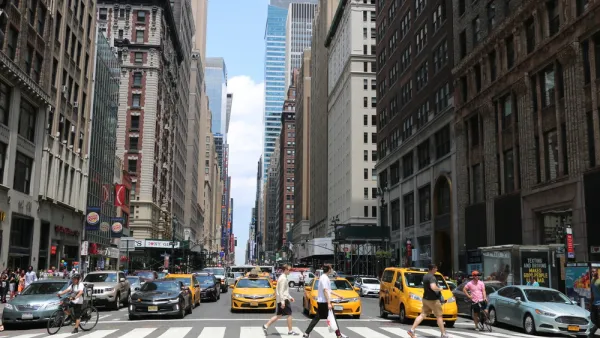
Praise for Gov. Andrew Cuomo from New York Times on Cordon Pricing
Thanks to the governor's support, there is reason for optimism that a plan to charge motorists entering Manhattan below 60th St. and toll the East River bridges will have a better outcome than Mayor Michael Bloomberg's plan did in April 2008.
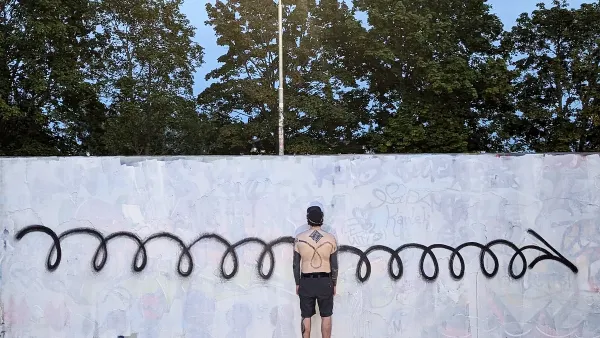
“Skin, Like a City, Will Tell You if You’ve Ignored its History”
Once an urban planner, Sean Colgrave traded in infrastructure for ink when he became a tattoo artist. Now he says: one profession has a lot to learn from the other.

These Bear Safety Signs Illustrate the Impact of Good Design
What makes a sign effective?

Planetizen Federal Action Tracker
A weekly monitor of how Trump’s orders and actions are impacting planners and planning in America.

The state-sanctioned urbicide of Austin
People don’t kill cities. Freeways do.

US to reduce Colorado River water deliveries to Mexico
A new Colorado Treaty amendment reduces Mexico’s Colorado River water allocation by 250,000 acre feet.

Mamdani overhauls NYC's Vision Zero plan with 100 new policy goals
The overhaul aims to reduce traffic deaths and make streets safer for pedestrians, cyclists and drivers through lower speed limits, new safety infrastructure and more.

Amtrak not solely to blame for New Jersey commuter rail's unreliability, report finds
A new study from the Garden State Initiative found that NJ Transit’s budget grew 20% across a 4 year period, but reliability declined significantly over the same period.

EPA erases limits on planet-warming pollution from power plants
Under Monday’s plan, power plants would still have some limits on how much mercury, arsenic and other contaminants they can emit.

FREE Course: Walkable City 1: Why Walkability?
After describing his path towards focusing on walkability as the essence of good planning, Jeff Speck marches through his five principal reasons for making more walkable places.
Reinventing Malls: Planning Alchemy—Turning Gray Fields Into Gold
The course focuses on the opportunities and imperatives that shape reinvention of mall sites.

Eagle County Government
Harvard University Graduate School of Design
Nashville Planning Department
The Architects Foundation
University of Cincinnati Online
The Pocatello Development Authority
The Urban Renewal Agency of the City of Pocatello
Journal of the American Planning Association