Once an urban planner, Sean Colgrave traded in infrastructure for ink when he became a tattoo artist. Now he says: one profession has a lot to learn from the other.


It starts with silence.
Not the awkward kind — the listening kind. The kind where you can hear the shift of denim on leather as someone fidgets in the chair, the faint hum of the machine still switched off. I’m leaning forward, elbows on my knees, pen poised but unmoving. Across from me, my client is describing something they’ve been carrying in their head for years, a tattoo they’ve never quite been able to articulate until now.
“I want it to feel like… the wind through here,” they say, gesturing to the inside of their forearm, “not just slapped on top.”
I nod, thinking not just about imagery, but about how it might move with the muscle and bone underneath, where it will sit in relation to other pieces already on their skin, and about how, years from now, it might still feel like it belongs.
Before I was a tattoo artist, I trained and worked in human geography and city planning. I spent years poring over site maps, zoning plans, and public feedback forms before swapping parcels of land for patches of skin. At first glance, the two trades seem worlds apart, but what I learned in planning definitely helped in tattooing — and I think that trade can go both ways.
Both live in the overlap between the personal and the political, between dreams and regulations. Both involve designing for a landscape already in use. And both, when done well, are less about imposing a vision than about cultivating trust.
Site specificity: Reading the existing conditions
Urban planning begins with site analysis — studying topography, climate, infrastructure, and socio-cultural context before any intervention. The goal is to understand not just the physical constraints but the rhythms and narratives of a place. Kevin Lynch, in The Image of the City (1960), argued that a designer’s role is to work with the “legibility” of a place — its paths, edges, districts, nodes, and landmarks — rather than overwrite them.
Tattooing demands the same attention. The “site” is the body: its tone, elasticity, movement patterns, and scars. A large back piece has to navigate the spine like a transit corridor cutting through a city. A forearm design might be “sun-facing” in the same way a south-facing plaza is. Ignoring the terrain can lead to distortions, poor healing, or a design that visually fights the body’s form.
In planning, I once worked on a small addition that altered the entire feel of a public space. The footprint was modest, barely a sliver on the site plan, but placed with care. It shifted how people moved, lingered, and looked. The space remained familiar yet was experienced in a new way.
Tattooing plays with that same sleight of hand. Heavy blackouts, currently favoured by celebrities, take the human form and remould it into something bolder, more abstract. They don’t erase the arm or shoulder — they reframe it, the way a well-placed element transforms a plaza.
One of my early mentors in planning put it simply: “Respect the site, or the site will reject your design.” Skin, like a city, will tell you if you’ve ignored its history.
Stakeholder consultation: From Arnstein’s Ladder to the studio
Sherry Arnstein’s Ladder of Citizen Participation (1969) remains a touchstone in planning theory. At the bottom are rungs of non-participation, where “engagement” is cosmetic. Higher up, tokenism allows people to be heard but not necessarily listened to. Only at the top — partnership, delegated power, citizen control — do communities truly shape outcomes.
Planning workshops and open forums aim to climb that ladder but often stall halfway.
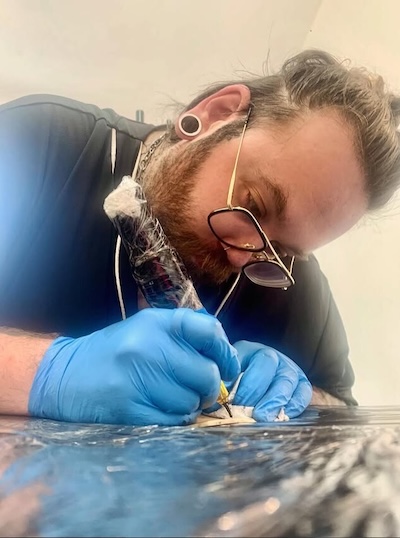
A tattoo consultation is a miniature version. The “community” is one person, but the stakes are high. A poor consultation treats the client as a passive recipient of the artist’s vision; a good one moves towards partnership.
One client came to me with a vague brief: “Something floral, maybe peonies.” Thirty minutes later, I knew the flowers were a memorial for her grandmother, who had grown them in her front garden. The design shifted to reflect not just beauty but a specific memory — like those flowers bending under summer rain.
This is Arnstein’s ladder in action: moving from token input to true co-authorship. Planners and tattooists alike know that when people see themselves in the design, they’re more likely to live happily with the result.
Design iteration: Feedback loops and reflective practice
Donald Schön’s The Reflective Practitioner (1983) describes design as a “conversation with the situation” — a back-and-forth between idea and context. In planning, this means draft plans evolve through public feedback, environmental review, and on-the-ground observation.
Tattooing is equally iterative. I’ll sketch an initial design, then place a stencil on the skin. The client might flex, twist, or frown. The curve might be wrong; a key element might fall into an awkward fold. We pull it off, adjust, try again.
One half-sleeve took us three separate stencil placements because the negative space kept falling too close to an old tattoo the client wanted to avoid. The result flowed beautifully — but only because we allowed the process to loop until it landed right.
Iteration in both fields is humility in action. A fixed idea imposed without adjustment risks being irrelevant, uncomfortable, or even harmful.
Long-term impact: Post-occupancy and living designs
Post-occupancy evaluation (POE) in planning measures how spaces perform after completion. Are they used as intended? Have they aged well? Are they adaptable? Jane Jacobs, in The Death and Life of Great American Cities (1961), argued that the best neighbourhoods adapt without losing their social fabric.
Tattoos also live through a post-occupancy phase. Lines soften, pigments fade, bodies change. A design across the ribs will distort differently on a dancer’s body than on someone sedentary. Good tattooists account for this, just as good planners design streetscapes to weather decades of use.
A client once asked for a large mandala on her torso. We simplified it once she said she was planning a pregnancy. The design now expands and contracts without losing its integrity, like a park that anticipates seasonal flooding.
Closing the loop
Back in the studio, my client smiles at the fresh stencil. It curves with their muscle, leaves breathing room for the scar above the wrist, and when they flex, it shifts like a living thing. We’re both happy, not because I “nailed it” in one shot, but because we got there together.
Tattooing has taught me that space, whether on skin or in a city, is personal. It carries memory, emotion, and identity. It demands respect.
For me, this isn’t just theory — I’ve sat at both tables. I know the weight of a planning decision on a community, and the permanence of a line of ink on skin. Both are acts of shaping identity.
If planners borrowed more from the tattoo world — its attentiveness, its instinct to listen first, its willingness to adapt — our cities might feel less like projects done to us, and more like living canvases we helped shape. Imagine architects and planners pulling up a chair alongside tattooers, muralists, and all the other art kids, swapping sketches and stories. The lines on a street plan, the lines on skin — both are declarations of identity. And when you work with that kind of energy, you’re not just drawing buildings or bridges; you’re shaping places people wear with pride.
Sean Colgrave is a UK-based tattooist, writer, and curator with an MA in Creative Practices. His work sits at the intersection of art, body, and storytelling, with a particular passion for drawing back the tattoo curtain to reveal the complexity, care, and creativity that fuels the industry. In 2024, Sean curated a major tattoo art and history exhibition that toured the UK, with further dates planned for 2026. He also guest lectures across fine art programs, helping new artists explore the body as a valid and vital site for contemporary expression.
Sean’s first book, The Tourist’s Guide to Tattooing, is due out soon — offering a candid, funny, and unflinching look at what really happens behind the stencil.
Follow Sean on Instagram @SeanColgrave.

10 great urban planning summer reads
Wherever you're going (or staying) this summer, here are some suggestions for books to bring along.
April must-reads: Top 10 articles from last month
The world's longest car-free bridge opens in Finland, Amtrak's new Mardi Gras line shatters ridership predictions, and Bay Area commuters could lose a third of Caltrain stations.

March Must-Reads: Top 10 Articles From Last Month
Seattle may roll back a development fee as housing permits plummet, an ambitious Google-led project in the heart of San Jose goes sideways, and a list of sci-fi books to feed your futurist dreams.

The state-sanctioned urbicide of Austin
People don’t kill cities. Freeways do.

US to reduce Colorado River water deliveries to Mexico
A new Colorado Treaty amendment reduces Mexico’s Colorado River water allocation by 250,000 acre feet.

New Jersey’s second-largest city bans standalone data centers
Jersey City will continue to allow co-location facilities, such as those meant for research institutions that store their own data.

Amtrak not solely to blame for New Jersey commuter rail's unreliability, report finds
A new study from the Garden State Initiative found that NJ Transit’s budget grew 20% across a 4 year period, but reliability declined significantly over the same period.

EPA erases limits on planet-warming pollution from power plants
Under Monday’s plan, power plants would still have some limits on how much mercury, arsenic and other contaminants they can emit.

Phoenix announces new on-demand transit service, more frequent RAPID buses
Both new services will launch in October, and are part of Phoenix's Project Effective Access Solutions for Easing Congestion.

FREE Course: Walkable City 1: Why Walkability?
After describing his path towards focusing on walkability as the essence of good planning, Jeff Speck marches through his five principal reasons for making more walkable places.
Reinventing Malls: Planning Alchemy—Turning Gray Fields Into Gold
The course focuses on the opportunities and imperatives that shape reinvention of mall sites.

Eagle County Government
Harvard University Graduate School of Design
Nashville Planning Department
The Architects Foundation
University of Cincinnati Online
The Pocatello Development Authority
The Urban Renewal Agency of the City of Pocatello
Journal of the American Planning Association

