Following recent bad news about the sluggish growth of the country's gross domestic product (GDP), the Brooking Institution reminds policy makers that growth does not necessarily trickle down to economic well-being.


Alan Berube follows on recent news about the sluggish national economy with data that focuses more on the economic well-being of metropolitan areas, while also producing some larger conclusions about the connections between economic growth and economic well-being.
First came the news from the U.S. Commerce Department "that GDP growth slowed to an annual rate of 0.7 percent in the fourth quarter of 2015, stoking fears about whether the ongoing recovery from the Great Recession can sustain momentum in the face of global economic instability."
Berube, however, reminds readers of the Brooking Institution's Metro Monitor tool, which allows additional insight into the economic health of the country. According to Berube, the Metro Monitor shows that 95 of the 100 largest metro areas showed increases in growth categories. "Yet growth in metro economies did not reliably improve all residents’ economic fortunes," states Berube.
To make that point Berube shares a chart laying out growth rankings and inclusion rankings, showing a weak relationship between the two categories. From that exercise, Berube produces the following findings:
Many metro areas that had high growth performed worse than their peers on inclusion, and vice versa (the upper left and lower right-hand quadrants). Nashville’s economy grew at a rapid rate from 2009 to 2014, ranking fifth among metro areas, but median wages fell and relative poverty rose. In Springfield, Mass., however, relative poverty dropped significantly, ranking the metro area second for inclusion, despite anemic overall growth that ranked the metro area 64th among the 100 largest.
The article concludes with an appeal to policy leaders to keep in mind all the measures of economic opportunity—not just the obvious—when evaluating the performance of the economy.
Read the full story: In metro areas, growth isn't reliably trickling down
Boom in Utah Town
Growth is at a standstill in most western boomtowns, but not in well-planned, thriving South Jordan, UT. An expedited permitting process and good planning are given credit as catalysts for growth.
Slowdown Offers Chance to Rethink Growth
The economic slowdown has caused a slowdown in growth, even in the Salt Lake City area -- recently one of the nation's fastest growing regions. This editorial calls on officials to use the slowdown as a chance to reconsider the area's growth pattern.
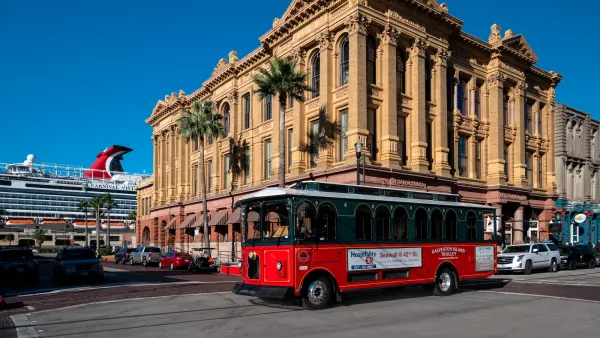
A Historic Texas Beach Town Faces Existential Growth Questions
Galveston, Texas is growing — and so are questions about its land use strategy.

Planetizen Federal Action Tracker
A weekly monitor of how Trump’s orders and actions are impacting planners and planning in America.

California plans to bury El Niño’s downpour
If the state plays its cards right, it may be able to store a billion acre-feet of El Niño’s water in aquifers.

Desperate measures: Advocates weigh draining Lake Powell to fill Colorado River
Draining the reservoir could reduce evaporation losses by a couple hundred thousand acre-feet.

Mamdani’s pied-à-terre tax survives legal challenge
A panel of judges found that the plaintiffs failed to demonstrate injury as a result of New York City's implementation of the tax.

Eastern Nebraska is running out of electricity
Data centers and electrification are straining eastern Nebraska’s grid, throttling economic development.

Seattle passes record-breaking transit services expansion
Proposition 1 will double the city’s transit tax to add 95,000 more bus trips and preserve 180,000 bus trips annually.

FREE Course: Walkable City 1: Why Walkability?
After describing his path towards focusing on walkability as the essence of good planning, Jeff Speck marches through his five principal reasons for making more walkable places.
Reinventing Malls: Planning Alchemy—Turning Gray Fields Into Gold
The course focuses on the opportunities and imperatives that shape reinvention of mall sites.

City of Rosemead
Rutgers University, Edward J. Bloustein School of Planning and Public Policy
One Hundred Miles
University of Michigan School for Environment and Sustainability (SEAS)
Hunter College, City University of New York (CUNY)
The Architects Foundation
City of Cambridge
Montrose County
The Pocatello Development Authority