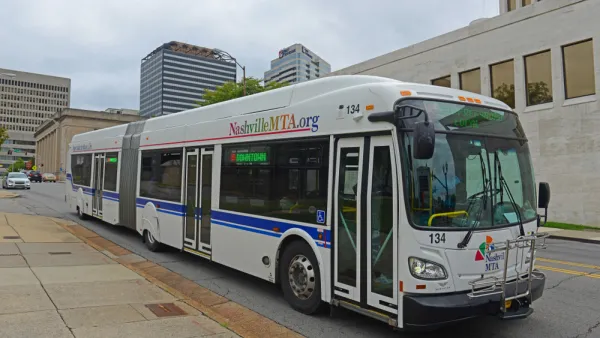
Nashville residents are being asked to choose their preference among a menu of transit planning options. The most expensive version of the plan would cost $5.4 billion, the least $800 million.


"A question of scale is at the heart of a new Metro Transit Authority report released Thursday that zeroes in on three possible scenarios to guide the city's future transit investments," reports Joey Garrison.
"After months of community meetings as part of the agency’s nMotion transit planning process, MTA officials and consultants unveiled transit visions at a lengthy MTA board meeting. Proposals cover the full gamut of options, headlined by light rail on major Nashville corridors and commuter rail to connect Nashville with Clarksville," adds Garrison.
Mayor Megan Barry will seek public input on the options before releasing a final version of the plan in late spring or summer, according to the article. The article also includes more detail about what is included at each end of the scale. The "top-tier" proposal, as the article calls it, would cost $5.4 billion. A middle-tier comes with a $2.4 billion price tag, and the "less ambitious plan" would total $800 million.
Read the full story: Nashville transit options unveiled: Go big or small?

A New Transit Hub Pitched in Nashville
The city of Nashville is trying to get back on track with some of the projects proposed in the 2016 nMotion plan—even without the massive pot of transit tax money it could have won at the ballot box.

Five Corridors of High Capacity Transit Coming to Nashville
A 25-year regional transit plan, which includes five corridors for light rail or bus rapid transit lines, is taking shape in Nashville,

Nashville Mulls Funding Ideas for its $6 Billion Regional Transit Plan
The Nashville Metropolitan Transit Authority and the Regional Transportation Authority of Middle Tennessee adopted the most comprehensive and expansive version of the nMotion plan. Now they have to fund all those big ideas.

Planetizen Federal Action Tracker
A weekly monitor of how Trump’s orders and actions are impacting planners and planning in America.

‘Going backwards:’ Baltimore mayor, students rally against state's transit funding plan
Maryland's proposed six-year plan provides no funding for Baltimore’s BMORE bus program and reduces its road maintenance funding.

Detroit to transform waterfront with $2.2 billion investment
Developers will convert about 18 acres of unused parking lot space into civic spaces.

HUD, USDA agree on framework to simplify housing environmental review standards
Their agreement is a requirement of the 21st Century ROAD to Housing Act.

Cost of water rising at a faster pace than inflation, median household income
California and Maryland residents have seen their water bills grow especially high.

NYC building owners overwhelmingly comply with new emissions limits
The New York City Department of Buildings is fining owners who did not file emissions reports.

FREE Course: Walkable City 1: Why Walkability?
After describing his path towards focusing on walkability as the essence of good planning, Jeff Speck marches through his five principal reasons for making more walkable places.
Reinventing Malls: Planning Alchemy—Turning Gray Fields Into Gold
The course focuses on the opportunities and imperatives that shape reinvention of mall sites.

planning NEXT
City of Thousand Oaks
City of Wisconsin Rapids
The Architects Foundation
University of Cincinnati Online
Northern Illinois Transit Authority (NITA)
The Pocatello Development Authority
The Urban Renewal Agency of the City of Pocatello