Surrounded on all sides by glassy, modern towers, Philly's West Market Street has lacked the sort of attractions that have brought downtown workers to neighboring streets.


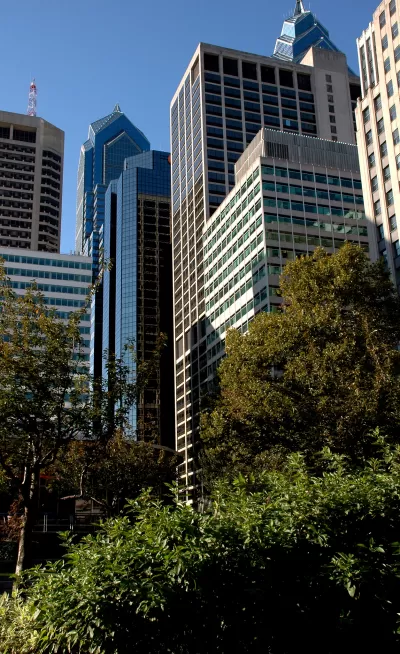
Philadelphia’s "most boring street," according to Philadelphia Inquirer architecture critic Inga Saffron, is overdue for needed improvements. West Market Street was "designed to be dull," writes Saffron—modeled on the canyon of financial towers along Park Avenue in Manhattan. However, building owners surrounding the street are beginning to see the potential benefits of adding amenities such as restaurants and retail outlets. Unfortunately, these improvements are proving to be a mixed-bag, with some converting formerly public space into unfriendly walled off private spaces.
At 1601 Market and Independence Blue Cross, the new owners have recently walled off their arcades behind glass. In theory, sacrificing these slivers of public space could be a good thing if it helped attract more interesting retailers to the street.
But 1601 simply increased its rentable square-footage without giving anything meaningful back to the public. Instead of finding an interesting tenant, it welcomed back the same boring bank at 16th Street, one of the city's most heavily trafficked pedestrian corners.
While these attempts to bring amenities to the neighborhood are in their infancy, neighborhood enthusiasts find additional hope in the arrival of new residential apartment buildings along West Market, which may yet breath new life into the moribund street.
FULL STORY: Changing Skyline: Can Philadelphia's most boring street get energized with new retail?

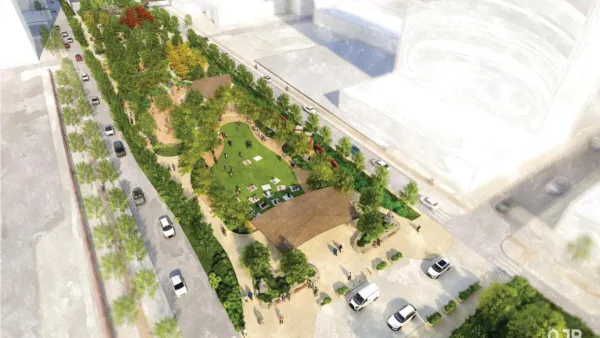
Philadelphia lawmakers fight to save 'Chinatown Stitch' from Trump cuts
The freeway cap project, approved and funded under the Biden administration, is now in jeopardy after the federal government rescinded all but $8 million in funding.
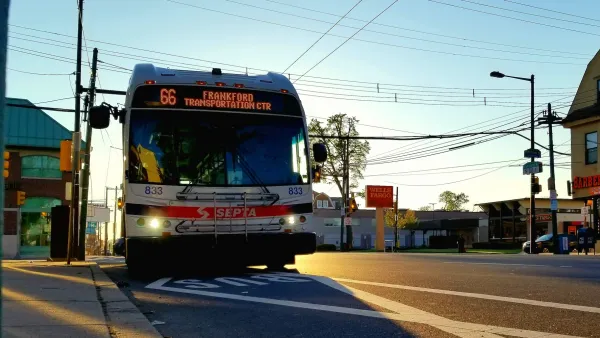
SEPTA's bus-mounted lane enforcement cameras cut travel times by up to 6%
The AI-assisted cameras have issued nearly 200,000 citations to drivers blocking bus lanes.
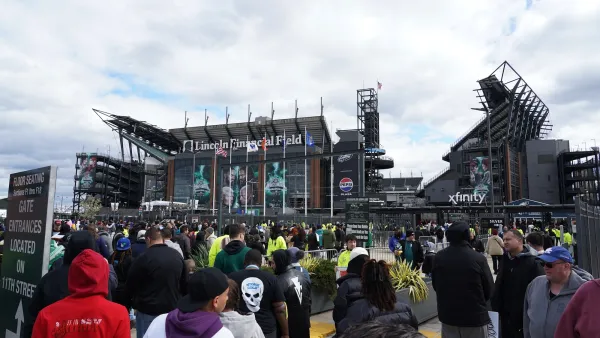
Philadelphia officials say city is ready for World Cup
The city touted its plans to ensure security and accessibility during FIFA World Cup events.

Planetizen Federal Action Tracker
A weekly monitor of how Trump’s orders and actions are impacting planners and planning in America.

The state-sanctioned urbicide of Austin
People don’t kill cities. Freeways do.

US to reduce Colorado River water deliveries to Mexico
A new Colorado Treaty amendment reduces Mexico’s Colorado River water allocation by 250,000 acre feet.

5 New England states march closer to 800 megawatt wind energy project
Securing federal approval for the project may be complicated under the Trump administration, which has historically been hostile towards domestic wind power.

Baltimore to break ground on $50 million Transit Priority Project
The project will bring faster bus trips, safer streets and better bike connections to Baltimore.

Airbnb launches $250 million 'last-dollar financing' housing accelerator, makes first investment in Austin
The company will put $6.4 million towards affordable housing development in Texas’ capital.

FREE Course: Walkable City 1: Why Walkability?
After describing his path towards focusing on walkability as the essence of good planning, Jeff Speck marches through his five principal reasons for making more walkable places.
Reinventing Malls: Planning Alchemy—Turning Gray Fields Into Gold
The course focuses on the opportunities and imperatives that shape reinvention of mall sites.

Eagle County Government
Harvard University Graduate School of Design
Nashville Planning Department
The Architects Foundation
University of Cincinnati Online
The Pocatello Development Authority
The Urban Renewal Agency of the City of Pocatello
Journal of the American Planning Association