Some presidential candidates favor sprawl, but a surprising number live in cities or inner-ring suburbs.


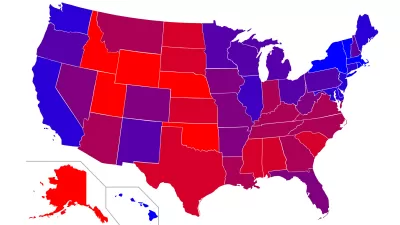
Since presidential candidates tend to be wealthy, middle-aged heads of households, and wealthy middle-aged families tend to live in sprawl, one might think that most Republican presidential candidates live in sprawl. I was able to find out where most (though not all) candidates live—and although it is true that most of them live in sprawl, this rule has some interesting exceptions.
To be sure, Republican front-runner Ben Carson unquestionably lives in sprawl. He lives in Upperco, a Baltimore outer suburb about 30 miles from downtown. Some parts of Upperco have a Walkscore of 0, and a look at Upperco on Google Street View reveals that streets are few and far between. Every house is very far from everything else. Another religious conservative, Rick Santorum, lives in a five-acre house with a 0 Walkscore in Great Falls, a wealthy outer suburb of Washington
Another favorite of religious conservatives, former Arkansas governor Mike Huckabee, has left his home state and moved to a beachfront mansion in resort-oriented Walton County, Florida. Although Huckabee's new home is only a few miles from new urbanist favorite Seaside, its Walkscore is 14.* Although the Huckabee manse seems to be in the middle of nowhere, he can walk half a mile to get a meal or a cup of coffee, if he doesn't mind the absence of sidewalks. Just as Gov. Huckabee's policies occasionally deviate from solid conservatism, his home isn't quite 100 percent sprawl.
On the other hand, Florida's two candidates favor inner ring suburbs. Jeb Bush lives in a townhouse in downtown Coral Gables, about five miles from downtown Miami. Coral Gables is a older inner-ring suburb with a highly walkable commercial district (the Miracle Mile area) and satisfactory bus service. Bush's street has a Walkscore of 77. Marco Rubio has spent most of his life in West Miami, a more working-class suburb just west of Coral Gables. Rubio's former West Miami home has a Walkscore of 80, and he lived only five blocks south of the 8 bus, which runs about every 10 or 15 minutes during the day and until 11 pm at night—pretty good by the low standards of Florida. On the negative side, S.W. 8th Street, the nearest commercial street, is a four-lane stroad. (A couple of years ago, Rubio sold the house to move his permanent residence to Washington; I was unable to find out where he lives in Washington.)
Tea Party favorite Ted Cruz prefers urban life. Cruz lives in a condo (Walkscore 75) in River Oaks, Houston's in-town, old money neighborhood. Cruz lives two miles from City Hall, a couple of blocks from numerous bus routes, and 0.3 miles from Whole Foods. On the negative side, the Whole Foods is on a stroad, as one might expect given Houston's reputation for car-oriented design.
Although governors generally live in governor's mansions, Ohio's John Kasich is an exception. He lives in a wooded area in Genoa Township, an outer suburb about 20 miles north of Columbus with a single-digit Walkscore. Similarly, New Jersey's Chris Christie lives in Mendham Township, NJ, a large-lot exurb with a Walkscore of 11. By contrast, Bobby Jindal lives in Louisiana's governor's mansion just north of downtown Baton Rouge.
Our two tycoon candidates favor very different environments. Carly Fiorina lives in a gated community about 25 miles south of Washington, in an area that (based on my look at the area on Street View) would probably have a negative Walkscore if such a thing were possible. On the other hand, Donald Trump has numerous residences, but one of them is just steps from Central Park.
In sum, it appears that the majority of Republican candidates do live in sprawl—but the exceptions are not necessarily the candidates I would have expected. The candidates with the most urban addresses are not always the most moderate.
At this point, you might be saying "So what? Does any of this trivia have any broader lessons?" Actually, yes. The one thing I noticed is that every single candidate either favors a highly walkable area (Walkscore 75+) or in an extremely car dependent area (Walkscore 15 or below). Not one of the candidates, as far as I can tell,** lives in the in-between areas (Walkscore 20-75) where most Americans live. If the Republican candidates reflect upper-class Americans generally, this tells us something about American tastes—or at least about the tastes of a certain slice of middle-aged, well-heeled America. Semi-walkable '50s suburbia is what Americans might be willing to settle for if they can't afford anything better—but I doubt it is really most people's "American Dream."
*In deference to the candidates' privacy, I have tried to avoid mentioning their street address even when I found it out.
**As you might have noticed some candidates are missing. I was unable to find out where Sens. Paul and Graham or Gov. Pataki live.

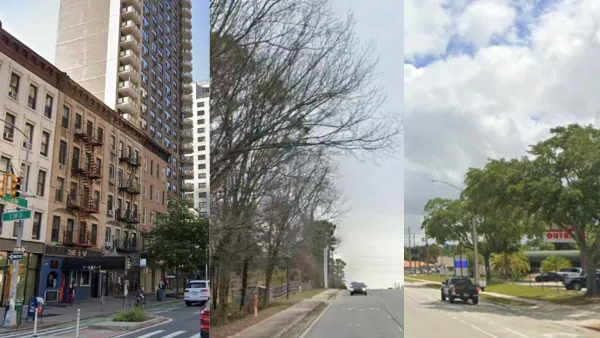
A Transect of sprawl
A development pattern this lifestyle-defining deserves its whole own classification system.

What the fall of earth's largest pre-industrial city can teach us about urban sprawl
Angkor was a low-density metropolis. It lasted six centuries, until it could no longer maintain its infrastructure in a changing climate. Today, it offers planners a sobering warning about the risks of dispersed urban living.

Nearly a third of US housing is in the wildland-urban interface — and at growing risk of wildfire
As suburbs increasingly mingle with undeveloped land, homes face a higher risk from destructive fires.

Planetizen Federal Action Tracker
A weekly monitor of how Trump’s orders and actions are impacting planners and planning in America.

‘Going backwards:’ Baltimore mayor, students rally against state's transit funding plan
Maryland's proposed six-year plan provides no funding for Baltimore’s BMORE bus program and reduces its road maintenance funding.
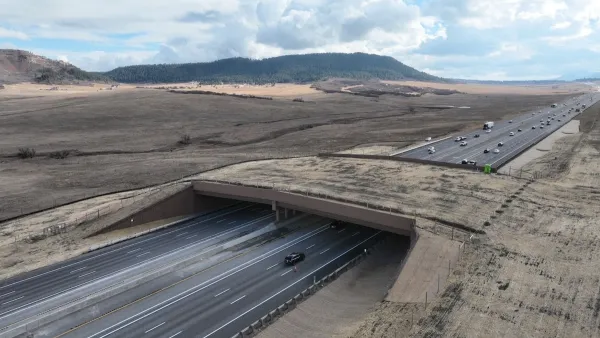
Record-breaking wildlife overpass in Colorado brings 91% reduction in animal collisions
Prior to the overpass, vehicles were hitting one deer per day on Colorado’s Interstate 25.

Mamdani sent nearly 6,000 pied-à-terre tax warnings to homes that didn’t qualify
A judge has ordered the administration to cancel thousands of pied-à-terre tax notices after it sent 35% of them erroneously.

Detroit to transform waterfront with $2.2 billion investment
Developers will convert about 18 acres of unused parking lot space into civic spaces.

‘Going backwards:’ Baltimore mayor, students rally against state's transit funding plan
Maryland's proposed six-year plan provides no funding for Baltimore’s BMORE bus program and reduces its road maintenance funding.

FREE Course: Walkable City 1: Why Walkability?
After describing his path towards focusing on walkability as the essence of good planning, Jeff Speck marches through his five principal reasons for making more walkable places.
Reinventing Malls: Planning Alchemy—Turning Gray Fields Into Gold
The course focuses on the opportunities and imperatives that shape reinvention of mall sites.

City of Thousand Oaks
City of Wisconsin Rapids
Harvard University Graduate School of Design
The Architects Foundation
University of Cincinnati Online
Northern Illinois Transit Authority (NITA)
The Pocatello Development Authority
The Urban Renewal Agency of the City of Pocatello


