The local food production industry so far has mostly been constrained to a niche market—expensive and available only to a small percentage of consumers. A project in Portland is working to change that.


Jared Green reports on an ambitious effort in Portland that is working toward developing new systems of support for local farmers committed to sustainable practices in bringing their products to institutional food buyers.
The non-profit Ecotrust runs the Redd on Salmon Street project, which recently won SXSW’s Place by Design resilience competition and is expected to open in 2016. Here's how Ecotrust pitches Redd on Salmon Street's ambition for local food industries: "The Redd will serve 'ag in the middle,' mid-size rural farmers, ranchers, and fishers who have outgrown direct-to-consumer channels, such as CSAs and farmers’ markets, and are looking to scale their business. The Redd will increase access to value-added producers, markets, and infrastructure (like warehousing, aggregation and distribution), a lack of which inhibits growth."
The project will rehabilitate two existing buildings to create an "80,000-square-foot food production and distribution facility in the Central Eastside neighborhood of Portland," according to Green. The article provides more detail about the project as well as a shout out to the other Place by Design finalists.
Kaplan Prize - The Redd on Salmon Street from Ecotrust on Vimeo.
Read the full story: In Portland, Ecotrust Builds a Hub for Sustainable Food
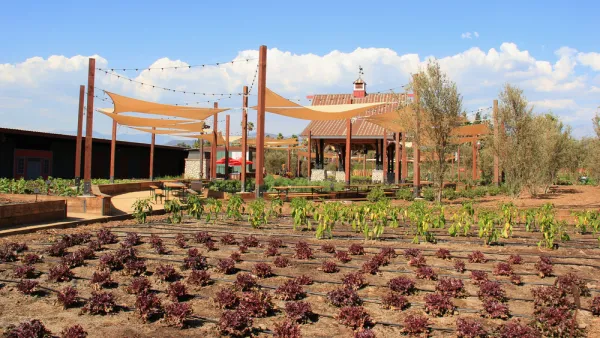
Urban Farming Program Struggles to Sprout
Los Angeles created a tax incentive to promote urban farms on the thousands of vacant lots around the city. So far, the incentive has been given out only four times.

Vertical Farms, Fad or Feast?
Hydroponic indoor farmers hope to charge a premium for plants grown out of season in indoor farms. The notion has generated attention from big investors, but whether or not consumers will follow is an open question.
Tax Credits to Encourage Urban Agriculture
Montgomery County, Maryland is the latest municipality to approve an agricultural tax credit to to create incentives for agricultural uses in urban areas.

Planetizen Federal Action Tracker
A weekly monitor of how Trump’s orders and actions are impacting planners and planning in America.

Eastern Nebraska is running out of electricity
Data centers and electrification are straining eastern Nebraska’s grid, throttling economic development.

Move over, LA: St. Louis gears up for Olympics, invests millions in downtown redevelopment
The Missouri city will host the 2028 Olympic soccer group stage and knockout matches.

Dallas releases zoning code overhaul to officials
The drafted overhaul is over 400 pages long.

NYC renovations for dangerous, ‘mercilessly crammed’ street delayed until 2027
Construction was supposed to begin this fall.

San Diego’s Midway Rising project gets greenlight from city council
The project looks to become the largest affordable housing development in California's history.

FREE Course: Walkable City 1: Why Walkability?
After describing his path towards focusing on walkability as the essence of good planning, Jeff Speck marches through his five principal reasons for making more walkable places.
Reinventing Malls: Planning Alchemy—Turning Gray Fields Into Gold
The course focuses on the opportunities and imperatives that shape reinvention of mall sites.

City of Rosemead
Rutgers University, Edward J. Bloustein School of Planning and Public Policy
One Hundred Miles
University of Michigan School for Environment and Sustainability (SEAS)
Hunter College, City University of New York (CUNY)
The Architects Foundation
City of Cambridge
The Pocatello Development Authority
The Urban Renewal Agency of the City of Pocatello