Northern Michigan's "premier summer resort town" finds itself embroiled in a heated development controversy, reflecting that town's changing population.


Matthew Dolan reports on the changing fortunes of Traverse City, Michigan. According to Dolan, "[l]ong a sought-after destination for summer tourists, Traverse City's year-round population, individual wealth and real estate prices have grown in recent years, squeezing out young professionals and others from living in downtown where some condos now top $1 million."
At the center of the debate surrounding the city's newfound success is a controversial mixed-use development proposal at the edge of the city's downtown.
"The housing debate is pitting some longtime residents against a newer, younger population as city leaders weigh the size and scope of extra tall downtown building projects. The height of the proposed towers is needed, developers say, to justify setting aside nearly half of the units for lower-income renters," writes Dolan.
Supporting the project are housing advocates who say that the development's mix of supply will allow more people to move to the city. On the other side are long time residents concerned with the scale of the project.
The article goes on to describe Traverse City as emblematic of several trends found in communities around the country: the need to build housing attractive to a mix of incomes and age groups, as well as a shift toward a less seasonal economy. The article is of feature length, with a lot more detail on the context of the debate and the current conditions in the area.
Read the full story: The growing pains of Traverse City

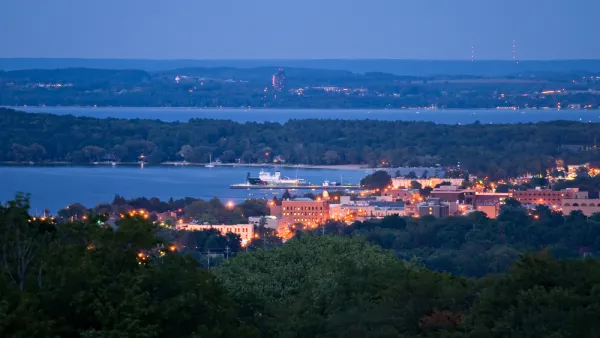
Sleepy Resort Towns Becoming Urban Destinations
Around the country, small, rural towns are experiencing the same political conflicts related to land use and planning more commonly associated with the city.
‘Instagrammed to Death’ or a Return to Pre-Pandemic Normal?
Familiar controversies might seem reassuring in 2022.
Left-NIMBYism and COVID-19
The events of the past year shows that the law of supply and demand applies to urban housing, and that gentrification can, in fact, be subdued.

Planetizen Federal Action Tracker
A weekly monitor of how Trump’s orders and actions are impacting planners and planning in America.

Amtrak, CN end decades-long dispute with eight-year agreement
The new operating agreement establishes an updated framework for the companies to work together, including processes to resolve disputes.

Judges permit Denver to divert 77,000 acre feet from the Colorado River for reservoir expansion
Overuse and climate change have caused the Colorado River’s water levels to plummet.

NYC DOT wants faster, more permanent street upgrades
The city is examining ways to build more concrete infrastructure without getting entangled in 'decades-long' projects.

'Something we’ve never seen before:' rising utility rates could strain city finances nationwide
Data centers, climate change and other factors have caused utility rates in the United States to increase by 38% since 2020.

Trump to overrule local leaders, lease millions of acres of America’s Pacific Island territories’ seafloors to mining companies
International law says that the Indigenous people of America’s territories have a right to prior and informed consent regarding projects that impact their countries.

FREE Course: Walkable City 1: Why Walkability?
After describing his path towards focusing on walkability as the essence of good planning, Jeff Speck marches through his five principal reasons for making more walkable places.
Reinventing Malls: Planning Alchemy—Turning Gray Fields Into Gold
The course focuses on the opportunities and imperatives that shape reinvention of mall sites.

Harvard University Graduate School of Design
KFH Group Inc.
Greater Baltimore Committee
The Architects Foundation
University of Cincinnati Online
The Pocatello Development Authority
The Urban Renewal Agency of the City of Pocatello