For some reason, many drivers think "Share the Road" means bikers should stay out of their way.


Tanya Snyder shares news of a new study that examines understanding of road signage explaining the rights of cyclists to use the road. "Researchers George Hess and M. Nils Peterson of North Carolina State University conducted an online survey of nearly 2,000 people to find out what various road signage means to them," according to Snyder. "On the screen, respondents were shown pictures of various traffic scenarios and street designs, and asked to interpret different signs and markings in those contexts."
The findings of the study: "Turns out 'Share the Road' had no effect whatsoever in leading people to respect cyclists’ right to occupy a full lane of traffic. A sharrow helped a little. In the survey, by far the clearest indication that cyclists have an equal right to the road was a sign stating unequivocally that cyclists 'may use full lane.'"
Snyder notes that the study confirms a policy change made by Delaware two years ago, when it dumped the "Share the Road" signs for this very reason.
Read the full story: “Share the Road” Signs Don’t Work


Let’s End Traffic Stops
The technology to make traffic enforcement obsolete is becoming available. But in the U.S. willing to use it?
New USDOT safety strategy highlights enforcement, embraces autonomous cars
The new National Roadway Safety Strategy emphasizes safety technology and enforcement and promises to further crack down on immigrant truck drivers with illicitly obtained licenses.
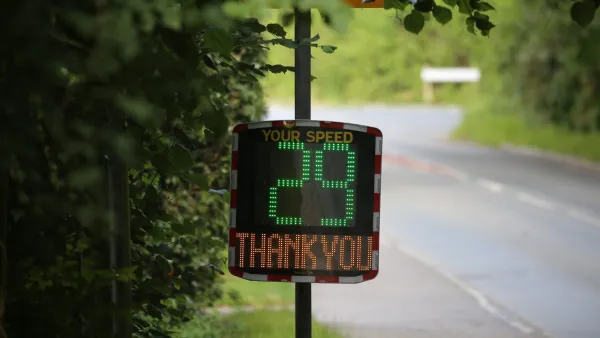
Austin road sign compliments safe drivers
An electronic display praises drivers who stay under the speed limit with personalized messages.

Planetizen Federal Action Tracker
A weekly monitor of how Trump’s orders and actions are impacting planners and planning in America.

The state-sanctioned urbicide of Austin
People don’t kill cities. Freeways do.

US to reduce Colorado River water deliveries to Mexico
A new Colorado Treaty amendment reduces Mexico’s Colorado River water allocation by 250,000 acre feet.

Nation's most wind-powered state turns to coal as data centers increase energy demand
For the first time in decades, Iowa has increased its generation of coal power.

NYC cools commuters with city's first rain garden above a bus stop
New York City officials say the plants in the rain garden can absorb 16 gallons of rainwater during heavy storms.

Brightline West’s future may rely on $6 billion federal loan
The company has until Nov. 2 to make a $400 million equity investment into its proposed high-speed rail line.

FREE Course: Walkable City 1: Why Walkability?
After describing his path towards focusing on walkability as the essence of good planning, Jeff Speck marches through his five principal reasons for making more walkable places.
Reinventing Malls: Planning Alchemy—Turning Gray Fields Into Gold
The course focuses on the opportunities and imperatives that shape reinvention of mall sites.

Greater Baltimore Committee
Eagle County Government
Harvard University Graduate School of Design
The Architects Foundation
University of Cincinnati Online
The Pocatello Development Authority
The Urban Renewal Agency of the City of Pocatello
Journal of the American Planning Association