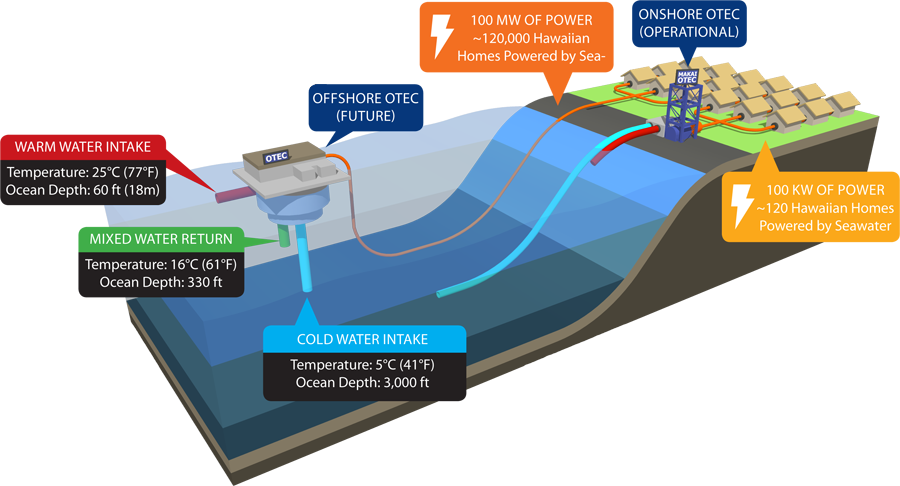
It's called Ocean Thermal Energy Conversion, or OTEC, and the world's largest plant was dedicated in Hawaii on August 21. It produces renewable energy by using the temperature difference between the ocean's deep cold water and warm surface water.


Emission-free energy is now being produced in Hawaii by Makai Ocean Engineering, thanks to funding by the Office of Naval Research through the Hawaii Natural Energy Institute," states Makai's news release. The $5 million, 105-kilowatt demonstration plant on the Big Island "only generates enough electricity to power 120 homes," writes Cole Mellino for EcoWatch. "But to date, it’s the largest such plant in the world."
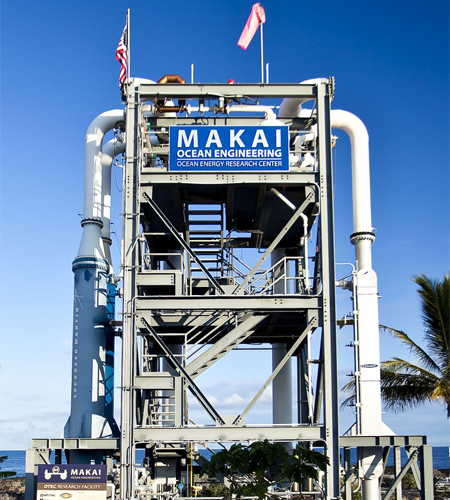
Credit: Makei Ocean Engineering
The company estimates that all of Hawaii’s electricity needs could be met by about 12 commercial-scale OTEC plants. They already have plans to construct a 1-megawatt facility in Japan.
“Anywhere tropical with deep water is ideal, especially if they import their fuel,” says Duke Hartman, vice president of business development at Makai.
While technically classified as a type "marine renewable energy," it's actually a form of solar energy, captured by the ocean and converted to electricity. "That’s beautiful because we can extract that energy 24/7 and use that power any time we want it, totally eliminating the need for an energy storage system,” states Hartman.
"Heat exchangers are really the key component to OTEC," states Hartman in this five-minute YouTube video as he point to the three pipes, standing on top of the plant.
Credit: Makei Ocean Engineering
"OTEC is a technology that the Navy has a significant interest for generating power at Naval bases around the world," states the naval research paper, "Understanding Predictability of the Ocean" [PDF]. "By using an [sic] Rankine engine cycle with fluorine gas cooled by deep ocean water and warmed by surface waters, turbines are used to generate electrical power that is sent back to shore." [The video explains it in more detail.].
"The breakthrough marks the first true closed-cycle OTEC plant to be connected to a U.S. electrical grid, and represents a major achievement for Hawaii, the United States, and marine renewable energy," according to the news release.
The biggest challenge remains will be funding. "We need a visionary investor to get us past the expensive pilot project into the large-scale commercial projects," states Hartman.
FULL STORY: Hawaii Flips Switch on World’s Largest Ocean Harvesting Clean Energy Plant

Bay Area Embraces ‘Balcony Solar’
Popular in Germany, wall- or balcony-mounted solar panels come at a lower cost and face fewer regulatory hurdles than rooftop solar, but their legal status in California is murky.
California May Join Hawaii With 100 Percent Renewable Energy by 2045
Senate Bill 100 by Sen. Kevin de León has one more hurdle to clear before it becomes law. While the state's greatest climate challenge isn't electricity generation, it will be helpful as more motorists turn toward electric vehicles.
Five Key Energy Bills the California Legislature May Decide this Week
Energy stakeholders in California are watching five important bills to see which go forward with three weeks remaining in the legislative season. One would require the state to generate all electricity from renewable sources by 2045.

Planetizen Federal Action Tracker
A weekly monitor of how Trump’s orders and actions are impacting planners and planning in America.

The state-sanctioned urbicide of Austin
People don’t kill cities. Freeways do.

US to reduce Colorado River water deliveries to Mexico
A new Colorado Treaty amendment reduces Mexico’s Colorado River water allocation by 250,000 acre feet.

5 New England states march closer to 800 megawatt wind energy project
Securing federal approval for the project may be complicated under the Trump administration, which has historically been hostile towards domestic wind power.

Baltimore to break ground on $50 million Transit Priority Project
The project will bring faster bus trips, safer streets and better bike connections to Baltimore.

Airbnb launches $250 million 'last-dollar financing' housing accelerator, makes first investment in Austin
The company will put $6.4 million towards affordable housing development in Texas’ capital.

FREE Course: Walkable City 1: Why Walkability?
After describing his path towards focusing on walkability as the essence of good planning, Jeff Speck marches through his five principal reasons for making more walkable places.
Reinventing Malls: Planning Alchemy—Turning Gray Fields Into Gold
The course focuses on the opportunities and imperatives that shape reinvention of mall sites.

Eagle County Government
Harvard University Graduate School of Design
Nashville Planning Department
The Architects Foundation
University of Cincinnati Online
The Pocatello Development Authority
The Urban Renewal Agency of the City of Pocatello
Journal of the American Planning Association