The first bridge in the country to allow all forms of traffic except for cars opened for a public preview over the weekend. Tens of thousands of Portlanders showed up to enjoy the bridge.


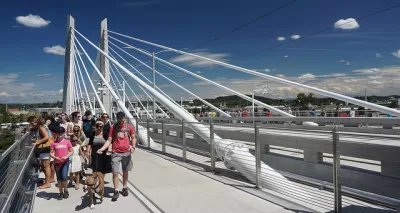
"With walkers and in strollers, on hopalongs and (in the case of quite a few happily panting dogs) on leashes, Portlanders packed a series of previews Sunday of Tilikum Crossing, the first bridge in the United States to carry buses, bikes, trains, streetcars and people walking but no private cars," reports Michael Andersen.
A TriMet official spokeswoman present at the event estimated that between 40,000 and 50,000 people crossed the bridge on the preview day.
Andersen details the events of the day and provides a review of the bridge and its experience:
"Though I’d personally walked across the bridge once before, the experience of doing it on a bike was surprisingly different — in a great way. It’s a fine trip on foot with good views of the city and (especially) the river. But like the other Willamette Bridges, it’s just a long way to walk in the sun.
But on a bicycle, Tilikum really feels like a magic carpet. It’s so quiet, so low-stress, so open to the air and so physically beautiful that it’s clearly more pleasant to ride across than anything else except the Steel Bridge’s lower deck. Even when MAX, bus and streetcar will be thumping past on the center lanes, the thick separation between the bikeways and pillars will keep them from causing any stress at all."
The article includes a lot of photos of the new bridge, so everyone everywhere else in the country can live vicariously through this one of its kind infrastructure and architectural feature.
Read the full story: By the tens of thousands, Portlanders preview their new car-free bridge

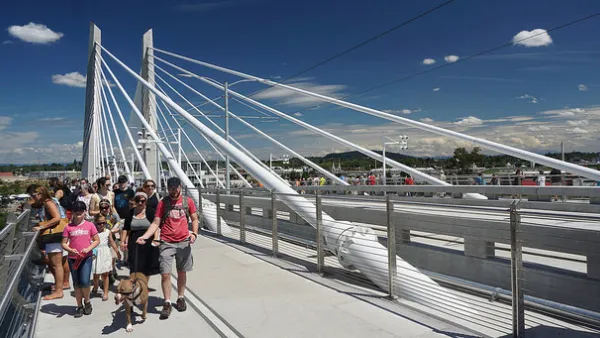
A Game-Changing Bike and Pedestrian Bridge Opens in Portland
A bridge in the works since the 1970s marks significant progress for active transportation in Portland, Oregon.
No Cars Allowed on Portland's New Street
Couch Court in Portland's central city is one of those rare pieces of public right of way where pedestrians and people on bikes rule.
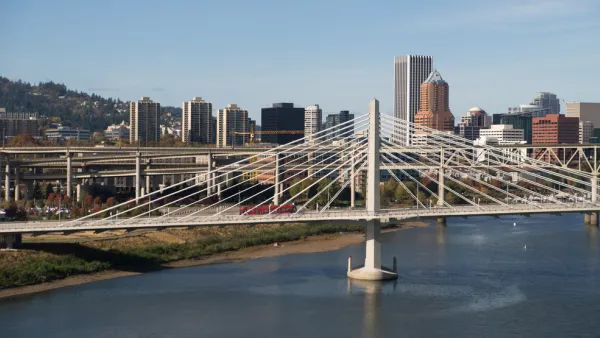
Ridership Numbers Below Target on Portland's One-Year-Old Orange Line
Eliot Njus reports on underwhelming ridership figures for the MAX Orange Line light rail service between Portland and Milwaukie. "Forecasts used to help justify federal funding for the project called for 17,000 average weekday trips in 2016. The

Planetizen Federal Action Tracker
A weekly monitor of how Trump’s orders and actions are impacting planners and planning in America.

The state-sanctioned urbicide of Austin
People don’t kill cities. Freeways do.

US to reduce Colorado River water deliveries to Mexico
A new Colorado Treaty amendment reduces Mexico’s Colorado River water allocation by 250,000 acre feet.

Nation's most wind-powered state turns to coal as data centers increase energy demand
For the first time in decades, Iowa has increased its generation of coal power.

NYC cools commuters with city's first rain garden above a bus stop
New York City officials say the plants in the rain garden can absorb 16 gallons of rainwater during heavy storms.

Brightline West’s future may rely on $6 billion federal loan
The company has until Nov. 2 to make a $400 million equity investment into its proposed high-speed rail line.

FREE Course: Walkable City 1: Why Walkability?
After describing his path towards focusing on walkability as the essence of good planning, Jeff Speck marches through his five principal reasons for making more walkable places.
Reinventing Malls: Planning Alchemy—Turning Gray Fields Into Gold
The course focuses on the opportunities and imperatives that shape reinvention of mall sites.

Greater Baltimore Committee
Eagle County Government
Harvard University Graduate School of Design
The Architects Foundation
University of Cincinnati Online
The Pocatello Development Authority
The Urban Renewal Agency of the City of Pocatello
Journal of the American Planning Association