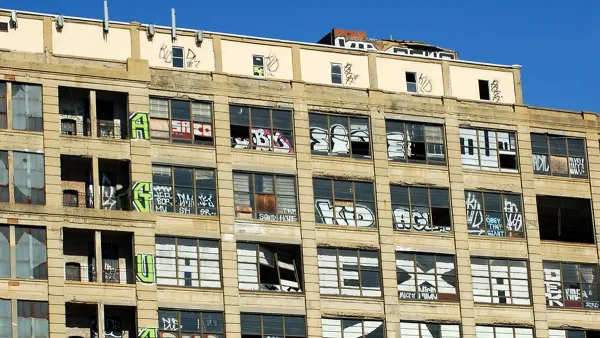
The city of Philadelphia's Doors and Windows Ordinance applied the Broken Windows Theory to positive results.


"To remediate dilapidated neighborhoods, four years ago Philadelphia passed an ordinance requiring vacant property owners to make simple, cheap renovations to building fronts," according to an article by Kate Wheeling, and the results have been solidly positive.
A team of researchers evaluated the abandoned building remediation strategy, enabled by the 2011 Doors and Windows Ordinance, and published their findings recently in the journal PLoS One.
"The researchers found that the restoration plan had a significant effect on crime: Over the study period, the city saw small reductions in total crime, specifically in assaults, gun assaults, robberies, and nuisance crimes around abandoned buildings that made moves to comply with the new ordinance. Even greater reductions were seen around buildings that applied for renovation permits above and beyond the windows and doors."
Read the full story: A Superficial Solution for Crime That Actually Works

Court Restores 'Doors and Windows' Code Enforcement Ordinance in Philadelphia
One of Philadelphia's most potent code enforcement tools is back in effect after the state Supreme Court overturned a previous ruling by a lower court.
Philadelphia Goes High-Tech to Monitor Vacant Properties
The city of Philadelphia has deployed high-tech sensors and a new statistical model in its ongoing fight against the blight and health problems that follow vacant and abandoned properties.

Philadelphia lawmakers fight to save 'Chinatown Stitch' from Trump cuts
The freeway cap project, approved and funded under the Biden administration, is now in jeopardy after the federal government rescinded all but $8 million in funding.

Planetizen Federal Action Tracker
A weekly monitor of how Trump’s orders and actions are impacting planners and planning in America.

Amtrak, CN end decades-long dispute with eight-year agreement
The new operating agreement establishes an updated framework for the companies to work together, including processes to resolve disputes.

Judges permit Denver to divert 77,000 acre feet from the Colorado River for reservoir expansion
Overuse and climate change have caused the Colorado River’s water levels to plummet.

Atlanta City Council unanimously backs $3.5 billion Beltline light rail project
The resolution was drafted after Atlanta Mayor Andre Dickens pulled support for the Atlanta Streetcar extension last year.

SEPTA to bring nearby frequent transit to over 1 million new riders as part of decade-long plan
The agency's Accelerate plan will also bring frequent transit to twice the amount of jobs that are currently located near it.

NYC plants over 18,000 trees, the most new foliage in a decade
Many of the trees were planted in communities vulnerable to extreme heat.

FREE Course: Walkable City 1: Why Walkability?
After describing his path towards focusing on walkability as the essence of good planning, Jeff Speck marches through his five principal reasons for making more walkable places.
Reinventing Malls: Planning Alchemy—Turning Gray Fields Into Gold
The course focuses on the opportunities and imperatives that shape reinvention of mall sites.

City of Thousand Oaks
City of Wisconsin Rapids
Harvard University Graduate School of Design
The Architects Foundation
University of Cincinnati Online
The Pocatello Development Authority
The Urban Renewal Agency of the City of Pocatello