An article in City Observatory's City Commentary sheds light on an underreported fact of life in some parts of the country: suburban displacement.


An article in City Observatory's City Commentary sheds light on an underreported fact of life in some parts of the country: suburban displacement.
"Imagine this," writes Joe Cortright, "A city government takes $65 million in public money and buys up more 1,300 units of aging but affordable housing, which is home mainly to low income and minority residents. It demolishes the housing, and plans to sell the land to private developers for office and retail development."
The situation described by Cortright might sound like something from the bad old news of urban renewal, but it's actually happening right now, in Marietta, Georgia. According to Cortright the story is a cautionary tale of gentrification and displacement but in an underrepresented setting: the suburbs.
In this case, the demolitions will destroy 10 percent of the multi-family housing in the city, leaving the families who live there to find new homes and new schools. The article includes a lot more details about situation as a case study of gentrification outside of the traditional sore spots of San Francisco, New York, and Washington D.C.
Planetizen readers might recall Marietta as the same city where Raquel Nelson was convicted of manslaughter when a drunk driver struck her and three of her children as the crossed a suburban highway near a bus stop in their neighborhood.
Read the full story: Why aren’t we talking about Marietta, Georgia?
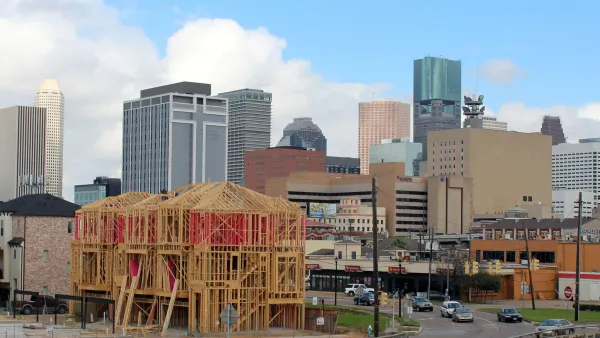
Houston's East River Redevelopment Threatens Historic Black Neighborhoods
Longtime residents are being left behind by new development that has raised housing costs and property taxes for some of Houston's most vulnerable communities, according to an article in the Houston Chronicle.
A Tour of Houston's Rapidly Gentrifying Neighborhoods
These Houston communities have experienced the most dramatic demographic changes in the last decade, according to new Census data.
Is Anti-Growth the Wrong Approach to Fighting Gentrification?
Limiting development has been a powerful tool for anti-gentrification activists, but have these policies had counter-productive effects?

Planetizen Federal Action Tracker
A weekly monitor of how Trump’s orders and actions are impacting planners and planning in America.

Washington state to charge fee to drivers with fuel-efficient cars
Revenue from the fee will go towards supporting the state’s highways.

Trump to blast ‘hydrocarbon highway’ through ‘world’s longest art gallery’
Environmental and historic preservation groups are suing to stop the project.

Data centers need power – lower income, rural residents pay the price
In 2025, data centers paid only 38% of the energy infrastructure costs linked to their growth, with households, especially rural and low-income residents, bearing the remaining burden.

MBTA Green Line project moved to next phrase of CIG program
The modernization effort will cost $4.08 billion.

22-mile pedestrian and bike path to encircle Atlanta by 2030
The project will also support affordable housing.

FREE Course: Walkable City 1: Why Walkability?
After describing his path towards focusing on walkability as the essence of good planning, Jeff Speck marches through his five principal reasons for making more walkable places.
Reinventing Malls: Planning Alchemy—Turning Gray Fields Into Gold
The course focuses on the opportunities and imperatives that shape reinvention of mall sites.

City of Charlotte
City of Rosemead
Rutgers University, Edward J. Bloustein School of Planning and Public Policy
University of Michigan School for Environment and Sustainability (SEAS)
Hunter College, City University of New York (CUNY)
The Architects Foundation
University District Partnership