Seattle Mayor Ed Murray announced the creation of a cabinet-level Office of Planning and Community Development to address the city's explosive growth.


"With dramatic growth taking hold in Seattle, Mayor Ed Murray wants to overhaul how the City of Seattle manages city planning and capital investments across City government," reports Stephen Fesler. Mayor Murray's method for the overhaul: creating a new, cabinet-level agency within the Mayor's Office known as the Office of Planning and Community Development (OPCD).
According to Fesler, Mayor Murray will create the new office via executive order, and the OPCD "would be tasked with a broad range of strategic planning functions like transportation, land use, housing, utilities, and parks." Moreover, "Planners and technicians from various City workgroups will be consolidated into one body with the hope that increased collaboration leads to better alignment and implementation of projects and plans."
The remainder of the article includes more details about how the city will restructure its resources to create the OPCD. Because the OPCD will rely on existing staff, the change is expected to have substantial impact on the city's Department of Planning and Development. Mayor Murray has targeted September for the announcement of a formal plan of implementation for the OPCD.
Read the full story: Mayor Ed Murray Announces New Office of Planning and Community Development

Big Changes in the New Year for the Seattle Department of Planning and Development
The traditional functions of planning are going to look a lot different in Seattle when the calendar changes to 2016.
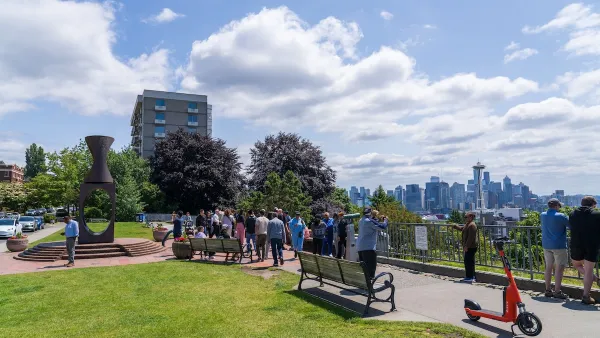
Yet again, Seattle’s density zoning update is hit with delays
The city must now examine the ‘maximum possible development’ under a future zoning scenario, rather than the ‘maximum likely development.’

Seattle Ponders a New Approach to Zoning for its Comprehensive Plan Update
The city of Seattle will have an updated comprehensive plan by the end of 2024, with zoning changes to follow by 2025.

Planetizen Federal Action Tracker
A weekly monitor of how Trump’s orders and actions are impacting planners and planning in America.

Eastern Nebraska is running out of electricity
Data centers and electrification are straining eastern Nebraska’s grid, throttling economic development.

Study reveals best places in the U.S. for cycling, walking
New research from Streetlight Data examines bicycle and pedestrian miles per capita in the 100 largest U.S. cities by population.

DSA members accuse Mamdani of 'abandoning values' over housing redevelopment
New York City's mayor plans to replace about 2,000 units of public housing with private, mixed-income housing.

All sides of BRT debate unhappy with CDOT’s most recent move
The Colorado Department of Transportation is no longer considering center-running bus lanes for Colorado Boulevard.

Massachusetts bogs generate both power, and cranberries
Putting solar panels above farmland is one way Massachusetts is advancing toward its goal of net-zero carbon emissions by 2050.

FREE Course: Walkable City 1: Why Walkability?
After describing his path towards focusing on walkability as the essence of good planning, Jeff Speck marches through his five principal reasons for making more walkable places.
Reinventing Malls: Planning Alchemy—Turning Gray Fields Into Gold
The course focuses on the opportunities and imperatives that shape reinvention of mall sites.

City of Rosemead
Rutgers University, Edward J. Bloustein School of Planning and Public Policy
One Hundred Miles
University of Michigan School for Environment and Sustainability (SEAS)
Hunter College, City University of New York (CUNY)
The Architects Foundation
City of Cambridge
The Pocatello Development Authority
The Urban Renewal Agency of the City of Pocatello