A lot has changed on the ground in Los Angeles County's unincorporated areas since 1980, when the last General Plan directing land use in these communities was written.


Fortunately, the Los Angeles County Board of Supervisors recently approved General Plan Update 2035. The document comes after an intensive process of analysis to both clean up inconsistencies and create a vision for the area's future.
Richard Bruckner and Connie Chung from the Los Angeles County Department of Regional Planning spoke with The Planning Report to walk readers through the plan's primary objectives. They articulated intentions to preserve industrial use, to further environmental conservation, and to encourage transit-oriented development. From a process perspective, Bruckner and Chung noted the plan's reliance on research, including a partnership with the Los Angeles County Economic Development Corporation to identify land important for job preservation.
Finally, Bruckner commented on the promise of California's new Enhanced Infrastructure Financing Districts for Los Angeles County, which often struggles to implement change within the constraints of its limited jurisdiction:
"I was very encouraged to learn that [EIFDs are] scalable across regions and even jurisdictions. One of the perplexing issues we face is that some of the islands we plan for are surrounded by two or three other jurisdictions. It’s a challenge to bring them all together. Enhanced Infrastructure Financing Districts may be just the tool not only to bring people together politically, but also to bring the economics of the area together around infrastructure investment.
Some of these areas sorely need infrastructure investment, particularly where the transit system is going. Sometimes our TOD strategy is unfortunately limited to half of the street, because the other half is in the City of LA or another bordering incorporated city. The future of some of these areas is partnering with the adjacent communities, and I appreciate that EIFDs could help do that."
FULL STORY: General Plan Update 2035: A Forward-Looking Roadmap for Unincorporated LA County


What Community-Based Zoning Enforcement Looks Like in South Central Los Angeles
Passion for urban planning, love of South Central LA communities, and historical background of the neighborhoods combine in this personal account by Jonathan P. Bell of community-based zoning enforcement.
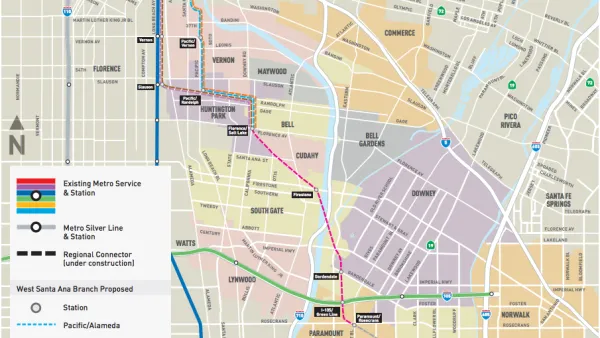
The L.A. Metro 'Megaproject' Connecting Downtown and Southeast L.A. County
The West Santa Ana Branch light rail would offer new infrastructure and economic activity to a transit-dependent part of the county.
How Will L.A.'s New Inglewood Football Stadium Revitalize South Los Angeles?
The Los Angeles Rams COO details both the stadium's sustainable design and the positive impact the privately funded complex will have on Southern California.

Planetizen Federal Action Tracker
A weekly monitor of how Trump’s orders and actions are impacting planners and planning in America.

The state-sanctioned urbicide of Austin
People don’t kill cities. Freeways do.

US to reduce Colorado River water deliveries to Mexico
A new Colorado Treaty amendment reduces Mexico’s Colorado River water allocation by 250,000 acre feet.

5 New England states march closer to 800 megawatt wind energy project
Securing federal approval for the project may be complicated under the Trump administration, which has historically been hostile towards domestic wind power.

Baltimore to break ground on $50 million Transit Priority Project
The project will bring faster bus trips, safer streets and better bike connections to Baltimore.

Airbnb launches $250 million 'last-dollar financing' housing accelerator, makes first investment in Austin
The company will put $6.4 million towards affordable housing development in Texas’ capital.

FREE Course: Walkable City 1: Why Walkability?
After describing his path towards focusing on walkability as the essence of good planning, Jeff Speck marches through his five principal reasons for making more walkable places.
Reinventing Malls: Planning Alchemy—Turning Gray Fields Into Gold
The course focuses on the opportunities and imperatives that shape reinvention of mall sites.

Eagle County Government
Harvard University Graduate School of Design
Nashville Planning Department
The Architects Foundation
University of Cincinnati Online
The Pocatello Development Authority
The Urban Renewal Agency of the City of Pocatello
Journal of the American Planning Association